
English or Hindi Medium for UPSC CSE? Rules, Selection Data and a Practical Choice
Rajshree Mourya
A mentor for UPSC.
Compare English and Hindi medium using UPSC rules, carefully labelled participation and selection statistics, and a practical timed-writing exercise.
By Rajshree Mourya
“Should I prepare in English or Hindi?” can become a bigger worry than the syllabus itself. Some aspirants fear that Hindi will limit them; others assume that understanding a lecture in English means they can write a strong answer in it. Neither assumption is a sound way to choose. Your medium should help you understand a question, retrieve relevant knowledge and communicate an accurate answer within time.
Both languages are valid options. The useful question is: in which medium can I produce my best work, consistently, with the resources and time available to me? This guide separates exam rules, participation figures and selection figures before offering a practical comparison exercise.
1. First separate four different language choices
The language you use to read a book, the medium in which you write Mains, a literature optional and your interview medium are different decisions. Reading an English report does not require choosing English as your answer medium. Writing in Hindi does not require choosing Hindi Literature as your optional.
Prelims: the question papers are set in Hindi and English.
Mains: except qualifying language papers, answers may be in English or an Eighth Schedule language. The rules also allow optional papers in English when Papers I–V are answered in an Eighth Schedule language. Literature papers have their own language instructions.
Technical terms: candidates using an Eighth Schedule language may add English versions of technical terms in brackets; this is not permission to mix languages freely.
Qualifying papers: English and the applicable Indian-language paper carry 300 marks each, require 25% and do not contribute to rank. Paper A exemptions apply to specified candidates.
Check the UPSC CSE 2026 notice, Appendix I, pages 26–29. For interview choices, the 2025 application instructions explicitly allowed Hindi-medium writers to choose Hindi or English, and English-medium writers to choose Hindi under the stated conditions. Confirm your own examination year's instructions before submitting preferences.
2. What the official participation statistics show
The following figures are from UPSC's 74th Annual Report, Appendix 8, printed page 90. It counts candidates who wrote the Essay paper, by medium. These are not final selections.
CSE 2022: English: 12,180; Hindi: 491; total across all media: 12,766.
CSE 2023: English: 13,607; Hindi: 517; total across all media: 14,206.
English had substantially more Essay candidates in these years. That establishes a difference in participation, not a language's effect on marks or an individual's chances. The all-media total includes other languages. Do not confuse the compulsory Hindi language-paper count with the number writing Essay or GS in Hindi.
3. Selection statistics: read the labels carefully
A 10 August 2026 Indian Express report of a Rajya Sabha reply gives the following counts for Hindi/Maithili-medium candidates recommended for IAS/IPS:
CSE 2021: 10 reported IAS/IPS recommendations.
CSE 2022: 27 reported IAS/IPS recommendations.
CSE 2023: 14 reported IAS/IPS recommendations.
CSE 2024: 5 reported IAS/IPS recommendations.
Scope: these are reported joint Hindi/Maithili counts, not Hindi-only totals, all-service CSE recommendations or IAS-only appointments. The underlying parliamentary answer was not independently retrieved for this article; these figures are attributed to the report. No matching English-medium selection series is verified here.
These counts cannot supply a fair English-versus-Hindi success-rate comparison. That requires comparable final recommendations and appeared-candidate denominators for each medium, the same CSE year and the same service coverage. A small selected count may accompany a small candidate pool. Even a correctly calculated rate would not, by itself, establish that the medium caused the outcome: preparation, prior education, optional subject and other differences may also matter.
Do not subtract this IAS/IPS subset from all CSE recommendations and call the remainder “English selections”. It would mix different populations and include other languages and services. Statistics should inform your questions, not frighten you into an unsuitable medium.
4. English medium: when it may suit you
English may be a practical choice if you already read academic material comfortably and can explain ideas in clear, short sentences without mentally translating every line. Test that ability in writing. Recognising vocabulary in a video is different from retrieving it in a timed answer.
Possible advantage: you may be able to use an English source directly, reducing the need to translate your notes.
Possible difficulty: searching for impressive words can slow writing and obscure an otherwise correct point.
Useful habit: prefer a precise claim, a relevant example and a logical conclusion over elaborate vocabulary.
For example, “Local bodies need predictable funds to plan services” is clearer than a long sentence whose meaning you cannot explain. Fluency should serve analysis. It should not become a performance of sophistication.
5. Hindi medium: when it may suit you
Hindi may suit you if you understand complex ideas more readily and can build accurate explanations in Hindi with less effort. Comfortable conversation is a starting point; also test academic terminology, handwriting speed and the ability to read the question precisely.
Possible advantage: you may express reasoning more naturally and spend less effort constructing sentences.
Possible difficulty: a source you need may require careful translation, and different materials may use inconsistent technical terms.
Useful habit: keep a short bilingual glossary and one consistent version of each concept in your main notes.
A glossary entry might contain “accountability — जवाबदेही”, followed by a one-sentence definition and a public-administration example. Do not fill pages with translations alone. Check whether you can use the concept correctly in an answer.
6. Try this medium-choice exercise before committing
Open the illustrated four-step medium-choice guide — save it for your practice session.
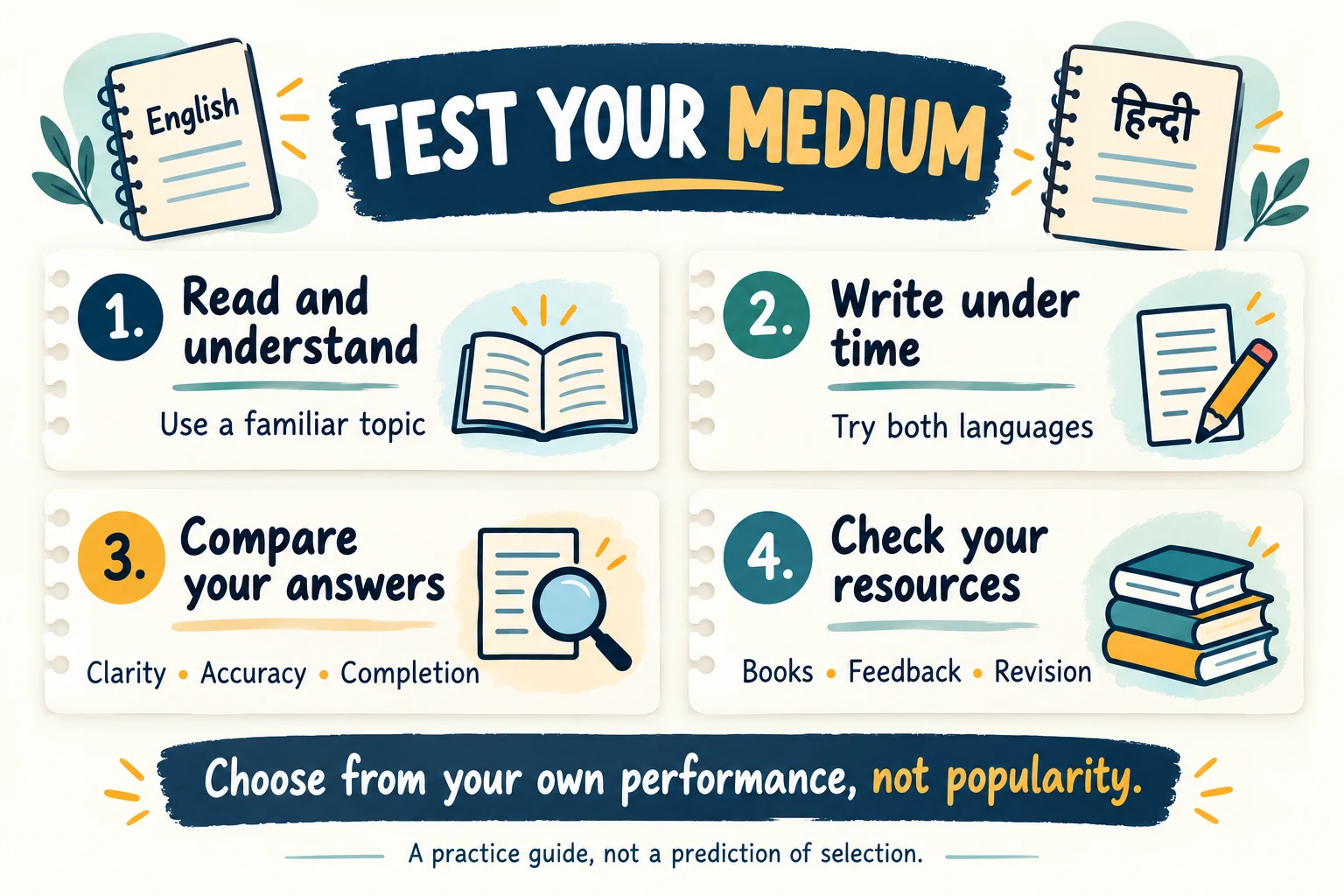
This is a suggested practice method, not a validated selection predictor. Choose two familiar syllabus topics. On separate days, write comparable short answers in English and Hindi with the same time and word limits. Alternate the order across topics so that always attempting one language second does not give it an unfair rehearsal advantage.
Understand: can you restate exactly what the question asks?
Write: note how much you completed and where you paused for language rather than knowledge.
Compare: ask a competent reviewer to assess relevance, factual accuracy, organisation, terminology and readability. Look for repeated patterns across several answers.
Check resources: locate a usable core book, current-affairs source, optional material and feedback support for your proposed medium.
Do not choose from a single unusually good or bad answer. If your reasoning is stronger in Hindi but a few technical terms cause trouble, a glossary may address the gap. If both languages are equally comfortable, resource access and consistency can help decide. If your content is weak in both, changing medium alone will not supply the missing knowledge.
7. Read across languages; keep revision manageable
You can learn a concept from a reliable source in either language and then summarise it in your intended answer medium. Keep one main revision note rather than maintaining two full parallel notebooks. Use a brief bilingual term list only where it helps.
After reading, close the source and explain the concept in your own words. Then check the explanation for missing qualifications and mistranslated terms. This simple check can expose a problem that passive reading hides. In PrepCat's Syllabus Tracker, choose a small topic to practise, then revisit it after feedback. A completed reading task and a usable written answer are separate milestones.
8. Should you switch medium during preparation?
Consider a switch when repeated timed practice shows a persistent language barrier and a realistic trial in the alternative medium improves your answers. First estimate the work involved: rewriting core notes, rebuilding terminology and obtaining feedback. A switch close to the examination may consume time you need for revision.
Switching because of a viral topper story or a frightening statistic is a weak basis for such a large change. Also check the applicable UPSC application rules and deadlines: a personal study decision does not automatically permit changing a submitted exam preference.
9. A calm decision checklist
Can I understand questions and express nuanced ideas in this medium?
Can I complete accurate answers within time?
Do I have dependable resources and feedback for GS and my optional?
Have I practised the qualifying language papers that apply to me?
Am I choosing from evidence about my work, rather than embarrassment or social pressure?
Conclusion: choose the language that lets your knowledge appear
Your medium is a working tool, not a measure of intelligence or worth. English and Hindi each require deliberate practice. Choose the language in which you can understand, analyse and communicate accurately; then build subject knowledge, revision habits and timed writing around it. Use selection data with its proper labels, and let repeated evidence from your own answers guide the decision.
Published 25 October 2026. Exam rules cited above are year-specific; readers should consult the notification for the year in which they apply.