
How to Read The Hindu and Indian Express for UPSC in Under 45 Minutes Daily
Rajshree Mourya
A mentor for UPSC.
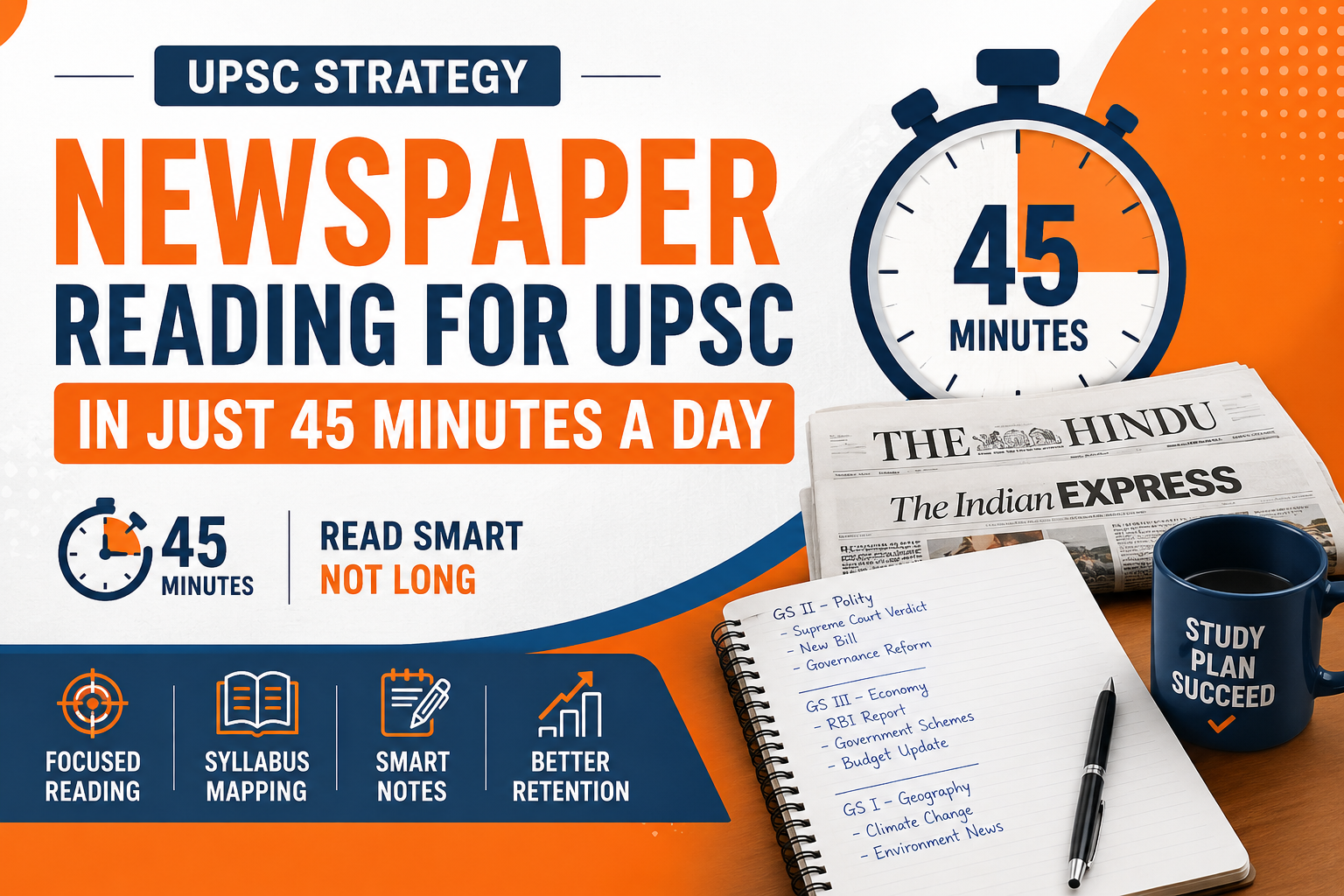
Newspaper reading is non-negotiable for UPSC preparation, but most aspirants spend two hours and remember almost nothing. Here is a disciplined 45-minute method that turns daily reading into exam-ready notes.
Ask any UPSC aspirant how long they spend on the newspaper, and the answer is often two to three hours, followed by the admission that little of it is retained by the next week. The problem is rarely a lack of effort. It is the absence of a method. Newspaper reading for UPSC is not the same as newspaper reading for general awareness, and once aspirants understand this distinction, the same daily habit can be compressed into forty-five focused minutes without any loss in exam value.
Why Most Aspirants Overspend Time on Newspapers
The typical mistake is reading The Hindu or Indian Express the way a casual reader would, front to back, absorbing sports scores, entertainment pages, and opinion pieces with equal attention as a Supreme Court verdict or a government scheme. UPSC does not test general reading; it tests the ability to connect current events to a fixed syllabus across Prelims and Mains. Once this filter is applied, roughly seventy percent of any day's newspaper becomes irrelevant to preparation, and time spent there is time borrowed from revision or answer writing.
The 45-Minute Structure
A disciplined reading session works best when it is broken into clear time blocks rather than a single continuous read. The following structure has worked well for aspirants balancing college, jobs, or long commutes.
Minutes 0 to 10: The Front Page and National News
Scan headlines first without reading full articles. Identify which stories relate to polity, governance, international relations, or the economy. Skip purely local incident reports, accidents, and crime stories unless they have a policy or governance angle, such as a new law or a Supreme Court observation.
Minutes 10 to 20: Editorial and Opinion Pages
This is the highest-value section of the newspaper for Mains answer writing. Read one or two editorials closely rather than skimming four superficially. Note the argument structure: what problem is being discussed, what solutions are proposed, and what the writer's stance is. This trains the analytical writing UPSC Mains rewards, and editorial vocabulary often finds its way directly into Essay and GS answers.
Minutes 20 to 30: Economy and Governance Pages
Look specifically for government schemes, RBI or NITI Aayog reports, budget-related updates, and international agreements. These map directly to GS Paper 2 and GS Paper 3 and are frequently the source of Prelims factual questions about implementing ministries, launch years, and objectives of schemes.
Minutes 30 to 40: Indian Express's Explained Section or The Hindu's Explainers
These sections do the syllabus-mapping work for you. An explainer on a Supreme Court judgment, a geopolitical development, or a scientific breakthrough already provides the background and significance that a raw news report does not. Reading one explainer daily builds contextual depth faster than reading five plain news items.
Minutes 40 to 45: Note Consolidation
Do not leave notes for later. In the final five minutes, write two or three lines per relevant story in your own words under the correct GS paper heading. A story read but not noted is, for exam purposes, a story not read at all.
What to Deliberately Skip
Skipping sections consciously is what makes the 45-minute target achievable. Aspirants can safely skip sports, entertainment, obituaries unless the person is of significant national importance, local crime reports without a policy dimension, and advertisement-heavy lifestyle pages. This is not laziness; it is syllabus discipline.
One Newspaper or Two?
A common question is whether both The Hindu and Indian Express are necessary. For most aspirants, one newspaper read thoroughly using this method is sufficient. If time allows, Indian Express's Explained section can be added purely for its explainer depth, without reading the rest of that paper. Reading two full newspapers daily is rarely a good use of preparation time and is one of the more persistent myths in UPSC circles, and it usually crowds out time that would be better spent on answer writing or optional subject preparation.
Print, Digital, or a Mix of Both
Whether to read in print or online is a matter of personal focus rather than exam strategy. Print copies remove the temptation of notifications and make it easier to underline and annotate directly. Digital editions, on the other hand, allow quick keyword searches and let commuting aspirants read on the move. Many working aspirants find a hybrid approach useful: skimming headlines digitally during a commute and doing the focused 45-minute session with a physical copy or a distraction-free reader app later in the day. What matters is that the format you choose does not become an excuse to scroll through unrelated content once the newspaper app is open.
Turning Reading into Retention
The 45-minute reading habit only pays off if it feeds into a weekly and monthly revision cycle. Aspirants should revisit their daily current affairs notes at the end of each week to consolidate them into a shorter monthly summary organised by GS paper. This is what eventually becomes exam-ready material, especially for Prelims, where a scheme's launch year or a report's key finding can appear as a direct factual question months after it was first covered.
Building the Habit
Consistency matters more than perfection here. It is more useful to read for 45 focused minutes every single day than to read for two hours occasionally when time permits. Aspirants who are new to this method should expect the first one to two weeks to feel slower than expected, since identifying relevant stories quickly is itself a skill that improves with practice. By the third week, most aspirants report comfortably finishing within the target time while retaining more than they did with longer, unstructured reading sessions.
Conclusion
Newspaper reading for UPSC is a skill of selection, not volume. Once aspirants stop treating the newspaper as general reading and start treating it as a syllabus-mapping exercise, forty-five minutes is genuinely enough. The goal is not to read everything; it is to read the right things, and to write them down before moving on with the day.