
How to Track Your UPSC Study Hours: A Simple System That Works
Akshay
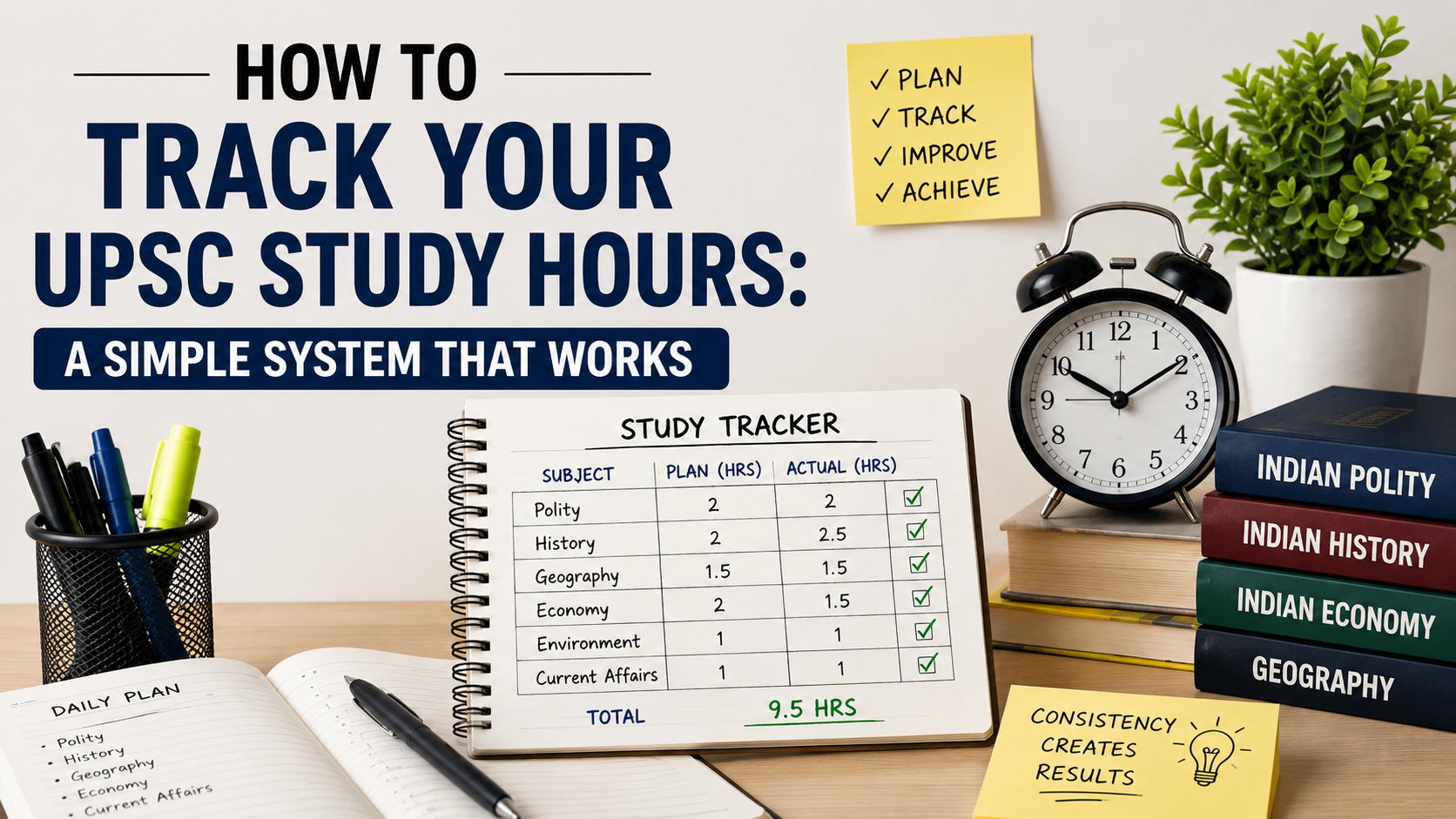
Every serious UPSC aspirant has heard the advice: “Study 8-10 hours a day.” But here is the question almost nobody answers properly: how do you actually know how many hours you studied, and more importantly, how many of those hours were genuinely productive? Most aspirants either don’t track their study hours at all, or they track them so loosely that the numbers become meaningless, a rough guess scribbled in a diary at the end of a tiring day.
Tracking your UPSC study hours is not about becoming obsessed with numbers. It is about building self-awareness, spotting patterns in your preparation, and making sure your effort actually matches your ambition. In this guide, we will walk through a simple, sustainable system for tracking UPSC study hours, one that thousands of aspirants have used to bring discipline and clarity into their preparation, without turning study tracking into a chore in itself.
Why Tracking Study Hours Matters for UPSC Preparation
The UPSC Civil Services Examination is not won in a single sprint. It is a marathon that stretches across 10 to 18 months of consistent preparation, covering the Preliminary exam, the Mains, and the Interview. Because the syllabus is so vast and the timeline so long, aspirants often lose track of whether they are actually progressing or simply staying busy.
Here is why a proper tracking system changes the game:
• It reveals the gap between “busy” and “productive.” Sitting at your desk for 10 hours does not mean you studied for 10 hours. Tracking exposes how much of that time was real, focused work.
• It builds accountability. When you know you have to log your hours honestly, you naturally start avoiding distractions.
• It helps balance subjects. Many aspirants unconsciously spend more time on subjects they enjoy (like History or Polity) and neglect harder ones (like CSAT or Economy). A tracker makes this imbalance visible.
• It supports better revision planning. Once you know how many hours a topic took, you can plan revision cycles more realistically instead of guessing.
• It reduces anxiety. A visible record of consistent effort, even on average days, reassures you during the emotionally taxing final months before the exam.
Common Mistakes Aspirants Make While Tracking Study Hours
Before we get to the system itself, it helps to understand what usually goes wrong. Most aspirants who try tracking give up within a few weeks because of these mistakes:
1. Tracking only total hours, not subject-wise hours. A single number like “9 hours today” tells you almost nothing useful.
2. Confusing “screen time” with study time. Watching a 2-hour YouTube lecture at 1.5x speed while checking your phone is not the same as focused reading.
3. No weekly or monthly review. Daily logs without a periodic review become a graveyard of unused data.
4. Overcomplicating the system. Aspirants often build elaborate spreadsheets with 15 columns, which become tiring to maintain and get abandoned within a week.
5. Not linking hours to the syllabus. Tracking time without tracking topic completion gives an incomplete picture of your actual preparation status.
The Simple System: A Step-by-Step Framework
The system below is deliberately simple. It takes less than 5 minutes a day to maintain, yet gives you a complete, honest picture of your preparation. It works whether you are a working professional studying part-time or a full-time aspirant.
Step 1: Define Your Daily Study Hour Target Realistically
Before tracking anything, set a realistic daily target. Fresh aspirants often aim for 12 hours from day one and burn out within two weeks. A better approach is to start with 5-6 focused hours and gradually build up to 8-10 hours as your stamina and concentration improve.
Use a tool like PrepCat’s Strategy Maker to build a personalised study plan based on your available months, daily study hours, and target attempt. Having a clear plan in place makes it much easier to track your progress against a realistic benchmark instead of an arbitrary number.
Step 2: Break Your Day into Subject-wise or Paper-wise Blocks
Instead of logging a single number for the whole day, divide your study time into blocks aligned with the UPSC syllabus structure for example, GS Paper 1, GS Paper 2, GS Paper 3, GS Paper 4, CSAT, Optional subject, Current Affairs, and Answer Writing. This way, your tracker doubles up as a syllabus balance-check.
A simple format that works well:
• Morning block (e.g., 6 AM – 9 AM): Static GS / NCERT reading
• Midday block (e.g., 11 AM – 2 PM): Optional subject or current affairs
• Evening block (e.g., 4 PM – 7 PM): Answer writing or revision
• Night block (e.g., 8 PM – 10 PM): Newspaper and daily current affairs
Step 3: Log Every Session Immediately, Not at the End of the Day
Memory is unreliable, especially after a long day of study. Log each study block right after you finish it subject, topic, start time, end time, and a one-line note on what was covered. This takes less than 30 seconds per session and dramatically improves accuracy compared to reconstructing your day at night.
Step 4: Distinguish Between “Raw Hours” and “Focused Hours”
This is the step most trackers miss. Not all study hours are equal. A useful trick is the Pomodoro-style approach: study in focused blocks of 45-50 minutes with a 5-10 minute break, and only count time where your phone was away and your attention was on the material. Over time, you will notice your focused-hour percentage rising as concentration improves — that trend line is often more motivating than the raw hour count itself.
Step 5: Use a Weekly Review, Not Just Daily Logging
At the end of each week, spend 10-15 minutes reviewing your log. Ask yourself:
• Did I hit my target hours on most days, or only on a few?
• Which subject got the least time, and why?
• Were my focused hours improving or declining through the week?
• Did my actual study match the plan I made at the start of the week?
Pair this weekly review with PrepCat’s Syllabus Tracker, where you can mark topics as Completed, Partially Done, Study Later, or Revision Soon. When study hours and syllabus completion are tracked together, you get a far more honest picture of your real progress than hours alone can show.
Step 6: Review Monthly and Adjust Your Strategy
Once a month, zoom out. Compare your logged hours against your original strategy plan. If certain subjects have consistently received fewer hours than planned, rebalance your next month’s schedule. If your focused-hour ratio has been dropping, it may be time to change your study environment, sleep schedule, or break pattern rather than simply adding more raw hours.
Tools You Can Use to Track UPSC Study Hours
You do not need expensive software to track study hours effectively. Here are options ranging from the simplest to the most structured:
• A physical notebook or diary: Simple, distraction-free, and effective for aspirants who prefer writing by hand.
• A basic spreadsheet: Columns for date, subject, topic, start time, end time, and notes. Easy to filter and analyse over weeks.
• Phone timer apps: Apps with Pomodoro timers can auto-log session durations, reducing manual effort.
• A dedicated preparation platform: Combining a study tracker with your syllabus and strategy in one place such as PrepCat’s Syllabus Tracker and Strategy Maker saves you from juggling multiple tools and keeps hours, topics, and targets connected.
How Many Study Hours Are Actually Enough for UPSC?
This is one of the most common questions aspirants ask, and the honest answer is: it depends on your baseline knowledge, your consistency, and the quality of your hours, not just the quantity. That said, general benchmarks that have worked for many successful candidates are:
• Beginners in the first 3-4 months: 5-6 focused hours a day, building the habit before increasing volume.
• Full-time aspirants in the middle phase: 7-9 focused hours a day, balanced across static subjects, optional, and current affairs.
• Working professionals: 3-4 highly focused hours on weekdays, with longer sessions of 6-8 hours on weekends.
• Final 2-3 months before Prelims/Mains: 8-10 hours, with a heavier emphasis on revision and answer writing over fresh reading.
Remember, these are reference points, not rules. A candidate who studies 6 truly focused hours daily will often outperform one who logs 10 distracted hours. This is exactly why tracking focused hours, and not just raw hours, matters so much.
How to Stay Consistent With Your Tracking System
Even the best tracking system fails if you cannot stick to it. Here are a few practical tips to make tracking a habit rather than a burden:
• Keep it simple. Five columns are enough. Do not build a system so complex that maintaining it feels like a second syllabus.
• Track at the same time every day. Log your first session right after breakfast, and your last one before bed, so it becomes a routine anchor.
• Review with peers. Discussing your weekly hours and progress with fellow aspirants in a study group or on a platform like PrepCat’s UPSC Community adds gentle accountability and motivation.
• Celebrate consistency, not perfection. A week with six days of steady 6-hour study is far more valuable than a week with two 12-hour days and five wasted ones.
• Reconnect tracking to your bigger goal. Occasionally revisit your original strategy plan and remind yourself why you started tracking in the first place.
Frequently Asked Questions
Is it necessary to track study hours for UPSC preparation?
It is not mandatory, but it is highly recommended. Tracking gives you objective data about your preparation instead of relying on how productive a day “felt.” Most aspirants who maintain a consistent tracking habit report better subject balance and lower last-minute panic before the exam.
Should I track hours or track syllabus completion?
Ideally, both. Hours tell you about your effort and consistency, while syllabus completion tells you about actual progress. Used together, as with PrepCat’s Syllabus Tracker, they give a complete and honest picture of where you stand.
What if I miss a day of tracking?
Simply resume the next day. Do not try to reconstruct the missed day from memory, and do not let one missed entry discourage you from continuing the habit. Consistency over months matters far more than a single missed log.
Is 10 hours a day necessary to clear UPSC?
No single number guarantees success. Many successful candidates have cleared the exam with 6-7 truly focused hours a day, while others who studied 10+ hours without focus have struggled. Quality and consistency outweigh sheer quantity.
Conclusion
Tracking your UPSC study hours does not need to be complicated. A simple daily log, broken down by subject, honestly measured in focused hours, and reviewed weekly and monthly, is enough to bring real clarity to your preparation. The goal is not to chase impressive numbers but to build an honest, sustainable rhythm that keeps you moving steadily towards your goal, exam after exam, month after month.
If you are looking for a single place to combine your study-hour tracking with syllabus progress and a personalised strategy, Prepcat brings together a Strategy Maker, a Syllabus Tracker, curated study material, and an active UPSC Community everything an aspirant needs to prepare smarter, not just longer. Start building your own simple tracking system today, and let your hours finally tell the true story of your preparation.