
UPSC 2027 Preparation Strategy for Beginners: After 12th & Graduation
Akshay
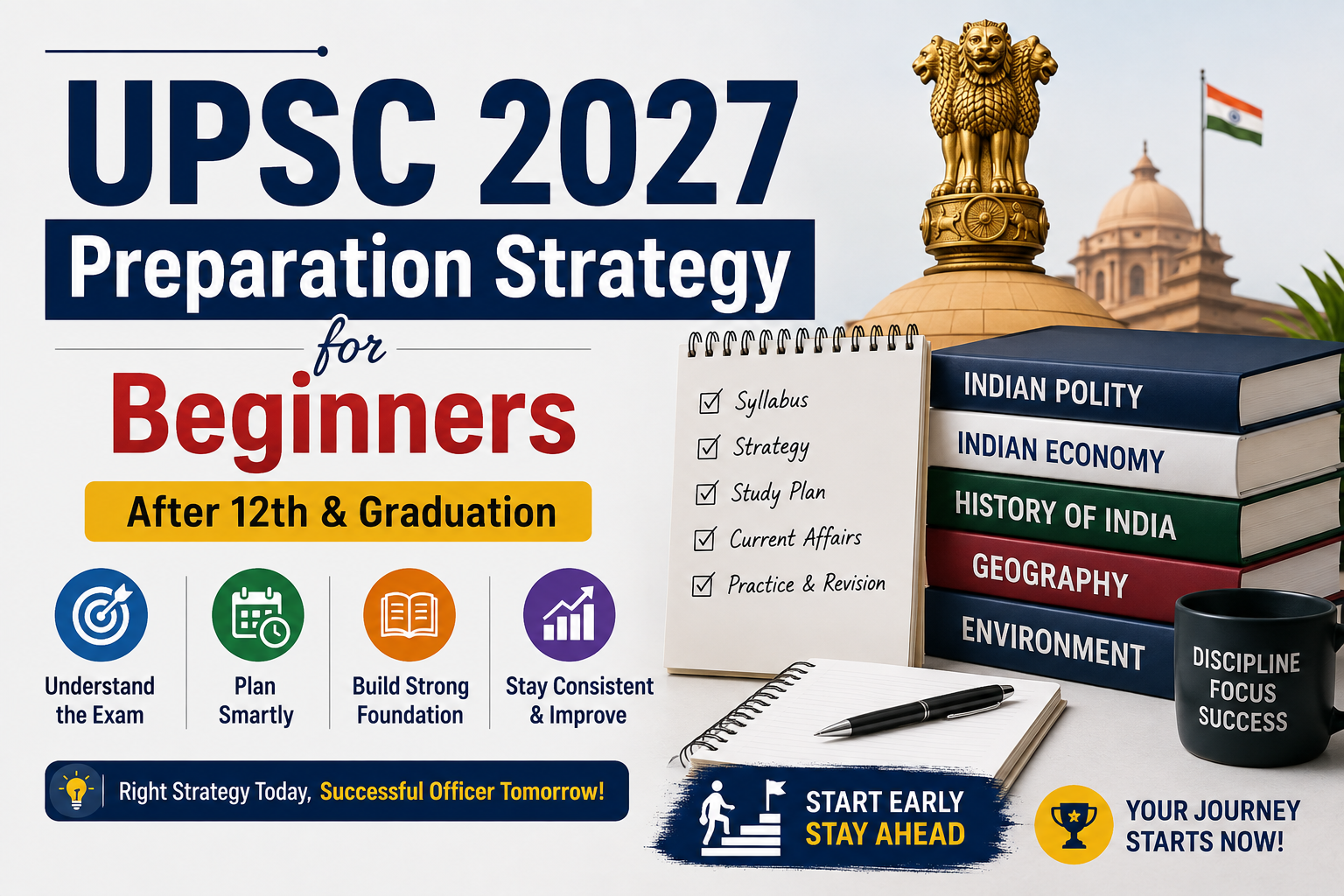
Every year, lakhs of students finish Class 12 or complete their graduation and ask the same question: "I want to become an IAS or IPS officer where do I even begin?" The UPSC Civil Services Examination (CSE) is often called India's toughest competitive exam, and for good reason it tests not just knowledge, but patience, planning, and consistency over one to two years of serious preparation.
This blog is written specifically for beginning students who have just cleared their 12th boards and are exploring an early start, as well as graduates who are beginning their UPSC 2027 journey from scratch. We will walk through eligibility, the exam pattern, a month-by-month strategy, book lists, common mistakes, and a realistic timeline you can actually follow, so that by the end of this guide you have a clear, actionable plan instead of just motivation.
Understanding the UPSC Exam: The Basics Every Beginner Must Know
Before building a strategy, it helps to understand what you are actually preparing for. The UPSC Civil Services Examination is conducted in three stages, and each stage tests a different skill set.
• Prelims (Objective Type): Two papers General Studies Paper 1 (GS) and CSAT Paper 2 (qualifying in nature). This stage is a screening test; marks scored here do not count towards the final rank.
• Mains (Written/Descriptive): Nine papers in total, including two qualifying language papers, an Essay paper, four General Studies papers, and two Optional Subject papers. This stage decides most of your final rank.
• Interview (Personality Test): A board interview of around 275 marks that assesses your personality, awareness, and decision-making ability, not just bookish knowledge.
Only around 10,000 to 13,000 candidates out of nearly 10 lakh applicants typically clear Prelims each year, and roughly 700-1000 candidates are finally selected. These numbers aren't meant to discourage you; they simply explain why a structured, long-term strategy matters far more than last-minute cramming.
Should You Start After 12th or After Graduation?
This is one of the most common doubts among beginners, and the honest answer is: both paths work, but they require different approaches.
Starting Right After 12th
You are not eligible to sit for the UPSC exam until you have a recognised bachelor's degree (or are in your final year of graduation, in which case you can appear in Prelims provisionally). So if you have just finished school, you cannot register for the exam immediately but you can absolutely begin your foundation now.
• Use these 2-3 years of college to build a rock-solid NCERT foundation (Class 6 to 12) in History, Geography, Polity, Economy, and Science.
• Develop a daily newspaper-reading habit early so current affairs never feel overwhelming later.
• Choose a graduation stream that could later support your optional subject choice, if you already have an inkling of one.
• Avoid over-studying UPSC-specific material too early, focus on college academics and NCERT basics without burning out.
Starting After Graduation
If you are starting after completing graduation, you have full eligibility and can dive directly into a structured 12-18 month preparation cycle. The advantage here is focus and eligibility; the challenge is that you have less runway, so time management becomes critical from day one.
Step 1: Check Eligibility and Understand the Exam Pattern Thoroughly
Before opening a single book, spend a few days reading the official UPSC notification (released around February each year on upsc.gov.in) end to end. Note down the age limits, number of attempts allowed for your category, educational qualification requirements, and the detailed syllabus for Prelims and Mains. Aspirants frequently make the mistake of preparing without ever reading the actual syllabus PDF line by line; this alone can cost you months of misdirected effort.
Step 2: Build Your NCERT Foundation First
NCERT textbooks from Class 6 to 12 are the single most recommended starting point for every UPSC topper, and for good reason they explain concepts in simple language without unnecessary complexity, which is exactly what a beginner needs before moving to advanced reference books.
• History: Class 6-8 (Ancient & Medieval), Class 9-12 (Modern India, Themes in Indian History)
• Geography: Class 6-12, especially Class 11 (Fundamentals of Physical Geography) and Class 12 (Indian Geography)
• Polity: Class 9-12 Political Science (Constitution, government structure, rights and duties)
• Economics: Class 9-12 (Introductory Microeconomics, Indian Economic Development)
• Science: Class 6-10 Science NCERTs for basic scientific and technological concepts
Set a realistic target of 2-3 months to complete this NCERT phase while making short, revisable notes. Do not skip this step even if you are a graduate with a related academic background UPSC tests concepts in a very specific, exam-oriented manner that pure academic study often misses.
Step 3: Move to Standard Reference Books
Once your NCERT base is strong, move on to standard books for each subject. Some widely used titles among aspirants include Laxmikanth for Indian Polity, Spectrum or Bipin Chandra for Modern History, Ramesh Singh for Indian Economy, G.C. Leong along with NCERTs for Geography, and Shankar IAS for Environment and Ecology. Avoid collecting too many books for the same subject. One good standard book, read multiple times with notes, is far more effective than five books read once.
Step 4: Choose Your Optional Subject Early and Wisely
Your optional subject carries 500 marks in Mains, so this decision deserves real thought rather than a last-minute pick. Choose based on three factors: your genuine interest, the availability of quality study material and guidance, and a reasonable overlap with the General Studies syllabus (subjects like Public Administration, Sociology, Geography, History, and Political Science & IR have overlap with GS papers, which saves preparation time).
• Avoid choosing an optional only because a friend or topper chose it. Your comfort with the subject matters more than someone else's success story.
• Once chosen, avoid switching optionals midway unless absolutely necessary, as this resets months of preparation.
Step 5: Build a Daily Current Affairs Habit From Day One
Current affairs preparation is not an activity you do a few months before the exam, it is a daily habit that must start on day one of your journey. Read one standard newspaper (The Hindu or Indian Express are commonly preferred) daily, focusing on editorials, government schemes, international relations, and economy-related news rather than sensational or purely regional stories.
• Maintain a simple daily current affairs notebook or digital note, organised subject-wise (Polity, Economy, Environment, S&T, IR).
• Revise a monthly compilation at the end of every month rather than letting notes pile up unread.
• Link current events to static topics wherever possible for example, a new government scheme should be linked back to the relevant polity or economy chapter.
Step 6: Practice Answer Writing From the Very Beginning
One of the biggest mistakes beginners make is delaying answer writing until a few months before Mains. In reality, Mains is a test of expression, structure, and the ability to write a balanced, well-structured answer within a strict word and time limit, a skill that only improves with regular practice.
• Start with one answer a day on any topic you have studied that week, focusing on structure: introduction, body with points, and conclusion.
• Practice within the time limit roughly 7-8 minutes per 10-mark, 150-word answer.
• Get your answers evaluated periodically by a mentor, senior, or an online answer-writing platform to identify blind spots in your writing style.
Step 7: Take Regular Mock Tests and Revise Continuously
Mock tests are not just practice, they are a diagnostic tool that tells you exactly where you stand. Begin taking sectional and full-length Prelims mock tests around 4-6 months before the exam, and gradually shift to full-length Mains test series closer to the Mains attempt.
• Analyse every mock test thoroughly. The goal is not just the score, but understanding why each wrong answer was wrong.
• Maintain an error log of concepts you repeatedly get wrong, and revise these specifically before the actual exam.
• Revision should follow the 'multiple pass' method; the first pass builds understanding, and each subsequent pass (2nd, 3rd, 4th) should get progressively faster.
A Realistic 12-Month Study Timeline for Beginners
While every aspirant's pace differs, here is a broad month-wise structure that beginners commonly follow. Adjust it based on your own daily study hours and background.
• Months 1-3: NCERT foundation (all subjects), syllabus mapping, newspaper habit begins
• Months 4-6: Standard reference books, optional subject foundation, note-making, current affairs compilation
• Months 7-8: First revision cycle, sectional tests, answer writing practice begins in full swing
• Months 9-10: Prelims-focused full-length mock tests, rapid revision of static portions
• Month 11: Prelims exam and post-Prelims Mains-focused shift (essay, ethics, optional deep-dive)
• Month 12 onward: Mains test series, answer writing intensively, followed by Interview preparation after results
Common Mistakes Beginners Should Avoid
• Collecting too many books and sources instead of revising fewer sources multiple times.
• Ignoring current affairs in the early months and trying to cover a year's news in the last month.
• Ignoring answer writing until a few weeks before Mains, when it is actually a skill built over months.
• Studying without ever attempting mock tests, which leaves you unaware of your actual exam-day performance.
• Comparing your timeline with toppers on social media instead of following a plan suited to your own pace and background.
• Neglecting physical health and sleep UPSC is a marathon, and burnout in month four helps no one.
Balancing College and UPSC Preparation (For 12th-Pass Aspirants)
If you are starting right after 12th and are currently in college, it's completely realistic to build your UPSC foundation alongside your degree without sacrificing either. The key is protected, non-negotiable study blocks rather than chasing unrealistic 12-hour days.
• Dedicate 1.5-2 focused hours daily to NCERT reading and newspaper habit, even during college semesters.
• Use semester breaks and holidays for deeper reading and note consolidation.
• Treat your final year of graduation as the transition point where UPSC preparation intensity gradually increases.
Frequently Asked Questions (FAQs)
1. Can I start UPSC preparation right after 12th?
Yes, you can start building your foundation (NCERTs, current affairs habit) right after 12th, but you can only register for the exam once you hold a bachelor's degree or are in your final year of graduation.
2. How many hours should a beginner study daily for UPSC 2027?
Most successful aspirants study 6-8 focused hours daily once preparation is in full swing, but beginners can start with 3-4 quality hours and gradually increase, since consistency matters more than raw hours.
3. Is coaching necessary for UPSC preparation?
Coaching is optional, not mandatory. Many aspirants clear UPSC through self-study using NCERTs, standard books, and structured online platforms, provided they follow a disciplined strategy and get their answers evaluated regularly.
4. Which optional subject is best for beginners?
There is no single 'best' optional for everyone the right choice depends on your interest, background, and the overlap with the General Studies syllabus. Subjects like Political Science, Sociology, Geography, and Public Administration are popular for their GS overlap.
5. How long does it realistically take to clear UPSC?
Most successful candidates take 12 to 24 months of serious, structured preparation, though the exact duration depends on your starting point, daily study hours, and how quickly you build the required foundation.
Conclusion:
UPSC 2027 preparation, whether you are starting right after 12th or after graduation, is less about finding a secret shortcut and more about following a simple, honest process consistently: build your NCERT foundation, read the newspaper daily, choose your optional subject wisely, practice answer writing from day one, and revise relentlessly through mock tests. Beginners who stay patient with this process, without comparing their timeline to others, are the ones who build a genuinely strong base for the months ahead.
If you're looking for a structured way to organise this entire journey tracking your syllabus, building a personalised strategy, accessing well-organised static and current affairs notes, and staying accountable with a community of fellow aspirants PrepCat is built exactly for this. As your personal UPSC preparation catalyst, PrepCat brings together a Strategy Maker, Syllabus Tracker, curated study notes, and an aspirant community in one place, so that beginners don't have to figure everything out alone. You can explore it at prepcat.in and take the first organised step towards your UPSC 2027 journey today.