
Buddhist Councils and Their Contributions: From Rajgir to Kashmir
The four Buddhist Councils are one of Ancient History's most error-prone static clusters — four different venues, four different royal patrons, four different presiding monks, and (the biggest trap of all) two rival traditions about what the "Fourth" Council even was. This toolkit fixes venue-patron-president-outcome to each council and flags exactly where aspirants go wrong.
📌 Revision Pointers
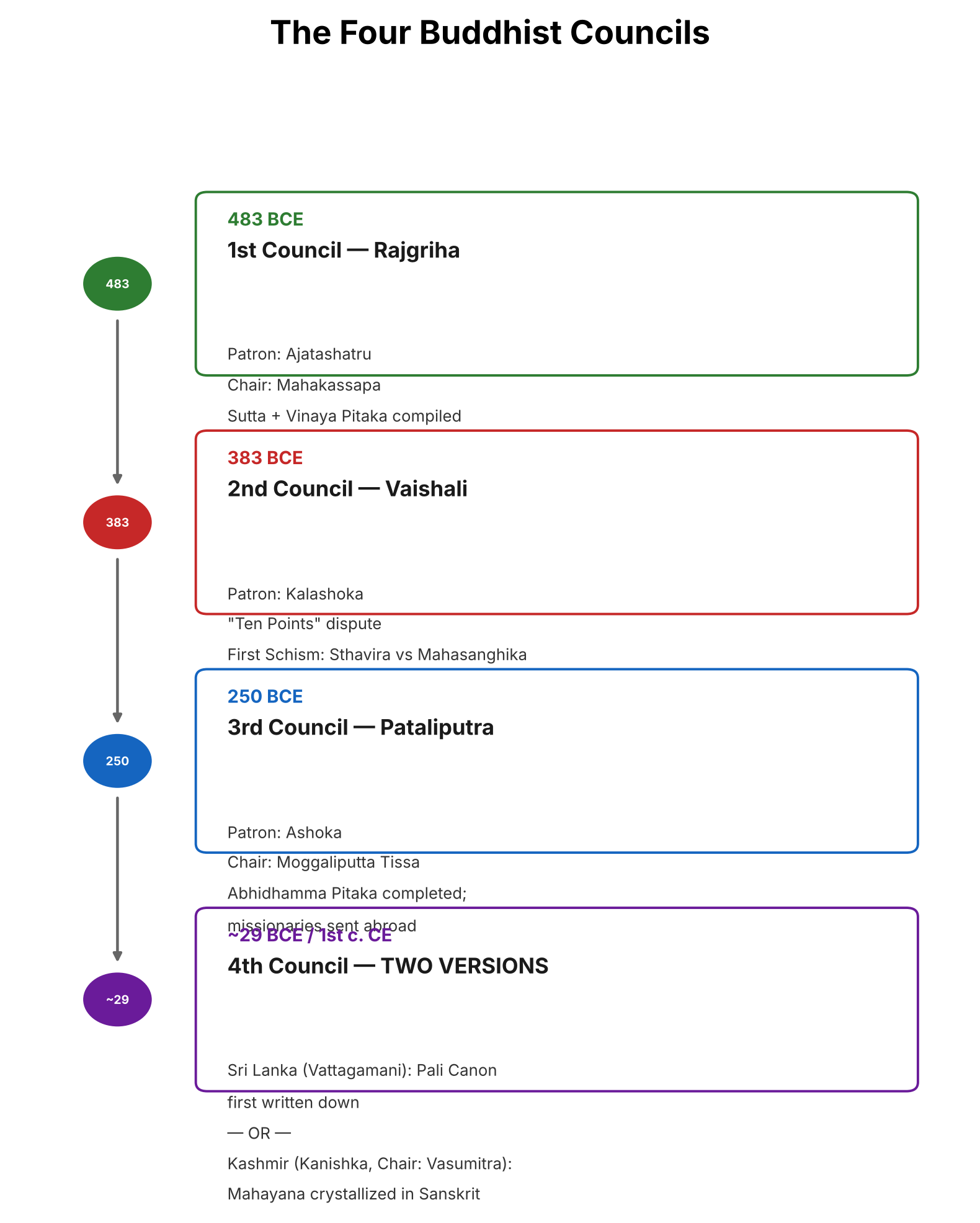
First Council - Rajgriha (483 BCE), patron Ajatashatru, chaired by Mahakassapa; Sutta and Vinaya Pitakas compiled.
Second Council - Vaishali (383 BCE), patron Kalashoka; the "Ten Points" dispute caused the first schism (Sthaviravada vs Mahasanghika).
Third Council - Pataliputra (250 BCE), patron Ashoka, chaired by Moggaliputta Tissa; Abhidhamma Pitaka completed the Tripitaka, followed by missionaries sent abroad.
Fourth Council has two rival identities - Sri Lanka under Vattagamani Abhaya (Pali Canon first written down) per the Theravada tradition, OR Kashmir under Kanishka (Mahayana crystallised in Sanskrit) per the Sarvastivada/Mahayana tradition.
Only the first three councils are universally accepted; the Fourth is where Buddhist traditions themselves disagree.
1. First Buddhist Council (483 BCE) - Rajgriha
Venue - held at Rajgriha (modern Rajgir), in the Saptaparni Cave, shortly after the Buddha's Mahaparinirvana (death).
Mnemonic Hook: "R for Rajgir, R for Right-after - the council held right after the Buddha's death."
Link: Rajgriha was also the early capital of the Magadha kingdom under the Haryanka dynasty.
Royal Patron - King Ajatashatru of the Haryanka dynasty.
Mnemonic Hook: "Ajatashatru - 'A' for the very first council, right After the Buddha's death."
Link: this is the same Ajatashatru who had imprisoned his own father, Bimbisara, to seize the Magadhan throne.
President - Mahakassapa (Mahakashyapa), the senior-most surviving monk of the Sangha.
Mnemonic Hook: "Maha-KASSAPA chaired because he was the Maha (great/senior)-most monk alive."
Key Reciters - Ananda recited the Sutta Pitaka (the Buddha's discourses); Upali recited the Vinaya Pitaka (rules of monastic discipline).
Mnemonic Hook: "Ananda was the Buddha's attendant, so he remembered what Buddha SAID (Sutta). Upali was a barber-turned-monk, so he remembered the RULES (Vinaya) that governed monks."
Link: only these two Pitakas existed after this council - the third, the Abhidhamma, had not yet been compiled.
Purpose/Outcome - to preserve the Buddha's actual teachings before they could be lost or distorted through oral transmission; it produced the first two of the three Pitakas.
Mnemonic Hook: "First council, first two Pitakas - the third was still missing."
2. Second Buddhist Council (383 BCE) - Vaishali
Venue and Royal Patron - held at Vaishali, about a century after the Buddha's death, under King Kalashoka (also called Kakavarni) of the Shishunaga dynasty.
Mnemonic Hook: "VAISHALI sounds like 'violate-shali' - it's the council about VIOLATIONS of the Vinaya rules."
Link: Vaishali, capital of the Vajji/Licchavi confederacy, was also where the Buddha delivered his last sermon before his death - don't confuse that earlier visit with this later council.
Trigger - a group of monks from the Vajji region (the "Vajjiputtakas") were accused of relaxing ten specific Vinaya rules, the "Ten Points" (Dasa Vatthu) - for example, accepting gold and silver donations, which stricter monks considered a clear violation.
Mnemonic Hook: "Ten Points, Ten Problems - the Vajjian monks' ten relaxed practices triggered the whole council."
Outcome - The First Schism - the council condemned the Ten Points, but a large section of monks refused to accept this verdict, splitting the Sangha for the first time into the Sthaviravadins ("Elders," orthodox and conservative) and the Mahasanghikas ("Great Community," more liberal).
Mnemonic Hook: "Vaishali = the FIRST split - Sthavira (strict Elders) vs Mahasanghika (the bigger, looser Community)."
Link: the later Theravada school traces its lineage to the Sthaviravadins of this very split.
3. Third Buddhist Council (250 BCE) - Pataliputra
Venue and Royal Patron - held at Pataliputra (Ashoka's Mauryan capital), under Emperor Ashoka, roughly two centuries after the Buddha's death.
Mnemonic Hook: "Pataliputra - Ashoka's own capital hosts his own council."
President - the monk Moggaliputta Tissa.
Mnemonic Hook: "MOGGALIputta - 'M' for the Mauryan-era council."
Link: do not confuse Moggaliputta Tissa (3rd Council, under Ashoka) with Mahakassapa (1st Council, right after the Buddha) - the names sound similarly monastic but are centuries apart.
Outcome - the Abhidhamma Pitaka (the philosophical/analytical texts) was compiled, finally completing all three Pitakas of the Tripitaka; the Kathavatthu ("Points of Controversy") was also compiled to refute heretical and schismatic views.
Mnemonic Hook: "Third council, third Pitaka - the Tripitaka (all three) is finally complete only after Pataliputra."
Aftermath - following this council, Ashoka despatched Buddhist missionaries abroad, most famously his son Mahendra and daughter Sanghamitra to Sri Lanka, carrying Buddhism beyond India for the first time in an organised way.
Mnemonic Hook: "Pataliputra finishes the texts, then sends them abroad - Mahendra and Sanghamitra to Sri Lanka."
4. Fourth Buddhist Council - The Council With Two Rival Identities
The Core Trap - unlike the first three councils, which every Buddhist tradition agrees on, the "Fourth" Buddhist Council is claimed by TWO separate traditions, describing two different events in two different places.
Mnemonic Hook: "Only the Fourth Council has an identity crisis - everyone agrees on the first three."
Theravada Version - Sri Lanka - held at Tambapanni (Aluvihara) in Sri Lanka, around 29 BCE, under King Vattagamani Abhaya; its landmark achievement was that the Pali Canon was committed to writing for the very first time, on palm leaves, instead of being preserved only by memory.
Mnemonic Hook: "Sri Lanka's council WRITES DOWN the Pali Canon for the first time - from memory to manuscript."
Sarvastivada/Mahayana Version - Kashmir - held in Kashmir (some texts say Kundalvana, others Jalandhar) around the 1st century CE, under the Kushan emperor Kanishka, presided over by the monk Vasumitra; this council crystallised Mahayana doctrine, adopted Sanskrit as the preferred language instead of Pali, and compiled the Mahavibhasha Shastra, a major commentary.
Mnemonic Hook: "Kanishka's Kashmir council = where Mahayana gets its Sanskrit makeover."
Link: this is also the council most often linked (though the exact mechanics are debated by historians) to the formal hardening of the Hinayana-Mahayana divide.
Quick Timeline/Flowchart
483 BCE - First Council, Rajgriha (Ajatashatru; Mahakassapa presides) - Sutta & Vinaya Pitaka compiled
↓
383 BCE - Second Council, Vaishali (Kalashoka) - "Ten Points" dispute - First Schism: Sthaviravada vs Mahasanghika
↓
250 BCE - Third Council, Pataliputra (Ashoka; Moggaliputta Tissa presides) - Abhidhamma Pitaka completes the Tripitaka; missionaries sent abroad
↓
~29 BCE - Fourth Council (Theravada version), Sri Lanka (Vattagamani Abhaya) - Pali Canon written down for the first time
↓
~1st century CE - Fourth Council (Sarvastivada/Mahayana version), Kashmir (Kanishka; Vasumitra presides) - Mahayana doctrine crystallised in Sanskrit
Quick Revision List
First Council (Rajgriha, 483 BCE) under Ajatashatru, chaired by Mahakassapa - compiled the Sutta and Vinaya Pitakas.
Second Council (Vaishali, 383 BCE) under Kalashoka - the "Ten Points" dispute caused the first schism, splitting the Sangha into Sthaviravada and Mahasanghika.
Third Council (Pataliputra, 250 BCE) under Ashoka, chaired by Moggaliputta Tissa - completed the Abhidhamma Pitaka (finishing the Tripitaka) and preceded Ashoka's missions abroad.
The Fourth Council has no single agreed identity: Theravada tradition places it in Sri Lanka under Vattagamani Abhaya (Pali Canon first written down); Sarvastivada/Mahayana tradition places it in Kashmir under Kanishka (Mahayana doctrine formalised in Sanskrit).
Only the first three councils are universally accepted across Buddhist traditions - the Fourth is where the traditions themselves part ways.
Ashoka's missionaries (Mahendra and Sanghamitra to Sri Lanka), sent after the Third Council, are what first carried Buddhism beyond India.
Common Confusion Traps
Swapping the patron kings: Ajatashatru (1st Council) and Kalashoka (2nd Council) both belong to early post-Buddha Magadha and are frequently interchanged. Fix: Ajatashatru = right after the Buddha's death (1st); Kalashoka = about a century later (2nd).
Treating the Schism as a Third Council event: many aspirants place the Sthavira-Mahasanghika split at Pataliputra. It actually happened at the Second Council in Vaishali; the Third Council at Pataliputra dealt with completing the Tripitaka, not the original schism.
Assuming there is only ONE Fourth Council: this is the single biggest trap in the whole topic - UPSC-style questions often test awareness that Sri Lanka (Vattagamani) and Kashmir (Kanishka) are two separate, tradition-specific claims to the "Fourth" Council, not one event in two places.
Confusing the two chairing monks of similar-sounding names: Mahakassapa (1st Council, right after the Buddha) and Moggaliputta Tissa (3rd Council, under Ashoka, roughly two centuries later) are not the same person and are not contemporaries.
Mixing up Pitaka completion order: the Sutta and Vinaya Pitakas were compiled at the First Council; the Abhidhamma Pitaka - the one that completes the Tripitaka - was compiled only at the Third Council, not the First or Second.
💭 Conclusion
Anchor each council to its one defining act - Rajgriha preserved the words, Vaishali caused the FIRST split, Pataliputra COMPLETED the Tripitaka, and the Fourth Council is where the traditions themselves split on venue, king and language.