
Climate Change Made Simple: Causes, India’s Risks, Solutions and Global Efforts
Understand climate change through a simple energy-balance diagram.
Connect the causes with impacts on India and practical mitigation and adaptation.
Revise UNFCCC, Kyoto, Paris and Kigali through a labelled timeline and three self-checks.
📌 Revision Pointers
Concept: Climate change is long-term change; global warming is one part.
Mechanism: Extra greenhouse gases slow outgoing infrared energy loss.
Causes: CO₂: fossil fuels and land use; CH₄: leaks, livestock, rice and waste; N₂O: soils and fertilisers.
India: Heat, water and agriculture, coasts, Himalayas and livelihoods are connected risks.
Action: Mitigation cuts the cause; adaptation reduces harm; both are needed.
Treaties: UNFCCC: framework; Kyoto: covered developed-country targets; Paris: NDCs; Kigali: HFC phasedown.
Paris: Well below 2°C; pursue 1.5°C; NDCs and collective stocktake every five years.
1. What Is Climate Change?
Climate change means long-term changes in temperatures and weather patterns, including averages, variability and extremes. Weather is what happens at a particular place and time; climate describes patterns over decades. One unusually cold day does not disprove global warming.
Global warming is the long-term rise in Earth’s average surface temperature. Climate change is broader: it includes altered rainfall, warming oceans, shrinking ice, rising seas and changing extremes. Natural factors have changed climate in the past, but human greenhouse-gas emissions are the main cause of recent global warming. IPCC’s 2023 assessment found that human activities had unequivocally caused global warming.
Open the mechanism diagram · Open the India and solutions chart · Open the international-efforts timeline.
2. The Basic Mechanism: A Stronger Greenhouse Effect
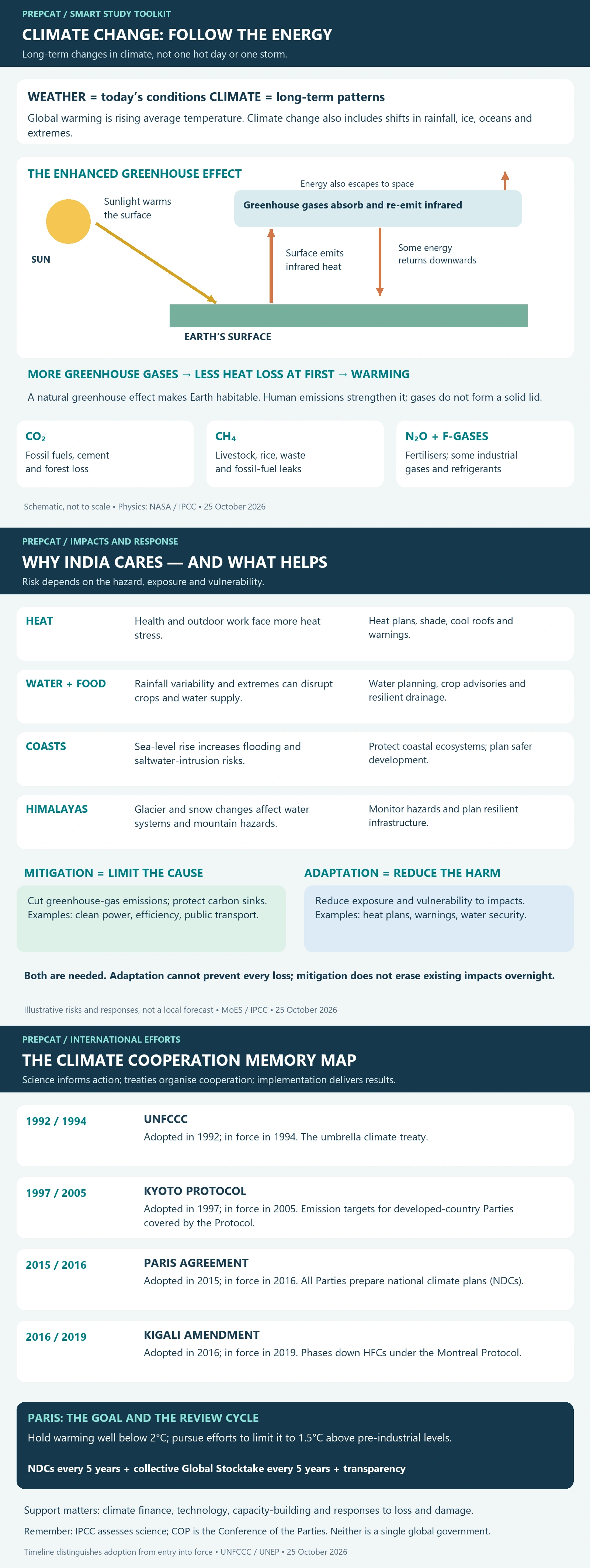
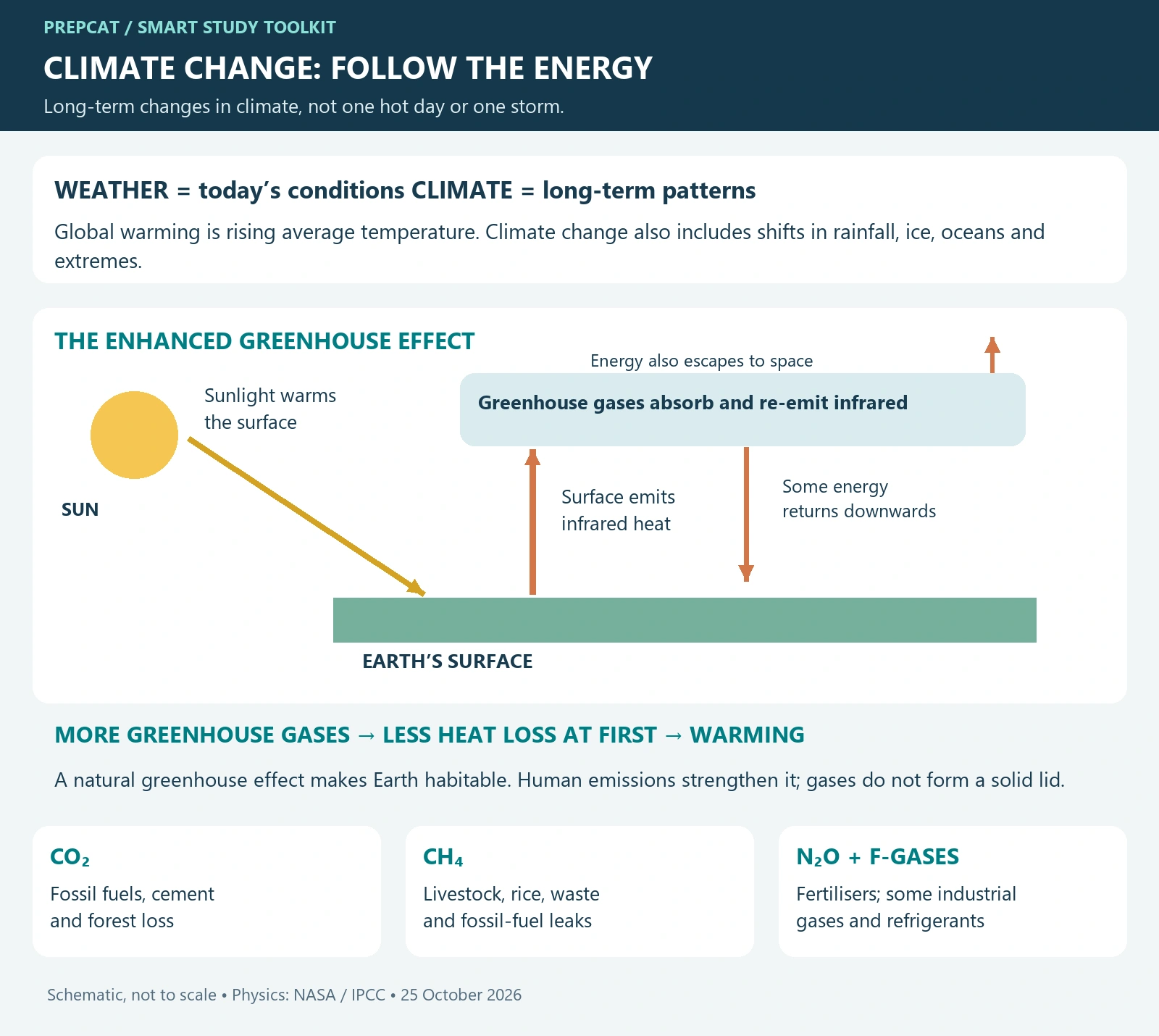
Sunlight supplies energy to Earth. The surface absorbs energy and emits infrared radiation. Greenhouse gases absorb and re-emit some of this outgoing radiation, including back towards the surface. They slow energy loss to space. This natural greenhouse effect makes Earth warmer and habitable.
Adding greenhouse gases initially reduces outgoing energy for the same surface temperature. Energy accumulates and the surface and lower atmosphere warm. The atmosphere is not a solid lid, and greenhouse gases do not simply block all sunlight or all escaping heat. Warming also increases atmospheric water vapour, which amplifies the initial change: a feedback.
3. Main Human Causes: Match the Gas to the Activity
Carbon dioxide (CO₂): burning coal, oil and gas, cement production, and land-use change. Forest loss can release stored carbon and weaken carbon uptake.
Methane (CH₄): fossil-fuel leaks, livestock, flooded rice cultivation and decomposing organic waste.
Nitrous oxide (N₂O): agricultural soils and nitrogen fertilisers, among other sources.
Fluorinated gases: some industrial processes and refrigerants. Some have very strong warming effects per unit mass.
Example: a coal-based power station releases CO₂ while producing electricity. An efficient appliance reduces electricity demand; cleaner electricity reduces emissions from supplying that demand. Both sides matter.
4. Impacts: More Than Higher Temperatures
Warming increases heat extremes and changes the water cycle. Heavy rainfall can intensify, while drought risk changes differently across regions. Oceans warm; glaciers and ice sheets lose mass. Sea level rises mainly because seawater expands as it warms and melting land ice adds water. Ecosystems, food systems, health and infrastructure face growing risks. Impacts are uneven: poorer or exposed communities often have fewer resources to cope.
A particular flood or cyclone also depends on weather, land use, drainage and exposure. Climate change can alter the probability or intensity of events; attributing one event requires evidence. “Every disaster is caused only by climate change” is an unsafe shortcut.
5. India: Why the Concept Matters in Daily Life and GS
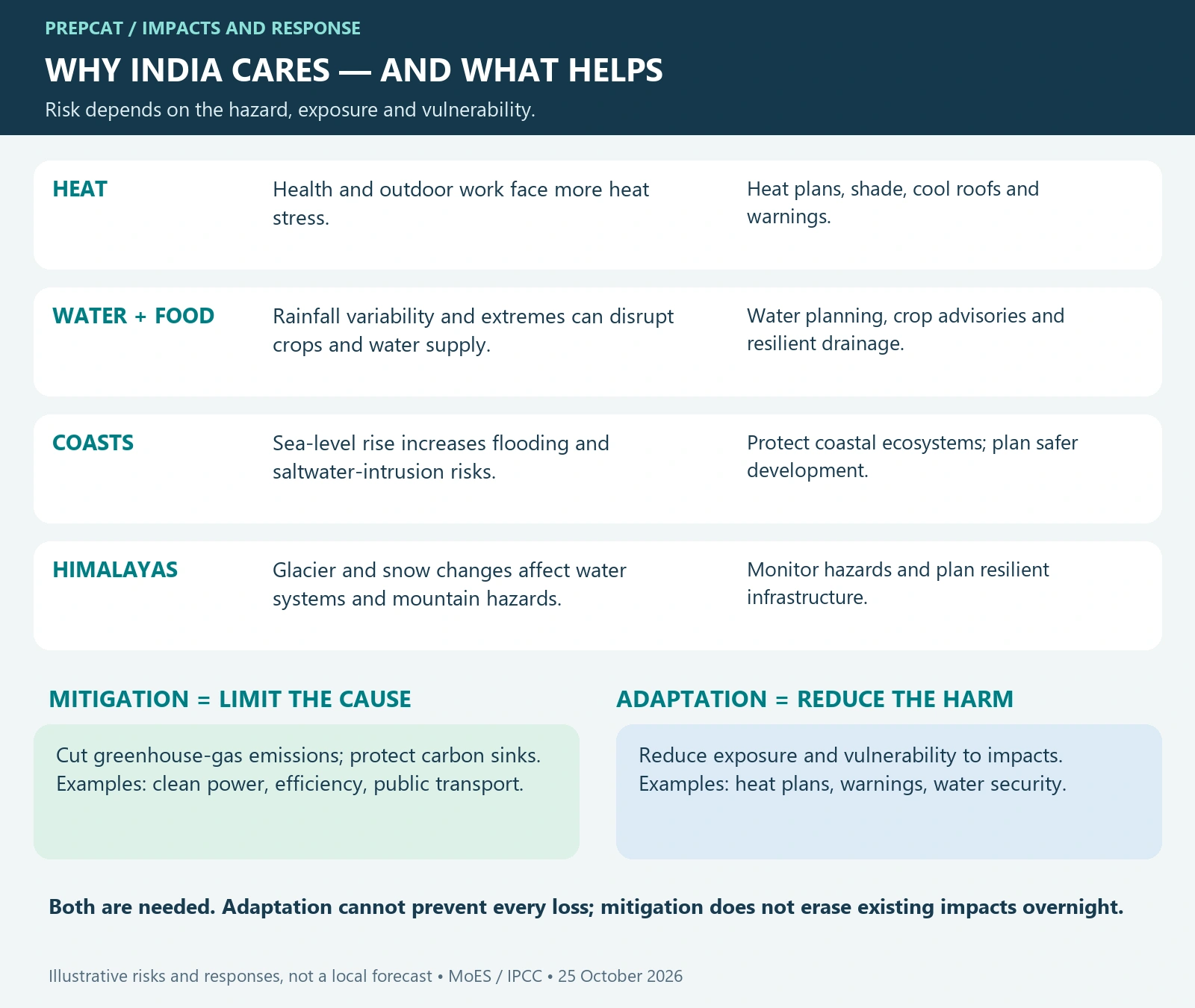
Heat and livelihoods: hotter conditions and heat extremes raise risks for health, outdoor workers, agriculture and electricity demand.
Monsoon, water and food: changes in rainfall patterns and heavy-rain events affect sowing, irrigation, reservoirs and urban flooding. Seasonal averages can hide long dry spells and intense downpours; India does not simply become uniformly wetter or drier.
Coasts and islands: higher sea levels increase coastal-flooding and saltwater-intrusion risks. Local land movement and coastal development also affect risk.
Himalayas: changing snow and glaciers affect mountain water systems and hazards. River outcomes vary by basin, season and the balance of rainfall, snow and glacier melt.
Ecosystems and the economy: forests, fisheries, infrastructure and public budgets face interconnected pressures. Resilient development protects livelihoods as well as nature.
For UPSC, connect the topic with GS1 geography and GS3 environment, agriculture and disaster management; international cooperation also links to GS2. India’s long-term strategy identifies a 2070 net-zero goal. A goal is a commitment to work towards, not proof that emissions have already reached zero.
6. How Do We Limit Climate Change and Reduce Harm?
We cannot instantly undo all existing changes. Every fraction of warming avoided reduces risk. Two complementary responses are essential:
Mitigation — tackle the cause: replace high-emission energy with low-emission sources, improve efficiency, electrify suitable uses, expand public transport, cut methane leaks and waste, improve industrial and agricultural practices, and protect or restore carbon-rich ecosystems.
Adaptation — reduce harm: heat action plans, early warnings, water management, resilient crops, flood-aware urban planning and safer infrastructure. Adaptation has limits, particularly at higher warming levels.
Net zero means balancing human-caused emissions with human-caused removals for the gas or gases specified. Sustained global net-zero CO₂ is needed to stabilise CO₂-induced warming; strong cuts in other greenhouse gases also matter. Tree planting alone cannot substitute for deep emission cuts.
At home and on campus: save energy, use efficient cooling, choose public transport or walking where feasible, reduce food waste, repair and reuse, and support sound waste management. Individual choices work best alongside clean infrastructure, business changes and public policy. For example, a city can combine solar-powered buildings (mitigation) with cool roofs and heat warnings (adaptation).
7. International Efforts: Remember the Purpose, Not Just the Date
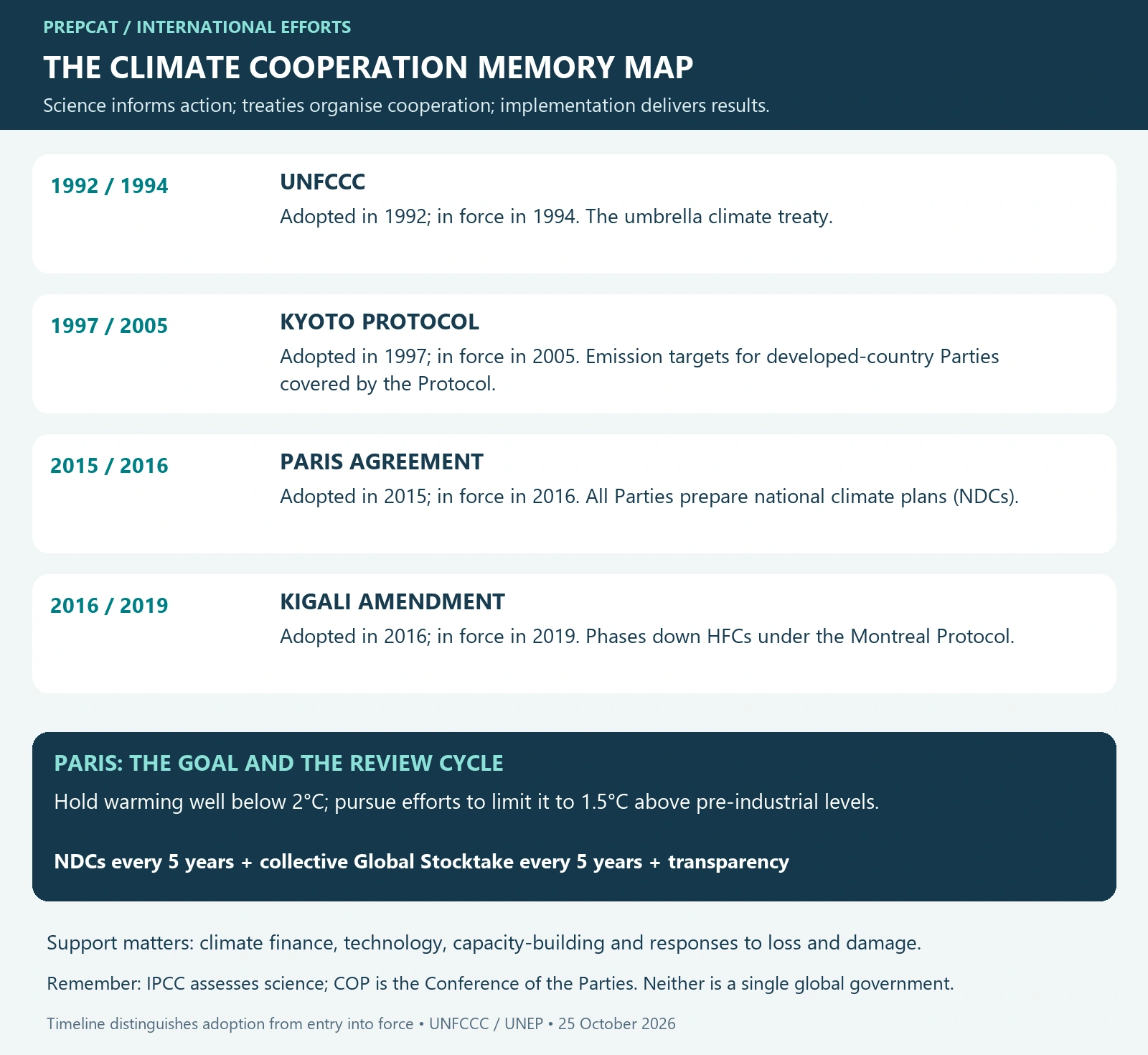
UNFCCC — adopted 1992; in force 1994: the umbrella treaty for climate cooperation. The Conference of the Parties (COP) reviews and negotiates action. Equity and common but differentiated responsibilities and respective capabilities recognise differences in responsibility and capacity.
Kyoto Protocol — adopted 1997; in force 2005: set binding emission targets for developed-country Parties covered by the Protocol.
Paris Agreement — adopted 2015; in force 2016: aims to hold global warming well below 2°C and pursue efforts towards 1.5°C above pre-industrial levels. All Parties prepare, communicate and maintain Nationally Determined Contributions (NDCs). Successive plans come every five years; a Global Stocktake assesses collective progress every five years. National targets differ; this is not an identical emission quota for every country.
Kigali Amendment — adopted 2016; in force 2019: phases down HFCs under the Montreal Protocol. HFCs are greenhouse gases but do not deplete ozone. This complements climate treaties.
Finance, technology and capacity: cooperation helps countries cut emissions and adapt. The Fund for responding to Loss and Damage assists particularly vulnerable developing countries with economic and non-economic losses from climate impacts; it does not replace mitigation or adaptation.
The IPCC assesses scientific knowledge; it does not negotiate national emission targets. Agreements need domestic implementation and transparent progress reporting to deliver results.
8. Quick Revision and Self-Check
Memory chain: activities → greenhouse gases → energy imbalance → warming → wider climate impacts → mitigation + adaptation + cooperation.
Trap: ozone depletion is not the main cause of global warming. A long-term temperature goal is not a daily local temperature ceiling. A single year above 1.5°C is not, by itself, the same as a long-term breach of the Paris temperature goal.
Q1. Is a heat-warning system mitigation or adaptation? Answer: mainly adaptation; it reduces harm rather than directly cutting emissions.
Q2. Why does warming raise sea level even without ice melt? Answer: seawater expands when it warms.
Q3. Which agreement uses NDCs, and which amendment phases down HFCs? Answer: Paris Agreement; Kigali Amendment.
Sources and Further Reading
UN: climate-change basics; NASA: causes and energy balance; IPCC: assessed causes and risks; IPCC: oceans, ice and sea level; IPCC: mitigation and net zero; MoES: Indian climate risks; India: first Biennial Transparency Report; UNFCCC: Convention; Kyoto Protocol; Paris Agreement; NDCs; UNEP: Kigali Amendment; Loss and Damage Fund: purpose; MoES: glacier change; WMO: annual versus long-term warming.
💭 Conclusion
Climate change begins with an altered energy balance but reaches into water, food, health, ecosystems and development. Cut emissions to limit future warming, adapt to reduce harm, and use international cooperation to support fair and effective implementation. The more warming we avoid, the more risk we prevent.