
DNA → RNA → Protein: Transcription vs Translation — A Visual Explainer
Follow genetic information from DNA to an amino-acid chain. A labelled flowchart, a worked sequence and a three-RNA memory hook separate transcription, translation and replication.
📌 Revision Pointers
Copy: replication = DNA → DNA.
Script: transcription = DNA → RNA.
Read: translation = mRNA → polypeptide.
RNA roles: mRNA message; tRNA adaptor; rRNA ribosome component.
Sequence trap: compare coding DNA and mRNA in the same direction; T becomes U.
Read the Visual: Information Flows
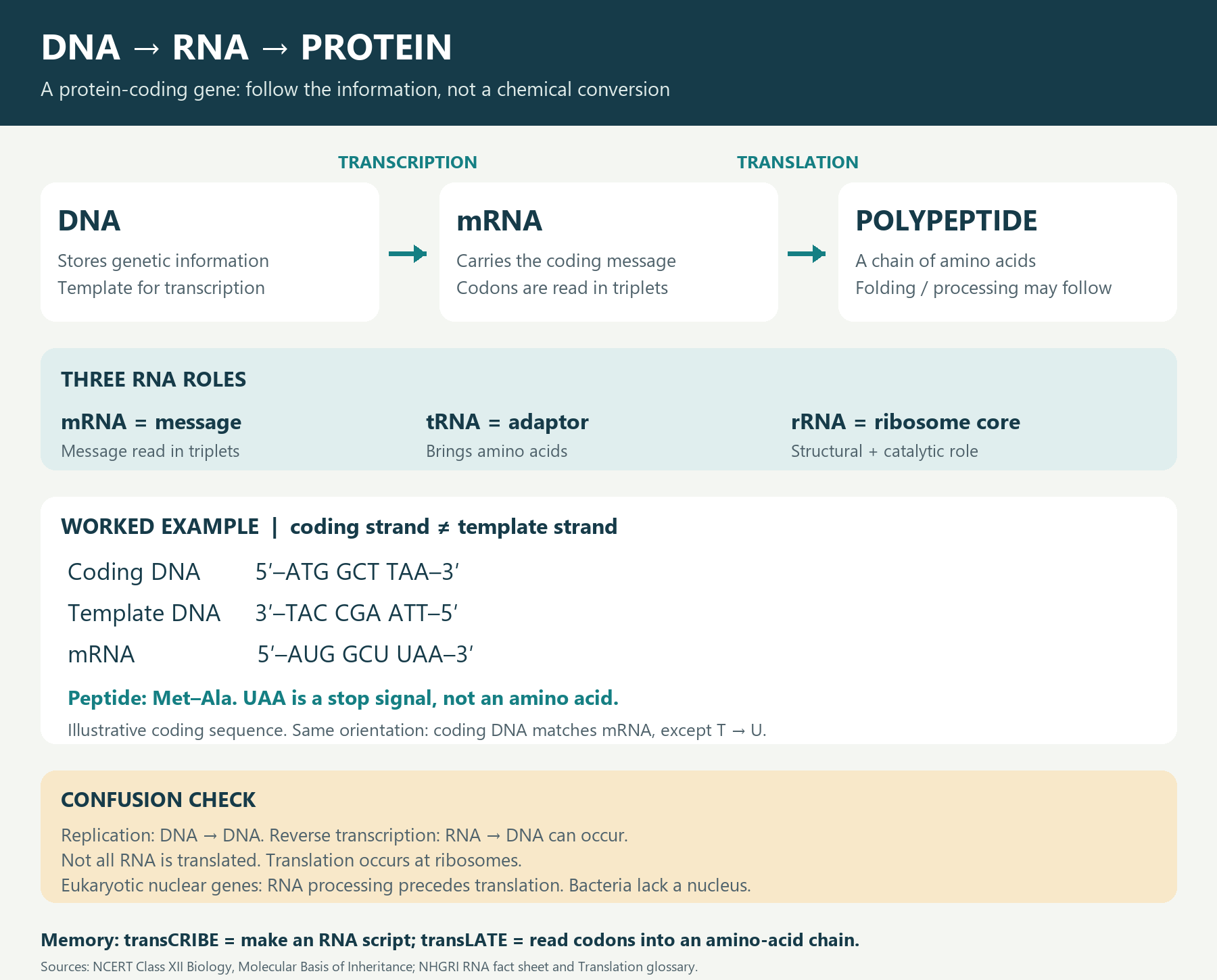
The chart simplifies expression of a protein-coding gene: DNA → mRNA → polypeptide. DNA provides the transcription template; the ribosome reads the mRNA during translation. The arrows represent information flow, not DNA physically turning into protein. Open the full-size visual.

Three Processes You Must Separate
Replication: DNA → DNA; genetic material is copied.
Transcription: DNA → RNA; RNA polymerase makes a complementary RNA transcript.
Translation: mRNA → polypeptide; ribosomes read codons to assemble amino acids.
The Three-RNA Memory Hook
Message–Adaptor–Machine core: mRNA carries the message; tRNA is the adaptor bringing amino acids; rRNA is a structural and catalytic component of the ribosome. A codon is a three-nucleotide unit on mRNA. A tRNA anticodon pairs with an appropriate codon; stop codons terminate translation rather than specifying amino acids.
Worked Sequence: Watch the Strand Direction
Coding DNA: 5′–ATG GCT TAA–3′
Template DNA: 3′–TAC CGA ATT–5′
mRNA: 5′–AUG GCU UAA–3′
Illustrative peptide: Met–Ala; UAA signals stop.
The coding strand matches the mRNA sequence when both are written in the same direction, except that RNA uses U instead of T. The template strand is complementary and antiparallel. This is a short illustrative coding sequence, not a complete gene.
Common Traps
Transcription produces RNA, not a protein.
Not every RNA is translated; many RNAs function as RNA.
For eukaryotic nuclear genes, RNA processing precedes translation; bacteria lack a membrane-bound nucleus.
RNA → DNA can occur through reverse transcription. The simple forward-flow chart is not a claim that all information transfer follows only those arrows.
Quick Self-Check
Which statement is correct?
A. Translation copies DNA into DNA.
B. A stop codon adds a special stop amino acid.
C. Transcription makes RNA from a DNA template.
D. Every RNA must be translated.
Answer: C
Explanation: Replication copies DNA; transcription produces RNA. Stop codons signal termination, and noncoding RNAs need not be translated.
Sources
NCERT: Molecular Basis of Inheritance; NHGRI: RNA fact sheet; NHGRI: Translation.
💭 Conclusion
First identify the template, then the product and the machinery. Use the sequence example to check strand direction, and remember that the simple DNA–RNA–protein map describes a central pathway rather than every possible role or transfer of genetic information.