
Fundamental Rights vs Fundamental Duties vs DPSP: Articles and Exceptions
Fundamental Rights, Directive Principles of State Policy and Fundamental Duties sit in three different Parts of the Constitution but get merged into one confused blob in most aspirants' heads - this note untangles their articles, sources of inspiration, enforceability and the landmark exceptions (Article 31C, Article 37, Emergency suspension) that connect them.
📌 Revision Pointers
Fundamental Rights (Part III, Art 12-35) are justiciable; DPSP (Part IV, Art 36-51) and Fundamental Duties (Part IVA, Art 51A) are not.
DPSP draws from the Irish Constitution; Fundamental Duties draw from the USSR Constitution.
The 42nd Amendment (1976) added Fundamental Duties and DPSP Articles 39A/43A/48A; the 86th Amendment (2002) added the 11th Duty and Article 21A.
Article 31C shields only Article 39(b)/(c) laws from Articles 14/19 challenges - Minerva Mills (1980) struck down its wider 1976 extension.
Fundamental Rights were originally 7, now 6, after Right to Property moved to Article 300A via the 44th Amendment.
1. Fundamental Rights: The Six Baskets (Part III, Articles 12-35)
Right to Equality (Articles 14-18) - Covers equality before law, no discrimination, equality of opportunity in public employment, abolition of untouchability, and abolition of titles.
Mnemonic Hook: "14 to 18 = EQUAL entry" - think of ages 14-18 as the "equal" teenage years before adulthood.
Link: Article 17 (untouchability) is the only Fundamental Right enforceable against private individuals too, not just the State.
Right to Freedom (Articles 19-22) - Six freedoms under Article 19 (speech, assembly, association, movement, residence, profession), protection in respect of conviction (Art 20), protection of life and personal liberty (Art 21), and protection against arrest and detention (Art 22).
Mnemonic Hook: "19 SIX, 20 SAFE, 21 LIFE, 22 ARREST" - remember each number by its keyword.
Link: Article 21A (Right to Education, 6-14 years) was inserted between 21 and 22 by the 86th Amendment (2002) - the same amendment that added the 11th Fundamental Duty.
Right against Exploitation (Articles 23-24) - Prohibits human trafficking and forced labour (Art 23), and bans employment of children below 14 in hazardous jobs (Art 24).
Mnemonic Hook: "23 TRAFFIC, 24 CHILD" - two-word tags for two articles.
Link: Article 24's age limit (14 years) matches Article 21A's age limit and Fundamental Duty 51A(k) - all three "14" provisions belong to the child-protection cluster.
Right to Freedom of Religion (Articles 25-28) - Freedom of conscience and free profession (Art 25), freedom to manage religious affairs (Art 26), freedom from taxes for promotion of a religion (Art 27), freedom from religious instruction in state-funded institutions (Art 28).
Mnemonic Hook: "25-28 = RELIGION Row" - four consecutive articles, one theme.
Link: None of these four is absolute - all are subject to public order, morality and health.
Cultural and Educational Rights (Articles 29-30) - Protection of minorities' language, script, culture (Art 29) and their right to establish and administer educational institutions (Art 30).
Mnemonic Hook: "29-30 = last two before Remedies" - the shortest basket, only two articles.
Link: Article 29 protects ANY section of citizens; Article 30 is exclusively for minorities - a favourite prelims trap.
Right to Constitutional Remedies (Article 32) - Allows direct approach to the Supreme Court for enforcement of Fundamental Rights; Dr. Ambedkar called it the "heart and soul" of the Constitution.
Mnemonic Hook: "32 = the number you dial for help" - the emergency-helpline article.
Link: Article 226 gives High Courts a similar but wider writ power (also for non-Fundamental-Rights matters) - Article 32 is narrower but non-suspendable except during a National Emergency.
2. Directive Principles of State Policy: Three Streams (Part IV, Articles 36-51)
Socialist Principles (Articles 38-43A) - Direct the State toward social/economic justice, equal pay for equal work (Art 39d), free legal aid (Art 39A), living wage and worker participation in management (Art 43A).
Mnemonic Hook: "S for Socialist, S for State-provides-Support" - these articles ask the State to actively redistribute and protect.
Link: Article 39A was inserted by the 42nd Amendment (1976), the same amendment that gave DPSP overall priority via a since-diluted Article 31C.
Gandhian Principles (Articles 40, 43, 46-48) - Organisation of village panchayats (Art 40), promotion of cottage industries (Art 43), promotion of educational/economic interests of SC/ST/OBC (Art 46), prohibition of cow slaughter and improvement of agriculture/animal husbandry (Art 48).
Mnemonic Hook: "Gandhian = Grassroots" - village, cottage, weaker sections, agriculture: all rural and Gandhi-linked ideals.
Link: Article 40 directly led to the 73rd Amendment (1992), which gave Panchayati Raj constitutional status decades later.
Liberal-Intellectual Principles (Articles 44-51) - Uniform Civil Code (Art 44), early childhood care (Art 45), separation of judiciary from executive (Art 50), protection of environment and wildlife (Art 48A), promotion of international peace (Art 51).
Mnemonic Hook: "Liberal = Later/Loftier ideals" - the articles numbered highest, aiming at modern, forward-looking goals.
Link: Article 48A (environment, added by the 42nd Amendment) is the DPSP twin of Fundamental Duty 51A(g) - same subject, two different Parts of the Constitution.
3. Fundamental Duties: The Eleven Commandments (Part IVA, Article 51A)
Original Ten - added by the 42nd Amendment, 1976 [51A(a) to 51A(j)] - Respect the Constitution, flag and anthem; cherish the freedom struggle's ideals; protect sovereignty and integrity; defend the nation; promote harmony and women's dignity; preserve composite culture; protect environment, forests, lakes, rivers, wildlife and have compassion for living creatures; develop scientific temper; safeguard public property; strive for excellence.
Mnemonic Hook: "Ten Duties, One Amendment (42nd), One Committee" - the Swaran Singh Committee recommended them, borrowed from the USSR's constitution.
Link: 51A(g) (protect environment/wildlife) is the citizen-facing mirror of DPSP Article 48A - remember them as a pair, not as competitors.
Eleventh Duty - added by the 86th Amendment, 2002 [51A(k)] - A parent or guardian must provide opportunities for education to their child/ward between the ages of 6 and 14.
Mnemonic Hook: "86 = the year Education got Added twice" - the same 86th Amendment inserted Article 21A (Right to Education) into Part III AND 51A(k) into Part IVA.
Link: Note the age band shifts here - 6 to 14 for this Duty and Article 21A, versus "below 14" for the child-labour Article 24.
4. The Exceptions That Trip Everyone Up
Article 37 - States plainly that DPSPs "shall not be enforceable by any court" but are nevertheless "fundamental in the governance of the country."
Mnemonic Hook: "37 = NOT justiciable, but not toothless either."
Link: This is the single most quoted line in DPSP-related prelims questions - memorise it verbatim.
Article 31C - Shields laws implementing Article 39(b) and (c) (material resources for common good, prevention of wealth concentration) from being struck down for violating Articles 14 or 19.
Mnemonic Hook: "31C = Cover for 39(b)/(c) only" - not a blanket shield for all DPSPs.
Link: The 42nd Amendment (1976) tried to extend this shield to ALL DPSPs; the Minerva Mills case (1980) struck that extension down as violating the basic structure, restoring the narrower original scope.
Fundamental Duties have no direct court enforcement - Like DPSPs, Article 51A duties cannot be enforced by courts against a citizen, though courts have used them to interpret and uphold laws (e.g., environmental judgments citing 51A(g)).
Mnemonic Hook: "Duties = Directions without a Directive Court order."
Link: This is the key similarity between DPSP and Fundamental Duties that examiners exploit - both are non-justiciable, only Fundamental Rights are.
Suspension during Emergency - Article 358 automatically suspends Article 19 during a National Emergency (external); Article 359 allows the President to suspend enforcement of other Fundamental Rights (except Articles 20 and 21) during any National Emergency.
Mnemonic Hook: "358 = only 19 goes, automatically; 359 = President picks the rest, 20 & 21 are un-touchable."
Link: This 44th Amendment (1978) safeguard - protecting Articles 20 and 21 even during Emergency - was a direct response to the excesses of the 1975-77 Emergency.
Quick Timeline/Flowchart
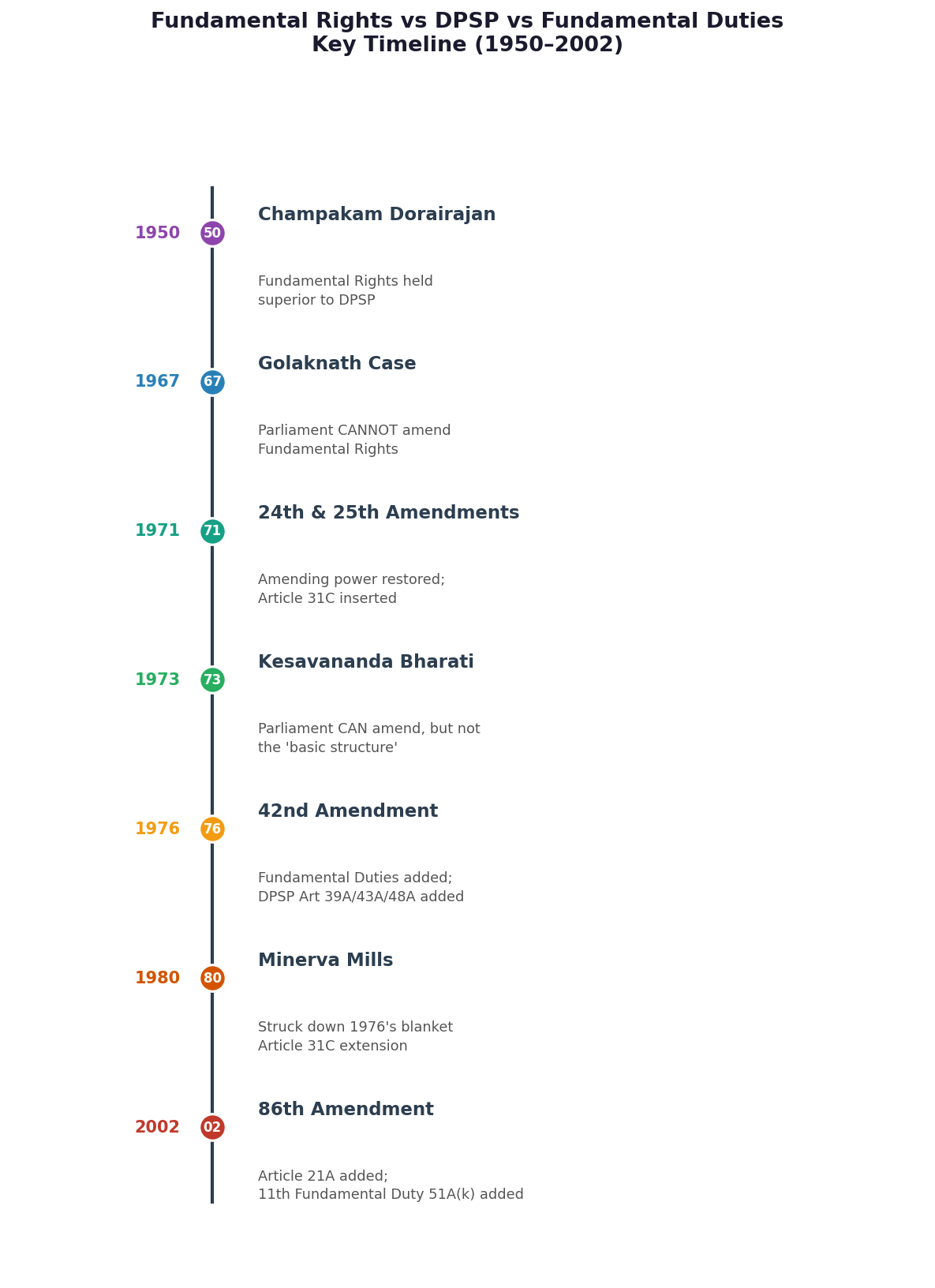
1950: Champakam Dorairajan case - Fundamental Rights held superior to DPSP
↓
1967: Golaknath case - Parliament cannot amend Fundamental Rights at all
↓
1971: 24th & 25th Amendments - Parliament restores its amending power; Article 31C inserted
↓
1973: Kesavananda Bharati case - Parliament CAN amend, but not the "basic structure"
↓
1976: 42nd Amendment - Fundamental Duties (Art 51A) added; DPSP Articles 39A, 43A, 48A added; Article 31C's shield extended to all DPSPs
↓
1980: Minerva Mills case - Strikes down the 1976 extension of Article 31C; reaffirms Fundamental Rights-DPSP "balance" as basic structure
↓
2002: 86th Amendment - Article 21A (Right to Education) inserted in Part III; 11th Fundamental Duty 51A(k) inserted in Part IVA
Quick Revision List
Fundamental Rights = Part III (Art 12-35), justiciable, enforceable via Article 32.
DPSP = Part IV (Art 36-51), non-justiciable, inspired by the Irish Constitution.
Fundamental Duties = Part IVA (Article 51A, 11 duties), non-justiciable, inspired by the USSR Constitution, added by the 42nd Amendment (10) and 86th Amendment (1 more).
Original 7 Fundamental Rights are now 6 - Right to Property was removed by the 44th Amendment (1978) and demoted to a legal right under Article 300A.
Article 31C is a limited shield (only for Article 39 b/c laws), not a general immunity for all DPSPs - Minerva Mills confirmed this limit.
The 86th Amendment (2002) is a triple-hit: Article 21A added to Part III, Article 45 reworded in Part IV, and Article 51A(k) added to Part IVA - all about education.
Common Confusion Traps
Ireland vs USSR mix-up: DPSP is borrowed from the Irish Constitution; Fundamental Duties are borrowed from the erstwhile USSR Constitution - these are frequently swapped in MCQs.
"10 Duties" trap: Many aspirants stop at the original 10 Fundamental Duties (1976) and forget the 11th one added in 2002 - the correct current total is 11.
Article 48 vs Article 48A: Article 48 (Gandhian, cow slaughter/agriculture) and Article 48A (Liberal-Intellectual, environment) look like typos of each other but belong to different classification streams entirely.
Article 21 vs Article 21A: Article 21 (Protection of Life and Personal Liberty) is an original 1950 provision; Article 21A (Right to Education) was inserted 52 years later by the 86th Amendment - never assume consecutive numbers mean the same vintage.
DPSP "unenforceable" does not mean "useless": Courts routinely use DPSPs to interpret the scope of Fundamental Rights (e.g., reading Article 21 with Article 39, 47, 48A) - non-justiciable is not the same as non-influential.
Golaknath vs Kesavananda Bharati: Golaknath (1967) said Parliament CANNOT amend Fundamental Rights at all; Kesavananda Bharati (1973) reversed this to say Parliament CAN amend any part, including Fundamental Rights, but not the "basic structure" - a commonly reversed pair in Mains answers.
💭 Conclusion
Anchor the whole comparison to one fact: only Part III is directly enforceable in court under Article 32 - everything in Part IV and Part IVA works through legislation, judicial interpretation and moral suasion, never through a writ.