
Major ISRO Missions & Space Programmes of India: The Complete Timeline & Confusion-Buster
ISRO's mission names — Chandrayaan, Mangalyaan, Aditya-L1, Gaganyaan, NISAR, Aditya, Astrosat — sound similar and launch in overlapping years, which is exactly why UPSC loves swapping them in MCQs. This note lines up every major ISRO mission by target, launch vehicle, and year, and untangles the most commonly confused pairs: Chandrayaan-2 vs Chandrayaan-3, Aditya-L1 vs Mangalyaan, and Gaganyaan's uncrewed tests vs its crewed flight.
📌 Revision Pointers
Chandrayaan-1 (2008) discovered water on the Moon; Chandrayaan-2 (2019) had a lander crash but a working orbiter; Chandrayaan-3 (2023) achieved the first soft-landing near the lunar south pole on 23 August, now National Space Day.
Mangalyaan/MOM (2013-14) made India the first nation to reach Mars orbit on its first attempt; Aditya-L1 (2023) is a SOLAR mission at the Sun-Earth L1 point, not a Mars mission - the two are frequently swapped in questions.
Gaganyaan-1 (G1) is an UNCREWED test flight carrying the robot Vyommitra; the actual crewed Gaganyaan flight comes only after multiple uncrewed test flights (G1, G2, G3) are cleared.
NISAR (launched 30 July 2025) is a JOINT NASA-ISRO Earth-observation satellite with dual L-band and S-band radar - not a purely Indian mission.
PSLV carried Chandrayaan-1, Mangalyaan, and Aditya-L1; GSLV Mk III/LVM3 (the human-rated, heavy-lift rocket) carried Chandrayaan-2, Chandrayaan-3, and will carry Gaganyaan.
1. The Moon Missions - Chandrayaan Series
Chandrayaan-1 (2008) - India's first lunar probe; launched on PSLV-C11; carried the Moon Impact Probe (MIP) and helped confirm the presence of water molecules on the Moon's surface via NASA's M3 instrument.
Mnemonic Hook: "Chandrayaan-1: the WATER-finder."
Link: One (1) mission, one big discovery - water.
Chandrayaan-2 (2019) - Launched on GSLV Mk III; consisted of an Orbiter, Lander (Vikram), and Rover (Pragyan); the Vikram lander crash-landed during its final descent, but the Orbiter remains functional and continues to send data.
Mnemonic Hook: "Chandrayaan-2: the lander that didn't land, but the orbiter that never left."
Link: Two (2) as in "too fast" - the lander's descent velocity error caused the crash.
Chandrayaan-3 (2023) - Launched on LVM3 (the renamed GSLV Mk III); successfully soft-landed near the lunar south pole on 23 August 2023, making India the fourth country to soft-land on the Moon and the first to land near the south pole; this date is now celebrated as National Space Day.
Mnemonic Hook: "Chandrayaan-3: third time's the charm, south pole first."
Link: Three (3) as in the "hat-trick" landing after Chandrayaan-2's miss.
Chandrayaan-4 (planned) - An approved future lunar sample-return mission, planned to use two separate launches that dock in space before heading to the Moon, intended to bring lunar samples back to Earth.
Mnemonic Hook: "Chandrayaan-4: fetch mission - go, grab, come back."
2. The Sun and Mars Missions - Don't Mix These Up
Mangalyaan / Mars Orbiter Mission, MOM (2013-2014) - Launched on PSLV-C25; made India the first country to reach Mars orbit in its very first attempt and the first Asian nation to reach Mars orbit at all; lost contact in 2022 after fuel exhaustion.
Mnemonic Hook: "Mangal(Mars)yaan = first-attempt success story."
Link: "Mangal" sounds like "Mars" in Hindi - the direct giveaway.
Aditya-L1 (2023) - India's first dedicated solar observation mission; launched on PSLV-C57; placed in a halo orbit around the Sun-Earth Lagrange Point 1 (L1), about 1.5 million km from Earth, to continuously observe the Sun without eclipses.
Mnemonic Hook: "Aditya = Sun; L1 = the parking spot, not a Mars mission."
Link: Many students confuse Aditya-L1 with a Mars mission because of the "MOM" naming pattern - Aditya-L1 studies the SUN, not Mars.
3. Human Spaceflight - Gaganyaan Programme
Gaganyaan Mission - India's indigenous human spaceflight programme, intended to send Indian astronauts (Gaganyatris) into a low Earth orbit of about 400 km aboard an Indian-built Orbital Module launched on the human-rated LVM3.
Mnemonic Hook: "Gaganyaan - 'Gagan' means sky; this is India's own sky-chariot."
Gaganyaan-1 / G1 (uncrewed test) - The first uncrewed test flight of the Gaganyaan Orbital Module, carrying the humanoid robot "Vyommitra" to validate life-support and crew-module systems before any human flight; repeatedly rescheduled through late 2025 and into 2026 as ISRO completed safety validations.
Mnemonic Hook: "Vyommitra rides first, so humans ride safe later."
Link: "Vyom" means sky/space in Sanskrit - Vyommitra is literally the "friend of space."
Gaganyaan-2 and Gaganyaan-3 (further uncrewed/test flights) - Additional uncrewed test flights planned before the first crewed mission, to progressively validate the crew escape system and other human-rating requirements.
Mnemonic Hook: "G1, G2, G3 - three rehearsals before the real show."
Link: The actual crewed Gaganyaan flight (sometimes referred to as Gaganyaan-4/H1) is targeted only after these uncrewed tests are cleared - do not assume "Gaganyaan mission" always means a crewed flight.
4. Earth Observation and International Collaboration
NISAR (NASA-ISRO Synthetic Aperture Radar) - A joint NASA-ISRO Earth observation satellite launched on GSLV from Sriharikota on 30 July 2025; carries both an L-band (NASA) and S-band (ISRO) radar to monitor land and ice deformation, ecosystem changes, and natural hazards with unprecedented precision.
Mnemonic Hook: "NISAR - Not Indian Satellite Alone: it's a NASA-ISRO marriage."
Link: The dual-band radar is the giveaway detail examiners use to test if you know this is a joint mission, not a purely Indian one.
Astrosat (2015) - India's first dedicated multi-wavelength space observatory, studying celestial sources simultaneously in X-ray, optical, and UV bands; frequently confused with Aditya-L1 since both are "space telescopes," but Astrosat observes deep-space objects while Aditya-L1 observes only the Sun.
Mnemonic Hook: "Astrosat looks OUTWARD at stars; Aditya-L1 looks INWARD at our Sun."
5. Launch Vehicles - Match the Rocket to the Mission
PSLV (Polar Satellite Launch Vehicle) - ISRO's reliable workhorse rocket; launched Chandrayaan-1, Mangalyaan, and Aditya-L1; used mainly for polar and sun-synchronous orbits.
Mnemonic Hook: "PSLV = the Sun-and-Mars carrier (Aditya-L1 and Mangalyaan both rode it)."
GSLV Mk III / LVM3 (Launch Vehicle Mark-3) - ISRO's heaviest-lift rocket, human-rated for Gaganyaan; launched Chandrayaan-2 and Chandrayaan-3; the same rocket was renamed from "GSLV Mk III" to "LVM3" partway through the programme, a favourite trap in questions.
Mnemonic Hook: "LVM3 = Lunar and Vyommitra's ride - the heavy-lifter."
Quick Timeline/Flowchart
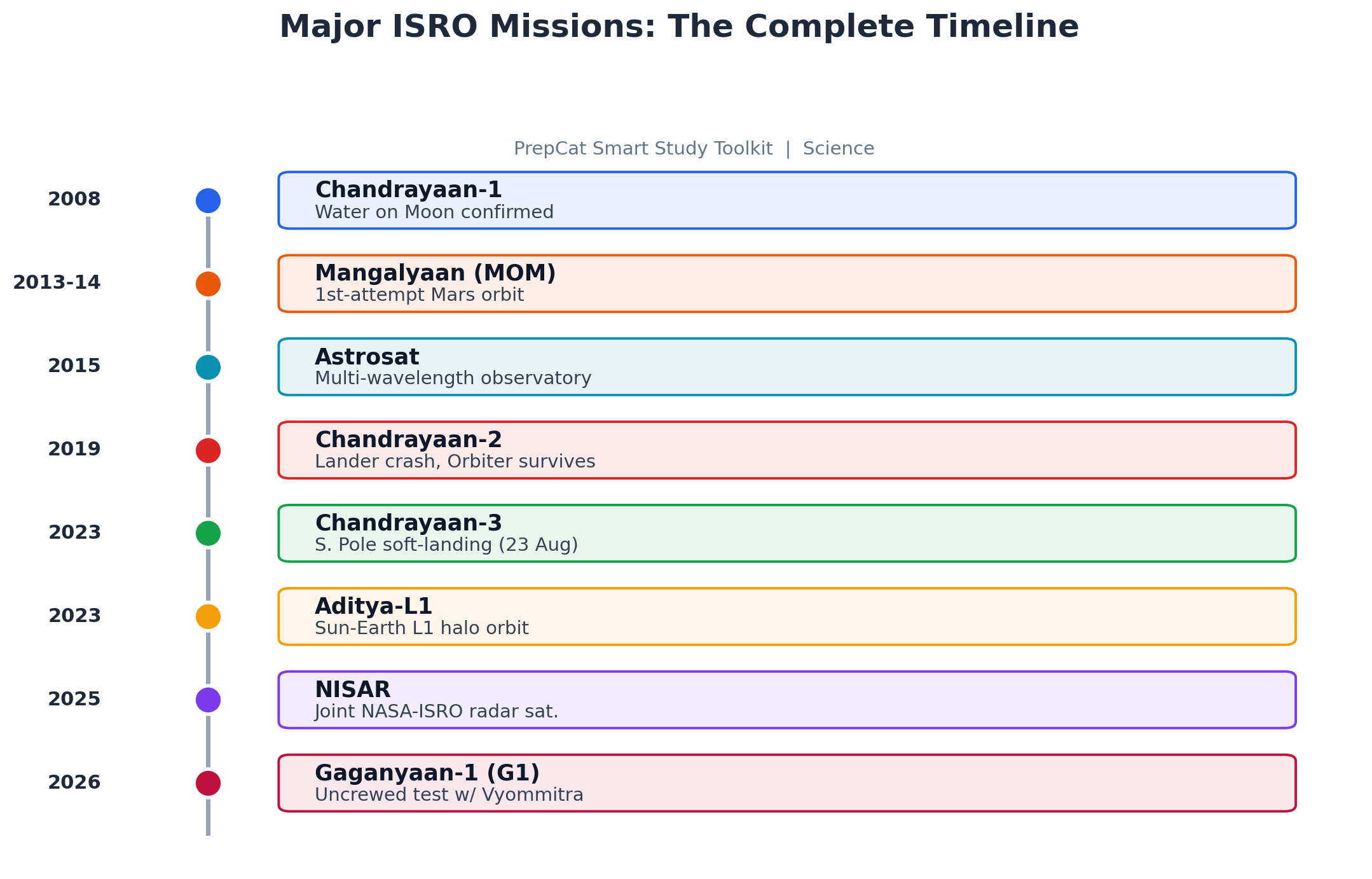
Chandrayaan-1 launched, confirms water on the Moon (2008)
↓
Mangalyaan/MOM reaches Mars orbit on first attempt (2013-2014)
↓
Astrosat, India's first multi-wavelength space observatory (2015)
↓
Chandrayaan-2 launched; Vikram lander crashes, Orbiter survives (2019)
↓
Chandrayaan-3 soft-lands near the lunar south pole, 23 August - National Space Day (2023)
↓
Aditya-L1 launched, reaches the Sun-Earth L1 halo orbit (2023)
↓
NISAR, the joint NASA-ISRO radar satellite, launched from Sriharikota (30 July 2025)
↓
Gaganyaan-1 (G1), the first uncrewed test flight carrying Vyommitra, targeted (2026)
↓
Further uncrewed tests (G2, G3) to precede India's first crewed spaceflight
Quick Revision List
Chandrayaan-1 (2008) = water discovery; Chandrayaan-2 (2019) = lander crash, orbiter survives; Chandrayaan-3 (2023) = first south-pole soft-landing (23 August = National Space Day).
Mangalyaan/MOM (2013-14) = Mars orbiter, first-attempt success; Aditya-L1 (2023) = Sun mission at the L1 Lagrange point - never confuse the two.
Astrosat (2015) = India's multi-wavelength space telescope looking outward at stars; different from Aditya-L1, which looks only at the Sun.
NISAR (30 July 2025) = joint NASA-ISRO radar satellite with dual L-band/S-band radar.
Gaganyaan-1 (G1) = uncrewed test flight with robot Vyommitra; crewed flight comes only after G1/G2/G3 uncrewed tests succeed.
PSLV launched Chandrayaan-1, Mangalyaan, Aditya-L1; GSLV Mk III/LVM3 (human-rated) launched Chandrayaan-2, Chandrayaan-3, and will launch Gaganyaan.
Common Confusion Traps
Aditya-L1 is NOT a Mars mission: Despite India's Mars fame from Mangalyaan, Aditya-L1 (2023) is India's SOLAR observatory at the Sun-Earth L1 point - a completely different target and a completely different year.
Chandrayaan-2's "failure" is only partial: Only the Vikram lander crashed; the Chandrayaan-2 Orbiter is still functional and continues to support later missions, including relaying data for Chandrayaan-3.
NISAR is not a solo ISRO mission: It is a joint NASA-ISRO satellite - a frequent trap for students who assume every Sriharikota launch is purely Indian.
Gaganyaan-1 (G1) is uncrewed: Many aspirants wrongly assume "Gaganyaan" always refers to the crewed flight; G1, G2, and G3 are uncrewed test flights that must succeed first.
GSLV Mk III and LVM3 are the SAME rocket, just renamed partway through the programme - not two different vehicles, a detail examiners like to test with "which vehicle is heavier" style questions.
💭 Conclusion
ISRO's mission portfolio has grown dense enough that examiners can build an entire question purely on which spacecraft went where, on which rocket, and in what year. Anchor each mission to its ONE defining fact - Chandrayaan-3's south-pole landing, Aditya-L1's Sun-Earth L1 point, NISAR's dual-agency radar, Gaganyaan's uncrewed-before-crewed sequence - and the rest of the confusion falls away.