
Neuron Structure & Transmission of a Nerve Impulse: A Visual Explainer
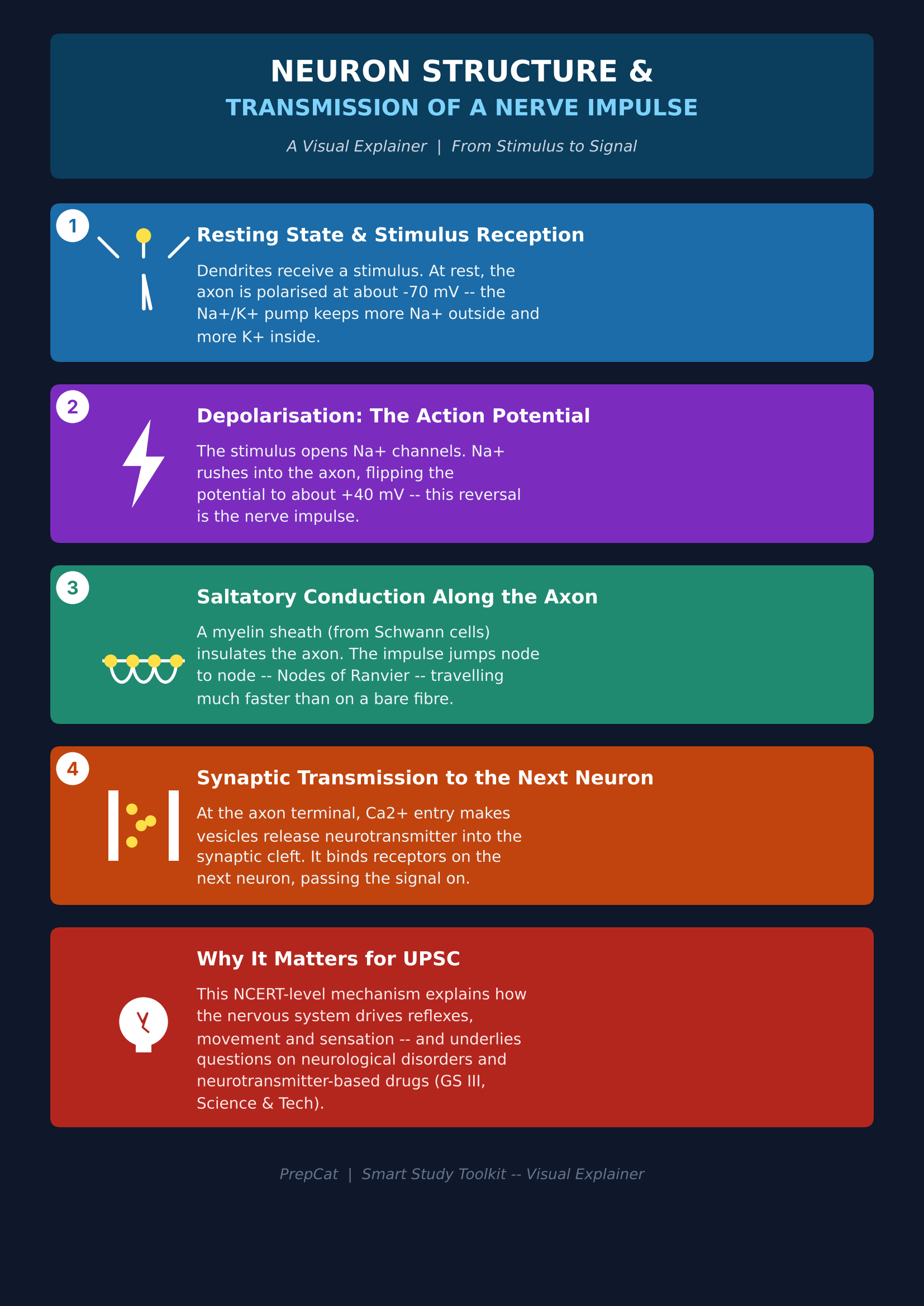
A single infographic tracing how a nerve impulse travels — from stimulus reception at the dendrites, through depolarisation and saltatory conduction along the axon, to neurotransmitter release at the synapse.
📌 Revision Pointers
At rest the axon is polarised at about -70mV; a stimulus opens Na+ channels and flips it to about +40mV, generating the action potential
The myelin sheath lets the impulse jump from one Node of Ranvier to the next (saltatory conduction), making transmission much faster
At the axon terminal, Ca2+ entry triggers neurotransmitter release into the synaptic cleft, passing the signal to the next neuron
The pathway of a nerve impulse, in one diagram: Stimulus Reception → Depolarisation (Action Potential) → Saltatory Conduction → Synaptic Transmission.
💭 Conclusion
A foundational NCERT Biology mechanism behind reflexes and voluntary movement — and the basis for questions on neurological disorders and neurotransmitter-targeted drugs in GS Paper III.