
Oxidation vs Reduction: Electron Transfer and Agent Names — A Visual Explainer
Use a colour-coded electron-transfer map to identify oxidation, reduction, oxidising agents and reducing agents without reversing their names.
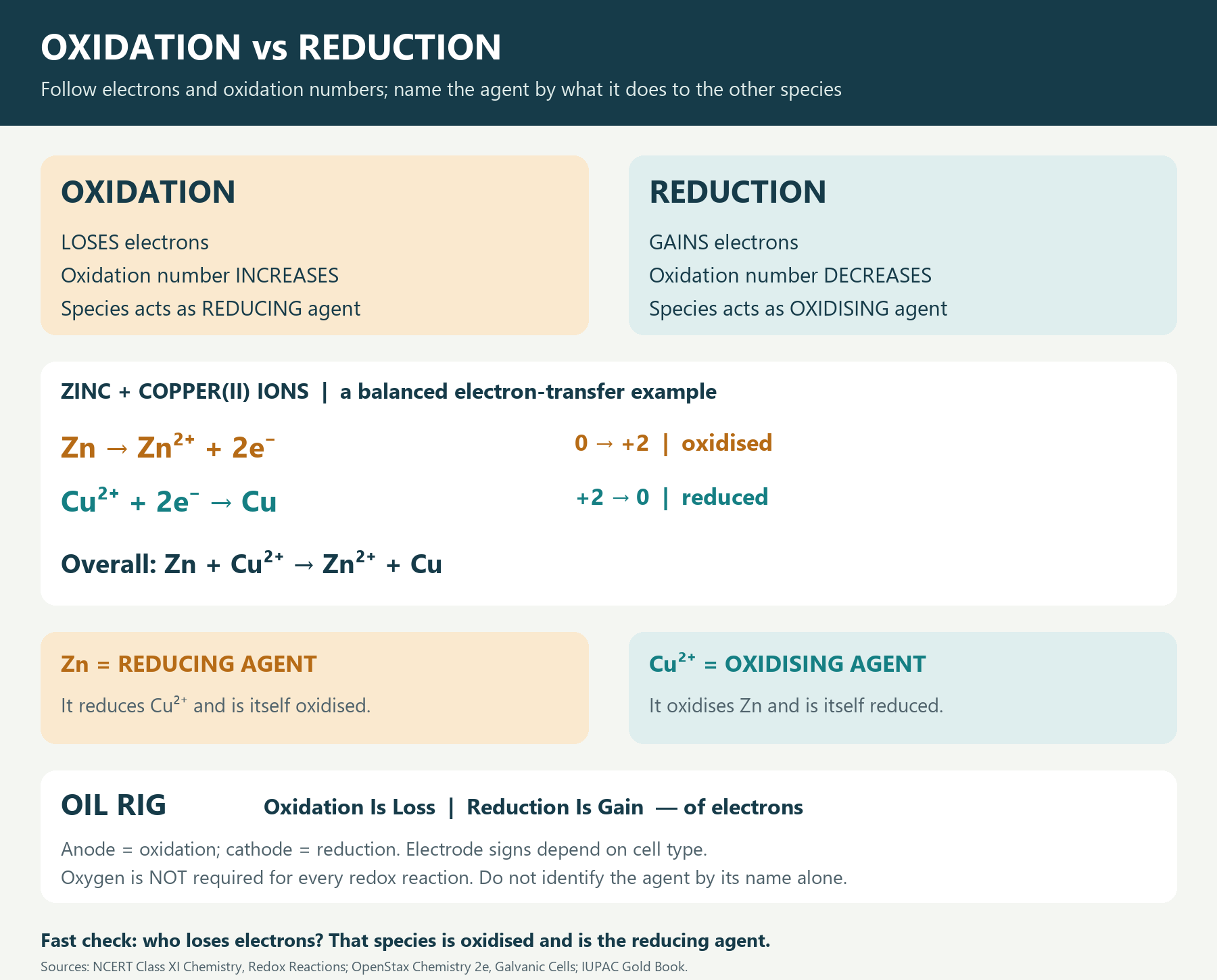
📌 Revision Pointers
OIL: oxidation is loss of electrons; oxidation number increases.
RIG: reduction is gain of electrons; oxidation number decreases.
Agent trap: reducing agent is oxidised; oxidising agent is reduced.
Example: Zn donates electrons; Cu²⁺ accepts them.
Electrodes: anode oxidation; cathode reduction.
Read the Visual: OIL RIG
Oxidation Is Loss; Reduction Is Gain—of electrons. Oxidation also corresponds to an increase in oxidation number, while reduction corresponds to a decrease. These changes occur together in a redox reaction. Open the full-size comparison chart.

The Agent-Name Reversal
Reducing agent: gives electrons to another species and is itself oxidised.
Oxidising agent: accepts electrons from another species and is itself reduced.
Name an agent by what it does to the other reactant. Do not confuse its action on another species with the change it undergoes itself.
Worked Example: Zinc and Copper(II) Ions
Oxidation: Zn → Zn²⁺ + 2e⁻. Zinc’s oxidation number rises from 0 to +2.
Reduction: Cu²⁺ + 2e⁻ → Cu. Copper’s oxidation number falls from +2 to 0.
Overall: Zn + Cu²⁺ → Zn²⁺ + Cu.
The two electrons cancel when the half-reactions are combined. Zn is the reducing agent; Cu²⁺ is the oxidising agent. Both atom counts and total charge are balanced. These are simplified ionic equations for the zinc–copper(II) reaction.
Common Traps
Oxygen is not compulsory: the example contains no oxygen but is a redox reaction.
Reduction is not loss: electron gain reduces the oxidation number.
Charge is not always oxidation number: they coincide for a monatomic ion; oxidation number is a formal bookkeeping assignment in more complex species.
Electrode names: oxidation occurs at the anode and reduction at the cathode. Do not memorise one fixed electrode sign for every cell type.
Quick Self-Check
In Zn + Cu²⁺ → Zn²⁺ + Cu, which statement is correct?
A. Zn gains two electrons.
B. Cu²⁺ is the reducing agent.
C. Cu²⁺ gains two electrons and is reduced.
D. No redox occurs because oxygen is absent.
Answer: C
Explanation: Cu²⁺ accepts two electrons, while Zn supplies them. Thus Cu²⁺ is the oxidising agent and Zn the reducing agent.
Sources
NCERT: Redox Reactions; OpenStax: zinc–copper half-reactions; IUPAC: oxidation; IUPAC: oxidation state.
💭 Conclusion
Identify the electron donor and acceptor first, then name the processes and agents. Checking oxidation numbers and balancing the half-reactions makes the answer more reliable than guessing from the presence of oxygen or the wording of an agent’s name.