
Renewable Energy Missions of India: Solar, Wind, Green Hydrogen Targets
Solar, wind, hydrogen and bioenergy missions in India carry similar-sounding names, overlapping launch years, and nested target figures (175 GW, 280 GW, 500 GW, 30 GW, 5 MMT) that are easy to swap under exam pressure. This note untangles which mission targets whom, which figure belongs to which year, and which numbers are often mixed up.
📌 Revision Pointers
JNNSM (2010) is domestic; ISA (2015) is an international body - never the same thing.
Panchamrit (COP26, 2021) is the source of India's current headline 2030 climate numbers.
PM-KUSUM serves farmers; PM Surya Ghar serves households - different schemes, different years.
30 GW offshore wind is still only a target; 1 GW is what is actually funded so far.
Green Hydrogen Mission (electrolysis) and the Bioenergy Scheme/GOBARdhan (organic waste) are different clean-fuel routes, not variants of the same mission.
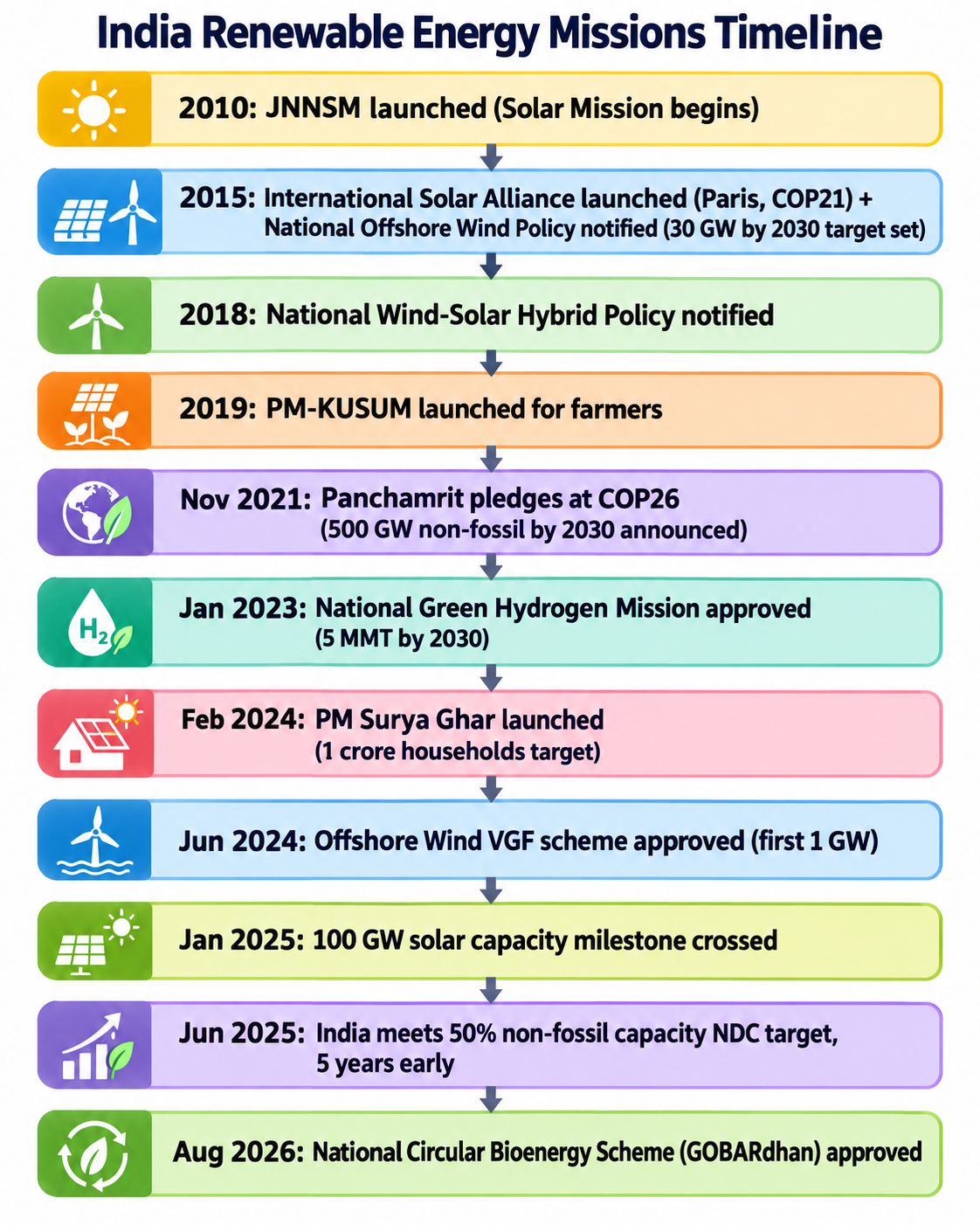
Diagram: the timeline above traces India's renewable energy missions from JNNSM (2010) to the National Circular Bioenergy Scheme (2026), exactly as listed in the Quick Timeline below.
1. Solar Energy Missions: From JNNSM to 280 GW
Jawaharlal Nehru National Solar Mission (JNNSM) - Launched 11 January 2010; rolled out in three phases - Phase I (2010-13): 1,100 MW, Phase II (2013-17): 10 GW, Phase III (2017-22): originally 20 GW, revised upward to 100 GW in December 2015.
Mnemonic Hook: "Jan 2010, Jan-uary" - JNNSM was born in January, the same month as Nehru's own mission-naming legacy.
Link: The 100 GW solar target was actually achieved only on 31 January 2025 - a full decade after the mission's revision.
International Solar Alliance (ISA) - Launched by India and France on 30 November 2015 at the COP21 Paris summit; headquartered at Gurugram, Haryana; a treaty-based international body of solar-rich countries, NOT a domestic scheme.
Mnemonic Hook: "ISA = International, so it needs an International city (Paris) and a foreign co-founder (France)."
Link: Aspirants frequently confuse ISA (an inter-governmental organisation) with JNNSM (a purely domestic mission) because both have "Solar" in the name and both trace to roughly the same decade.
280 GW by 2030 - Solar is the single largest component of India's 500 GW non-fossil target for 2030; installed solar capacity stood at 164.59 GW, already the largest non-fossil source, ahead of wind.
Mnemonic Hook: "Solar alone is roughly half of 500" - solar's 2030 share is designed to be close to half the entire non-fossil capacity target.
Link: Compare with wind's much smaller 2030 share in the next section.
2. Wind Energy: Onshore Push, Offshore Promise
National Wind-Solar Hybrid Policy - Notified in May 2018 by the Ministry of New and Renewable Energy (MNRE); promotes large grid-connected wind-solar hybrid systems at the same site to reduce variability and improve grid stability; conceived within the since-superseded 2015 target of 175 GW renewable capacity by 2022 (100 GW solar + 60 GW wind + 15 GW biomass/small-hydro).
Mnemonic Hook: "2018 Hybrid combines 2015's twin targets (100+60) on one site."
Link: The 175 GW-by-2022 figure is the historical ancestor of today's 500 GW-by-2030 figure - don't let an exam question's base year trick you into mixing the two.
National Offshore Wind Energy Policy - Notified in 2015; sets a target of 30 GW offshore wind capacity by 2030, concentrated off the Gujarat and Tamil Nadu coasts.
Mnemonic Hook: "Offshore = off by a decade" - the policy is from 2015 but its target year is 2030, a 15-year runway.
Link: No offshore wind project has yet commenced generation, which is why a dedicated funding push followed.
Offshore Wind VGF Scheme - A ₹7,453 crore Viability Gap Funding scheme approved by the Union Cabinet on 19 June 2024 to support India's first 1 GW of offshore wind projects.
Mnemonic Hook: "VGF 2024 kickstarts just 1 GW - a toe in the water, not the full 30 GW target."
Link: Installed onshore wind capacity itself stands at 58.14 GW - don't confuse this already-built onshore figure with the still-unbuilt 30 GW offshore target.
3. Green Hydrogen and Bioenergy Missions
National Green Hydrogen Mission - Approved by the Union Cabinet on 4 January 2023 with an initial outlay of ₹19,744 crore up to FY 2029-30; targets at least 5 MMT (million metric tonnes) of green hydrogen production capacity annually by 2030, backed by roughly 125 GW of additional renewable capacity.
Mnemonic Hook: "Three signature figures travel together: ₹19,744 crore, 5 MMT, 125 GW."
Link: This is India's newest (2023) big-ticket energy mission - don't confuse its ₹19,744 crore outlay with PM Surya Ghar's much larger ₹75,021 crore allocation in section 4.
National Circular Bioenergy Scheme (GOBARdhan) - Approved in August 2026 with a ₹23,731 crore outlay over ten years (FY 2026-27 to FY 2035-36); focuses on organic/cattle-waste management and bio-CNG production, distinct from hydrogen, which uses electrolysis of water rather than organic waste.
Mnemonic Hook: "GOBARdhan = GOBAR (cattle dung) + dhan (wealth) - waste into wealth, not water into hydrogen."
Link: Don't mix this up with the Green Hydrogen Mission just because both are "clean fuel" missions - one runs on dung and crop residue, the other on electrolysed water.
4. Farmer and Household Solar Schemes
PM-KUSUM (Pradhan Mantri Kisan Urja Suraksha evam Utthaan Mahabhiyan) - Launched in 2019 for farmers, with three components: Component A (small solar power plants on barren/fallow land), Component B (standalone solar-powered irrigation pumps), and Component C (solarisation of existing grid-connected agricultural pumps/feeders); central allocation ₹34,422 crore; deadline extended to March 2027, with a KUSUM 2.0 framework under development.
Mnemonic Hook: "KUSUM is for the Kisan - A for plants on land, B for pumps off-grid, C for Connecting existing pumps to solar."
Link: Compare directly with PM Surya Ghar below - KUSUM is farm/irrigation-focused, Surya Ghar is household/rooftop-focused.
PM Surya Ghar: Muft Bijli Yojana - Launched February 2024 for residential rooftop solar; central subsidy up to ₹78,000 per household; central outlay ₹75,021 crore; target of 1 crore (10 million) households solarised by the end of FY 2026-27; backed additionally by an 890-million-USD World Bank loan.
Mnemonic Hook: "Surya Ghar = Sun at Home - a rooftop scheme for your Ghar giving you Muft (free) units, unlike KUSUM's farm focus."
Link: Its ₹75,021 crore outlay dwarfs the Green Hydrogen Mission's ₹19,744 crore - an easy numbers trap if you don't anchor each figure to its scheme name.
Quick Timeline/Flowchart
2010: JNNSM launched (Solar Mission begins)
↓
2015: International Solar Alliance launched (Paris, COP21) + National Offshore Wind Policy notified (30 GW by 2030 target set)
↓
2018: National Wind-Solar Hybrid Policy notified
↓
2019: PM-KUSUM launched for farmers
↓
Nov 2021: Panchamrit pledges at COP26 (500 GW non-fossil by 2030 announced)
↓
Jan 2023: National Green Hydrogen Mission approved (5 MMT by 2030)
↓
Feb 2024: PM Surya Ghar launched (1 crore households target)
↓
Jun 2024: Offshore Wind VGF scheme approved (first 1 GW)
↓
Jan 2025: 100 GW solar capacity milestone crossed
↓
Jun 2025: India meets 50% non-fossil capacity NDC target, 5 years early
↓
Aug 2026: National Circular Bioenergy Scheme (GOBARdhan) approved
Quick Revision List
JNNSM (2010, domestic mission) is not the same as ISA (2015, international body, HQ Gurugram) - different animals despite both having "Solar" in the name.
Solar target escalated: 20 GW (2010 original) → 100 GW (2015 revision, achieved Jan 2025) → roughly 280 GW (2030, within the 500 GW non-fossil goal).
Panchamrit (COP26, Nov 2021) gave India its headline 2030 numbers: 500 GW non-fossil capacity, 50% renewable energy share, 1 billion tonnes emissions cut, 45% carbon-intensity cut, and net-zero by 2070.
PM-KUSUM (2019) is farmer/irrigation-focused; PM Surya Ghar (2024) is household rooftop-focused - do not swap their target groups.
Offshore wind has a 30 GW-by-2030 target (2015 policy) but only a 1 GW pilot is currently funded (2024 VGF scheme) - target and on-ground progress are two different figures.
Green Hydrogen Mission (₹19,744 crore, 2023) targets fuel from electrolysis; the Bioenergy Scheme/GOBARdhan (₹23,731 crore, 2026) targets fuel from organic waste - both are "clean fuel" missions but run on entirely different inputs.
Common Confusion Traps
JNNSM vs ISA: JNNSM (2010) is India's own domestic solar mission; the International Solar Alliance (2015) is a separate treaty-based multilateral organisation India co-founded with France. An option naming "ISA" as "India's national solar scheme" is a trap.
175 GW (2022) vs 500 GW (2030): The 175 GW renewable-by-2022 target (2015, underlying the Wind-Solar Hybrid Policy) is an older, since-superseded figure; 500 GW non-fossil-by-2030 is the current Panchamrit figure. Don't quote the older number as today's target.
PM-KUSUM vs PM Surya Ghar: Both are solar subsidy schemes but for different beneficiaries - KUSUM for farmers/irrigation (2019), Surya Ghar for residential rooftops (2024). Watch for questions that swap their launch years or target groups.
Offshore wind target vs funded pilot: The 30 GW offshore wind target (2015 policy, for 2030) is often mistaken for an achieved or fully-funded figure; only the first 1 GW has viability-gap funding (2024), and no project has yet begun generation.
Green Hydrogen Mission vs GOBARdhan/Bioenergy Scheme: Both are "clean fuel" missions with similar-sounding crore figures (₹19,744 crore vs ₹23,731 crore) but one is electrolysis-based hydrogen (2023), the other is organic-waste-based bio-CNG (2026) - don't let the similar outlay figures or "clean energy" framing merge them in your memory.
💭 Conclusion
If you remember one anchor fact, make it this: India's 500 GW non-fossil-by-2030 pledge from the 2021 Panchamrit is the umbrella target, and every other mission above - solar, wind, hydrogen, bioenergy - is simply one load-bearing pillar under that single roof.