
Solar vs Lunar Eclipses: Geometry and Shadows — A Visual Explainer
Compare solar and lunar alignments with an original labelled diagram.
Remember new Moon vs full Moon, umbra vs penumbra vs antumbra, and why eclipses are not monthly.
📌 Revision Pointers
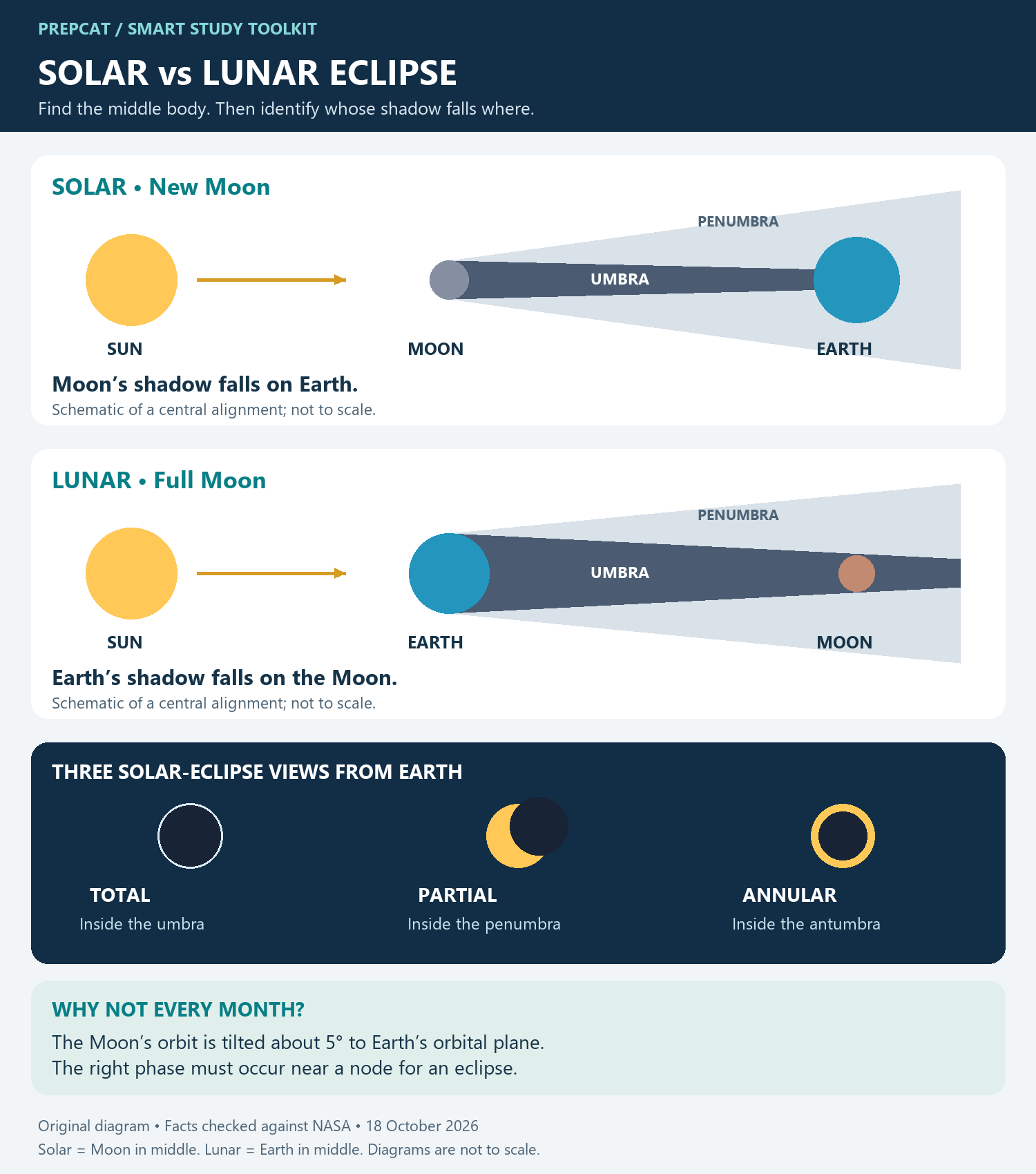
Solar: Moon in the middle; new Moon.
Lunar: Earth in the middle; full Moon.
Solar viewing zones: umbra → total; penumbra → partial; antumbra → annular.
Alignment: phase plus proximity to a node; orbit tilted about 5°.
Core Concept: Who Is in the Middle?
Solar eclipse: Sun → Moon → Earth. The Moon blocks some or all of the Sun for an observer on Earth. It requires a new Moon.
Lunar eclipse: Sun → Earth → Moon. The Moon passes through Earth’s shadow. It requires a full Moon.
Open the full-resolution eclipse diagram.
Diagram is schematic: sizes, distances and shadow angles are not to scale. The two alignment rows illustrate central eclipses.
Read the Shadows
Umbra: the dark central shadow, where the light source is completely hidden. On Earth, an observer in the Moon’s umbra sees a total solar eclipse.
Penumbra: only part of the Sun is blocked. An observer in the Moon’s penumbra sees a partial solar eclipse.
Antumbra: the region beyond the tip of the umbra. When it reaches Earth, the Moon appears too small to cover the entire Sun; observers in that region see an annular eclipse.
Why Does an Eclipse Not Occur Every Month?
The Moon’s orbital plane is tilted by about 5° relative to Earth’s orbital plane around the Sun. The two intersection points are called nodes. Most new or full Moons pass above or below the alignment needed for an eclipse. The appropriate phase must occur near a node.
Lunar Types: A Different Classification
In a total lunar eclipse, the entire Moon enters Earth’s umbra; in a partial one, only part enters it. A penumbral lunar eclipse involves Earth’s penumbra without entry into the umbra. A totally eclipsed Moon can appear reddish because sunlight reaching it through Earth’s atmosphere is filtered and refracted.
Memory Hook and Common Traps
Name the object that looks eclipsed: Sun in a solar eclipse; Moon in a lunar eclipse.
Phase is necessary, not sufficient: not every new Moon produces a solar eclipse.
Annular is not annual: it describes a ring, not a yearly frequency.
Visibility differs: total solar eclipses have a narrow ground track; a lunar eclipse can be seen across the night side where the Moon is above the horizon.
Quick Self-Check
1. Earth is the middle body and the Moon enters its umbra. Which eclipse and phase? Answer: lunar eclipse; full Moon.
2. An observer sees a ring of sunlight around the Moon. Umbra or antumbra? Answer: antumbra; annular solar eclipse.
Viewing note: never look directly at the Sun without suitable solar-viewing protection. Ordinary sunglasses are not solar filters.
Sources
NASA: eclipse geometry; NASA: shadow terminology; NASA: lunar eclipse types.
💭 Conclusion
Start with the middle body, then identify the shadow and observer. This method separates eclipse geometry from the appearance of the Sun or Moon and prevents the most common phase and shadow mix-ups.