
Spring vs Neap Tides: Moon Phases and Tidal Range — A Visual Explainer
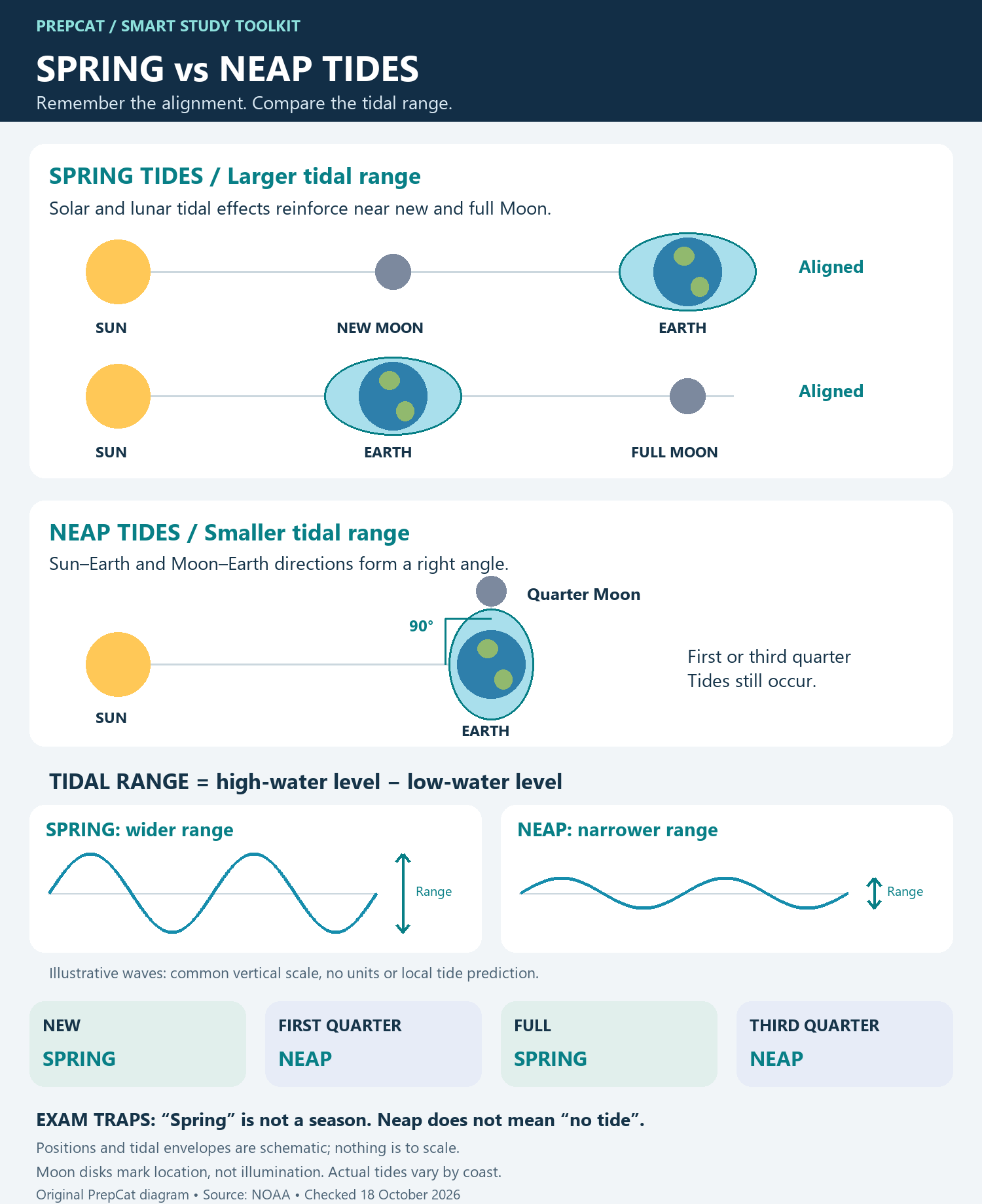
An original diagram explains new-Moon and full-Moon alignments, quarter-Moon geometry and tidal range.
Includes a phase-cycle memory hook, worked example and two quick checks.
📌 Revision Pointers
Spring: new and full Moon; larger tidal range.
Neap: first and third quarters; smaller range, not zero tides.
Range: high-water level minus low-water level, using the same datum.
Local timing: actual tide times and ranges depend on the coast and can lag lunar phases.
Core Concept: Compare the Range, Not Just High Tide
Tidal range is the vertical difference between a high-water level and the corresponding low-water level. Spring and neap tides describe a recurring change in this range.
Open the full-resolution labelled diagram.
Spring Tides: Aligned Bodies, Larger Range
Near new Moon, the order is Sun → Moon → Earth. Near full Moon, it is Sun → Earth → Moon. In both configurations the solar and lunar tidal effects reinforce. High tides tend to be higher and low tides lower, producing a larger range.
Neap Tides: Right-Angle Directions, Smaller Range
Near the first and third quarters, the Moon–Earth direction is approximately perpendicular to the Sun–Earth direction. Solar and lunar tidal effects partly counteract, so the tidal range is smaller. They do not cancel completely: tides still occur.
Read the Diagram Correctly
The pale-blue envelopes around Earth illustrate a simplified tidal response, not literal coastlines or real ocean heights. The waves compare ranges on the same illustrative vertical scale; they are not a forecast. The Sun, Moon, bulges and distances are not drawn to scale.
Worked Example
Suppose a hypothetical coast has high water at 4.0 m and low water at 0.5 m during a spring-tide period: its range is 3.5 m. If high water is 3.0 m and low water 1.5 m during a neap period, the range is 1.5 m. Compare levels measured against the same reference datum.
Memory Hook
“Straight → Spring; Square → Smaller.” A straight alignment gives spring tides; right-angle directions give the smaller neap range. Follow the cycle: new → first quarter → full → third quarter, or spring → neap → spring → neap.
Common Traps
Spring is not seasonal: spring tides occur throughout the year, around both new and full Moons.
Neap is not no tide: it means a smaller tidal range.
Full Moon is not cancellation: the Sun and Moon lie on opposite sides, yet their tidal effects reinforce.
Local conditions matter: basin shape, depth and weather influence actual water levels. Maximum range can lag the relevant lunar phase; use a local tide table for actual times.
Quick Self-Check
1. Sun–Earth–Moon are aligned at full Moon. Spring or neap? Answer: spring; larger tidal range.
2. Does a first-quarter Moon mean that high and low tide stop? Answer: no; neap tides have a smaller range.
Sources
NOAA: spring and neap tides; NOAA: position and tidal variation; NOAA: idealised tidal envelopes and real-ocean limitations.
💭 Conclusion
Use the Sun–Earth–Moon geometry to predict whether tidal effects reinforce or partly counteract, then compare the high-to-low range. Keep the idealised diagram separate from actual local water levels and tide times.