
Temperature Inversion: Why Winter Air Traps Pollution — A Visual Explainer
See how temperature changes with height in normal and inverted profiles.
Follow clear-night surface cooling and its effect on pollutant dispersion.
Connect winter stagnation in India with mixing height and ventilation.
📌 Revision Pointers
Definition: temperature rises with height within the inversion layer.
Surface mechanism: clear, calm, long nights favour ground cooling.
Pollution: reduced dilution can increase concentration without increasing emissions.
Ventilation: mean wind speed × mixing height in the cited CPCB formulation.
Trap: an inversion is neither a solid lid nor global warming.
Temperature Inversion: Read the Atmosphere from the Ground Up
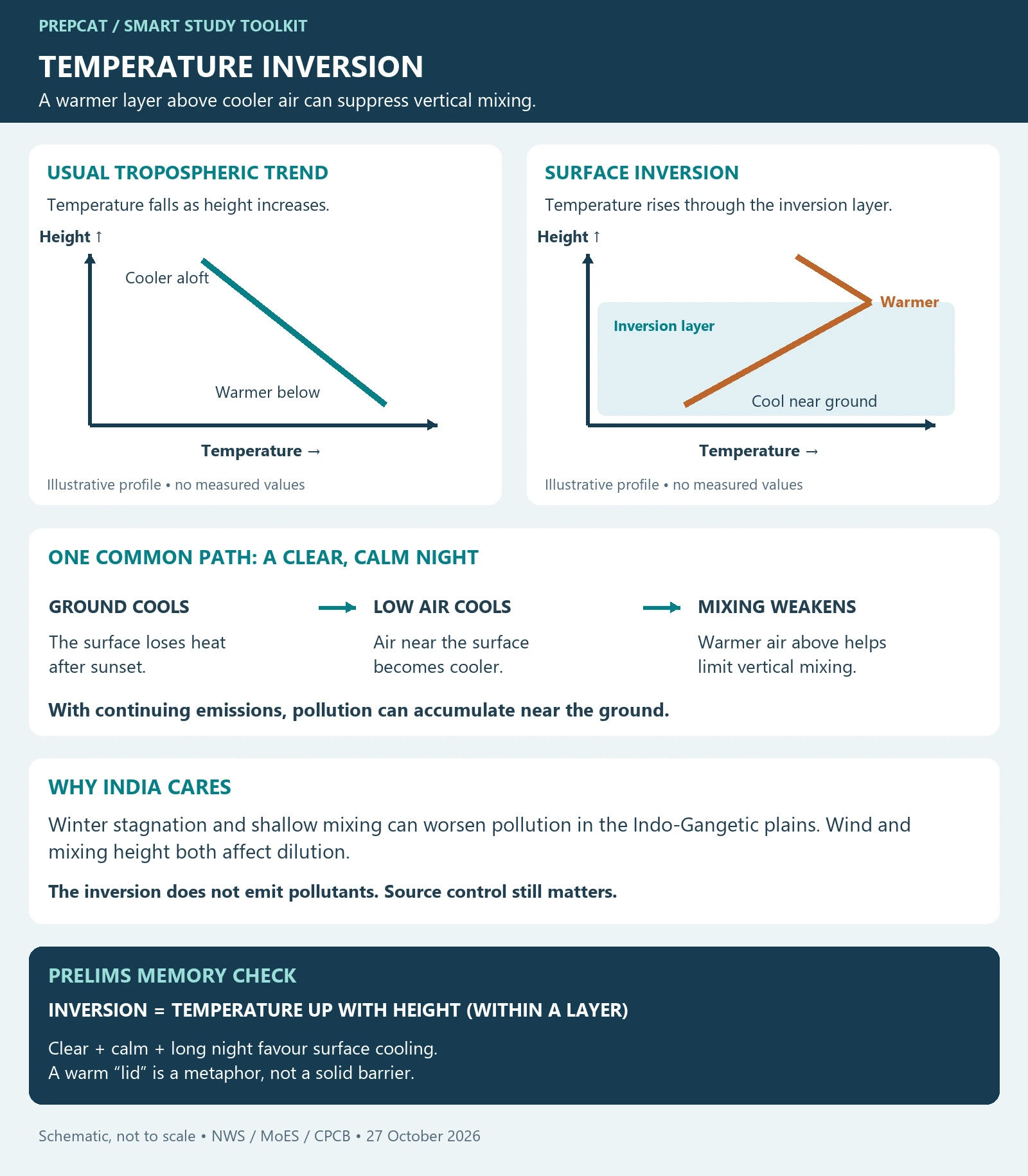
Basic concept: An inversion is an atmospheric layer in which temperature increases with height. It reverses the usual downward temperature trend through the troposphere. The change applies within that layer, not necessarily to the entire atmosphere.
Read the visual: On each profile, height increases upwards and temperature increases to the right. A line leaning right as it rises marks an inversion. The profiles are schematic, with no measured temperatures or heights.
How a Surface Inversion Forms
After sunset, the ground loses heat and cools the air close to it. On clear, calm nights, a cooler near-surface layer can develop beneath warmer air. Long nights favour this cooling. This is one formation mechanism; warmer air moving over cooler air can also produce an inversion.
Why mixing weakens: A parcel displaced upward within an inversion encounters warmer surrounding air, which discourages further buoyant rise. “Warm lid” is a useful memory image, but air is not sealed under a solid roof.
From Weather to Air Pollution
When emissions continue while vertical mixing is weak, pollutants can accumulate in a smaller near-surface air volume. An inversion changes dispersion; it does not manufacture the emissions. Pollutant concentrations also depend on sources, transport, chemistry and removal. A downward temperature trend alone does not guarantee vigorous mixing.
Illustrative example: Imagine two mornings with similar emissions, but weaker wind and a shallower mixing layer on the second. Less dilution can allow higher near-surface concentrations. This is a teaching comparison, not an air-quality forecast.
India and UPSC Relevance
The Ministry of Earth Sciences identifies calm winds, stable winter conditions and low mixing height as factors worsening pollution, particularly in the Indo-Gangetic plains. CPCB also describes shallow mixing and calm conditions during the post-monsoon and winter seasons.
Ventilation coefficient: In the CPCB report's formulation, it is mean wind speed multiplied by mixing height. It combines horizontal transport with the vertical depth available for dilution. Lower ventilation generally means poorer dispersal; it is not a measure of how much pollution sources emit.
This connects GS1 climatology with GS3 environmental pollution. In a Mains answer, separate emission sources from meteorological conditions, explain their interaction, and then discuss source controls rather than blaming weather alone.
Common Confusion Traps
Layer versus planet: A local inversion is not the same as long-term global warming.
Emissions versus concentration: Unchanged emissions can produce different concentrations under different weather.
One mechanism versus all: Clear-night surface cooling is one way an inversion forms, not the only way.
Trend versus mixing: Temperature decreasing with height does not, by itself, prove an unstable atmosphere.
Quick Self-Check
Q1. Within an inversion, does temperature rise or fall with height?
Answer: It rises.
Q2. Does an inversion itself emit PM2.5?
Answer: No. It can inhibit dispersion of pollution released or formed in the air.
Q3. Consider two statements: (1) Clear, calm nights favour radiative surface inversions. (2) Lower mixing height always means lower emissions. Which is correct?
Answer: Statement 1 only. Mixing height concerns dilution, not the amount emitted.
Sources for Further Reading
💭 Conclusion
Read an inversion as a vertical temperature pattern that can restrict mixing. Combining that pattern with emissions, wind and mixing height explains why winter pollution can intensify. The most useful exam habit is to distinguish the source of a pollutant from the weather controlling its dispersion.