
Current Affairs — 25 October 2026
RBI facilities: resilient banking needs infrastructure and skills
Farmer ID milestone and digital agricultural services
CCPA: material disclosures in walkie-talkie advertisements
National Urban Conclave: empower cities and measure services
Indigenous submarine AIP: development milestone versus deployment
AI and alternative proteins: Hack the Fork
Operation Trident: disrupting drug networks and illicit finance
India–South Korea maritime cooperation and shipbuilding
Victoria Mode and India’s shifting climate zones
Coral recovery experiments: promising science with limits
TUMAINI trial and evidence against Bundibugyo Ebola
IMC Gaya: industrial corridors and implementation institutions
75 years since polling began in the first general election
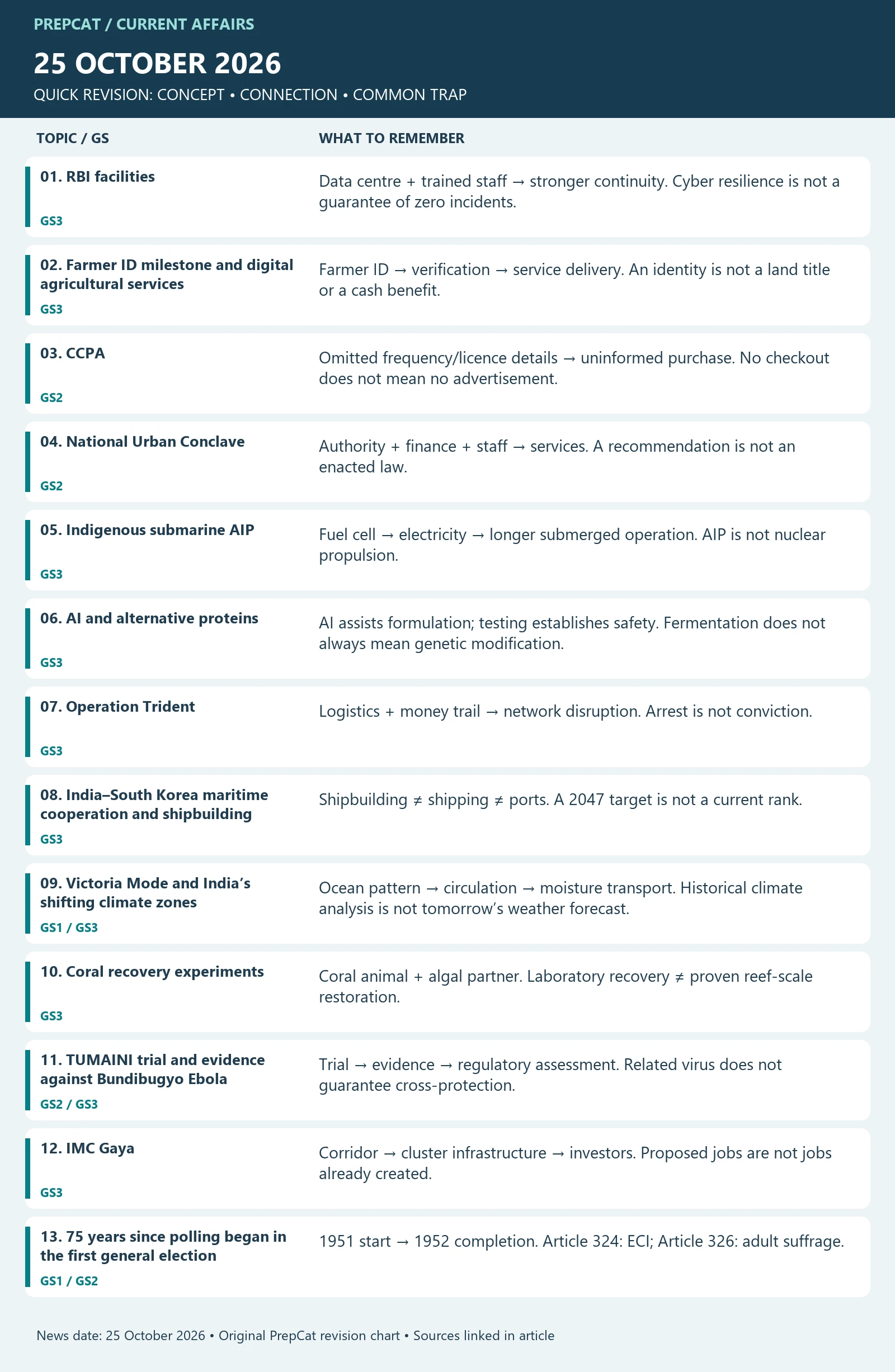
📌 Revision Pointers
RBI facilities: Bhubaneswar: data infrastructure plus cybersecurity training; operational disruption is different from insolvency.
Farmer ID milestone and digital agricultural services: 11 crore IDs is a registry milestone, not a new payment announcement or automatic proof of ownership.
CCPA: CCPA: omission can mislead; website promotion can qualify as advertising without online checkout.
National Urban Conclave: Conclave recommendations are not enacted municipal law; treated-water reuse links urban services with circularity.
Indigenous submarine AIP: AIP supports submerged endurance; testing, integration and operational deployment are separate stages.
AI and alternative proteins: NIFTEM-K, Kundli: AI applied to food systems; prototype success does not establish safety or regulatory approval.
Operation Trident: Release date: 25 October; operation date: 23 October. Follow financial links, not only seized quantities.
India–South Korea maritime cooperation and shipbuilding: Busan: maritime industry; top-five by 2047 is an ambition, not an achieved ranking.
Victoria Mode and India’s shifting climate zones: North Pacific Victoria Mode; historical data 1951–2020; climate-zone shifts are not a district-level desertification forecast.
Coral recovery experiments: Bleached does not necessarily mean dead; laboratory recovery is not a proven reef-scale solution.
TUMAINI trial and evidence against Bundibugyo Ebola: Bunia, DRC; Bundibugyo is distinct from Zaire Ebola; a trial launch is not approval or demonstrated protection.
IMC Gaya: Gaya → Bihar → Amritsar–Kolkata Industrial Corridor; MoU value is not realised investment.
75 years since polling began in the first general election: 25 October 1951: polling began; election cycle 1951–52. Distinguish Articles 324 and 326.
Revision guide: Read the chart for recall, then use the concept notes and practice questions. Dates below distinguish the news report from the underlying event; proposals and research findings are labelled accordingly.
1. RBI facilities: resilient banking needs infrastructure and skills (GS3)
Basic Concept: Operational resilience means keeping essential financial services functioning during disruptions and restoring them safely afterwards. Backup capacity and trained staff address different vulnerabilities.
Core Context: Banking depends on interconnected data, communication and payment systems. A cyber incident can interrupt services even when a bank remains financially solvent; cybersecurity therefore matters for financial stability.
Latest Developments: On 25 October, the RBI Data Centre and Cybersecurity Training Institute were inaugurated in Bhubaneswar, Odisha. The facilities aim to strengthen digital infrastructure and the financial sector’s ability to respond to cyber threats.
UPSC Prelims Pointers: RBI is India’s central bank. Cybersecurity concerns confidentiality, integrity and availability; availability means legitimate users can obtain services when needed.
Sources: PIB, 25 October; Governor’s interview, 25 October.
2. Farmer ID milestone and digital agricultural services (GS3)
Basic Concept: A Farmer ID is a unique digital identity used to connect verified farmer information with agricultural services. A registry is an information system, not a cash-transfer scheme.
Core Context: Repeated verification can delay credit, insurance and relief. Reliable records can reduce duplication, but correction facilities, privacy safeguards and inclusion of actual cultivators remain important.
Latest Developments: The Agriculture Ministry’s 24 October release, carried in the 25 October news cycle, reported 11 crore Farmer IDs completed by the night of 23 October, ahead of the 31 March 2027 target. The initiative operates under the Digital Agriculture Mission.
UPSC Prelims Pointers: Do not equate IDs created with cash beneficiaries or land titles. The ministry says states and UTs are taking steps, subject to applicable rules, to include tenants and actual cultivators.
Sources: Agriculture Ministry, 24 October; Parliament: registry architecture and target.
3. CCPA: material disclosures in walkie-talkie advertisements (GS2)
Basic Concept: A misleading advertisement can deceive by omitting important information as well as by making a false statement. Buyers need to know conditions affecting lawful use.
Core Context: Wireless devices may be subject to frequency, licensing and approval requirements. A seller’s regulatory approvals do not replace clear information for a buyer.
Latest Developments: On 25 October, CCPA announced action against walkie-talkie advertisements that omitted essential regulatory details. It also clarified that promotional claims on a website can be examined even if the site has no shopping cart.
UPSC Prelims Pointers: CCPA acts under the Consumer Protection Act, 2019. The cited 2018 exemption covers personal mobile radios in 446.0–446.2 MHz only subject to applicable conditions; it does not exempt every walkie-talkie.
Sources: Consumer Affairs Ministry, 25 October; CCPA official portal.
4. National Urban Conclave: empower cities and measure services (GS2)
Basic Concept: Urban decentralisation gives local institutions authority, finance and staff to manage city services. Building an asset is different from delivering a reliable service.
Core Context: Water, housing, walking access and waste management require coordination across municipal and state agencies. Infrastructure must be maintained after construction.
Latest Developments: The Conclave concluded in Bhubaneswar on 25 October. Recommendations included stronger municipal autonomy, integrated planning and outcome-based service delivery. A Used Water Marketplace under AMRUT 2.0 was launched to connect treated-water suppliers and potential users.
UPSC Prelims Pointers: Recommendations for empowered mayors and revised municipal laws are proposals requiring further action, not a nationwide legal change already in force. AMRUT concerns urban infrastructure.
Sources: Housing and Urban Affairs Ministry, 25 October; NITI Aayog address, 25 October.
5. Indigenous submarine AIP: development milestone versus deployment (GS3)
Basic Concept: Air-independent propulsion enables a conventional submarine to generate power underwater without drawing atmospheric air for that process. It improves submerged endurance.
Core Context: A diesel-electric submarine ordinarily uses batteries underwater and must obtain air when running its diesel engines. Fuel-cell AIP can reduce the need to surface or snorkel, within its design limits.
Latest Developments: The Defence Ministry’s 24 October announcement, in the 25 October news cycle, reported inauguration of Setting to Work Phase-2 activity for the indigenous AIP system. This is a development and testing milestone; it should not be described as completed operational deployment.
UPSC Prelims Pointers: DRDO’s programme uses phosphoric-acid fuel-cell technology. A fuel cell converts chemical energy into electricity; AIP does not turn a conventional submarine into a nuclear-powered vessel.
Sources: Defence Ministry milestone, 24 October; Parliament: fuel-cell technology background.
6. AI and alternative proteins: Hack the Fork (GS3)
Basic Concept: Alternative proteins can be produced using plant ingredients, microbial fermentation or other technologies. AI can help analyse formulations and production data; it does not replace food-safety testing.
Core Context: A new food must be evaluated for nutrition, safety, cost and acceptability. A successful prototype is an early step, not evidence that a product is approved or commercially viable.
Latest Developments: NIFTEM-K at Kundli hosted the AI × Food Tech hackathon “Hack the Fork” on 24–25 October. Teams explored alternative-protein applications, nutritional optimisation, food safety and waste reduction.
UPSC Prelims Pointers: NIFTEM-K expands to National Institute of Food Technology Entrepreneurship and Management, Kundli. Fermentation uses microorganisms or their enzymes; it is not synonymous with genetic modification.
Sources: Food Processing Industries Ministry, 25 October.
7. Operation Trident: disrupting drug networks and illicit finance (GS3)
Basic Concept: Network-focused enforcement investigates the people, routes and finances connecting an illicit supply chain. Financial investigation complements physical seizures.
Core Context: Cross-border drug trafficking can involve transport intermediaries and informal value-transfer networks. Coordination between central agencies and state police is needed across jurisdictions.
Latest Developments: A 25 October Home Ministry release described NCB-led Operation Trident, conducted on 23 October across Assam, Mizoram and Manipur with other enforcement agencies. The educational significance is the shift from seizure totals towards dismantling logistics and financial networks.
UPSC Prelims Pointers: NCB means Narcotics Control Bureau. ED investigates money-laundering matters within its mandate. An arrest or asset freeze is a procedural action, not a conviction.
Sources: Home Ministry, 25 October.
8. India–South Korea maritime cooperation and shipbuilding (GS3)
Basic Concept: Shipbuilding joins engineering, design, steel, equipment and skilled fabrication. Building a ship differs from operating a shipping service or managing a port.
Core Context: Maritime manufacturing can create supplier networks and technical employment, but competitiveness depends on productivity, finance, quality and delivery reliability.
Latest Developments: The Shipping Minister began a four-day South Korea visit on 25 October, opening engagements in Busan. The official release described cooperation in shipbuilding, shipping, ports and logistics under the VOYAGES framework and India’s ambition to be a top-five shipbuilding nation by 2047.
UPSC Prelims Pointers: Busan is in South Korea. The 2047 ranking is a policy goal, not India’s present rank. Diplomatic engagement does not itself establish completed investment or technology transfer.
Sources: Ports, Shipping and Waterways Ministry, 25 October.
9. Victoria Mode and India’s shifting climate zones (GS1 / GS3)
Basic Concept: A teleconnection links climate variations in distant regions. Climate classification uses long-term temperature and rainfall patterns, rather than weather on a single day.
Core Context: Victoria Mode is a North Pacific sea-surface-temperature pattern. Changes in ocean conditions can influence atmospheric circulation and moisture transport over distant land areas.
Latest Developments: A study highlighted in the 25 October news cycle, published in MAUSAM on 1 October, analysed Indian observations from 1951–2020. It identified shifts towards drier climate classes in parts of northern India and associated reduced moisture transport with the negative phase of Victoria Mode.
UPSC Prelims Pointers: Separate publication date from observation period. This is a historical analysis, not a forecast that every northern district will become desert. Victoria Mode and equatorial ENSO are distinct patterns.
Sources: Original MAUSAM study; NextIAS follow-up explainer.
10. Coral recovery experiments: promising science with limits (GS3)
Basic Concept: Corals are animals. Many reef-building corals host microscopic photosynthetic algae that supply energy. Stress can disrupt this partnership and cause bleaching.
Core Context: Bleaching does not always mean immediate coral death. Recovery depends on survival, the return of suitable symbionts and environmental conditions.
Latest Developments: Coral-recovery research featured in the 25 October science coverage. An October paper in Environmental Microbiology Reports tested fusion of genetically matching coral fragments with heat-evolved algae. It found local physiological recovery but also detected algal acquisition in unfused controls sharing the water.
UPSC Prelims Pointers: The experiment does not establish that tissue fusion alone caused all algal transfer, or that the method works at reef scale. Restoration research complements emission reduction and control of local stresses.
Sources: Original study abstract and experimental limits; 25 October science-news index.
11. TUMAINI trial and evidence against Bundibugyo Ebola (GS2 / GS3)
Basic Concept: A clinical trial tests safety and effectiveness under a research protocol. Protection against one related virus cannot simply be assumed against another.
Core Context: Ervebo is licensed against Ebola virus associated with the Zaire species. Its effectiveness against Bundibugyo requires evidence. Ring vaccination focuses on contacts at high risk around detected cases.
Latest Developments: The TUMAINI Phase 2/3 trial began enrolling participants in Bunia, Democratic Republic of the Congo, on 23 October and was covered in the 25 October news cycle. WHO described it as a trial of vaccine candidates against Bundibugyo virus.
UPSC Prelims Pointers: TUMAINI is a trial framework, not a declaration that a Bundibugyo vaccine is approved. WHO and CEPI support research; trial enrolment does not establish efficacy.
Sources: WHO, 23 October; CEPI trial design.
12. IMC Gaya: industrial corridors and implementation institutions (GS3)
Basic Concept: An industrial corridor connects production centres with transport and support infrastructure. A special purpose vehicle is a dedicated organisation for implementing a project.
Core Context: Industrial clusters need reliable roads, power, water and clearances. Announced investment intentions must be distinguished from realised production and employment.
Latest Developments: The formal launch of Bihar Integrated Manufacturing City Gaya Limited was announced on 24 October and reported in the 25 October cycle. It is the implementing SPV for the Integrated Manufacturing Cluster at Gaya under the Amritsar–Kolkata Industrial Corridor. Infrastructure construction was reported as underway.
UPSC Prelims Pointers: Gaya is in Bihar; AKIC means Amritsar–Kolkata Industrial Corridor. Investor MoUs and employment potential are commitments or estimates, not completed investments and jobs.
Sources: Commerce and Industry Ministry, 24 October.
13. 75 years since polling began in the first general election (GS1 / GS2)
Basic Concept: Universal adult suffrage bases electoral participation on citizenship and the legal voting age, rather than wealth, education or social status.
Core Context: India’s first general election was a major administrative exercise conducted over several months in 1951–52. Different regions voted at different times.
Latest Developments: 25 October 2026 marked 75 years since polling began on 25 October 1951. ECI’s election atlas confirms that starting date. The anniversary offers a useful link between post-independence history, electoral administration and inclusive institutions.
UPSC Prelims Pointers: The first election began in 1951, not 1952 alone. Voting age was initially 21; the 61st Constitutional Amendment reduced it to 18. Article 324 concerns ECI; Article 326 concerns adult suffrage.
Sources: Election Commission atlas.
Practice MCQs
Original practice questions based on this roundup; these are not previous-year UPSC questions.
Q1. With reference to Farmer IDs, consider the following statements:
A Farmer ID is intended to support verification for agricultural services.
Creation of a Farmer ID automatically transfers ownership of agricultural land.
Which of the statements given above is/are correct?
(A) 1 only
(B) 2 only
(C) Both 1 and 2
(D) Neither 1 nor 2
Answer: (A) 1 only
Explanation: The registry supports service delivery. An identity record does not automatically convey land ownership.
Q2. With reference to submarine AIP, consider the following statements:
Fuel-cell AIP produces electricity through an electrochemical process.
AIP necessarily makes a submarine nuclear-powered.
Which of the statements given above is/are correct?
(A) 1 only
(B) 2 only
(C) Both 1 and 2
(D) Neither 1 nor 2
Answer: (A) 1 only
Explanation: Fuel cells convert chemical energy into electricity. Air-independent propulsion and nuclear propulsion are different technologies.
Q3. Consider the following statements about the National Urban Conclave:
Its recommendations automatically amend every state’s municipal law.
Reliable service delivery requires operation and maintenance after assets are built.
Which of the statements given above is/are correct?
(A) 1 only
(B) 2 only
(C) Both 1 and 2
(D) Neither 1 nor 2
Answer: (B) 2 only
Explanation: Recommendations require further action through the relevant institutions. Creating infrastructure alone does not ensure continued service.
Q4. Consider the following statements about coral bleaching:
Reef-building corals are plants.
Bleached corals may survive and recover under suitable conditions.
Laboratory recovery by itself proves that restoration will succeed at reef scale.
Which of the statements given above is/are correct?
(A) 1 and 2 only
(B) 2 only
(C) 2 and 3 only
(D) 1, 2 and 3
Answer: (B) 2 only
Explanation: Corals are animals. Bleaching can be reversible, but survival is not assured. Controlled experiments do not establish field-scale effectiveness.
Q5. With reference to Victoria Mode, consider the following statements:
It is associated with sea-surface-temperature variations in the North Pacific.
A study using observations from 1951–2020 is necessarily a daily weather forecast for October 2026.
Which of the statements given above is/are correct?
(A) 1 only
(B) 2 only
(C) Both 1 and 2
(D) Neither 1 nor 2
Answer: (A) 1 only
Explanation: Victoria Mode is a North Pacific pattern. Historical climate classification and short-range weather forecasting answer different questions.
Q6. Consider the following statements about TUMAINI:
It is a clinical trial framework assessing vaccine candidates against Bundibugyo virus.
Starting the trial establishes that all candidates are already approved and effective.
Which of the statements given above is/are correct?
(A) 1 only
(B) 2 only
(C) Both 1 and 2
(D) Neither 1 nor 2
Answer: (A) 1 only
Explanation: A trial generates evidence. Enrolment or administration in research does not establish regulatory approval or efficacy.
Q7. Consider the following statements about India’s first general election:
Polling began on 25 October 1951.
The first general election was completed everywhere on that same day.
Article 326 concerns elections based on adult suffrage.
Which of the statements given above is/are correct?
(A) 1 and 3 only
(B) 1 and 2 only
(C) 2 and 3 only
(D) 1, 2 and 3
Answer: (A) 1 and 3 only
Explanation: ECI records the start as 25 October 1951. Voting extended across the 1951–52 election cycle; Article 326 provides for adult suffrage.
💭 Conclusion
This edition connects the day’s developments with the underlying concepts needed for UPSC preparation. Revise institutions and mechanisms alongside the news, and distinguish announcements, proposals, research evidence and completed implementation. Use the chart for recall and the MCQs to check understanding.