
Current Affairs — 27 October 2026
Cyclone Arnab: preparedness and cascading disruption
E85/E100 rules: fuel certification and compatibility
DAC acquisition approvals: what Acceptance of Necessity means
Green propulsion: support for Manastu Space
ESTIC 2026: research must become tested solutions
CBD COP17: India’s statement on biodiversity implementation
Carbon capture, utilisation and storage: read the full chain
Gyan Bharatam and the Indo-French manuscript partnership
Srishti launched: shipbuilding milestones explained
DPIIT review: simpler regulation and single-window systems
State IIP revision: base years and comparable statistics
TRAI subscription data: connections are not unique people
NAMASTE: sanitation-worker safety and social protection
Balanced orchard nutrition: soil tests before inputs
BRICS Parliamentary Forum: from preview to joint declaration
Double-fortified salt: a nutrition-policy tool, not a cure-all
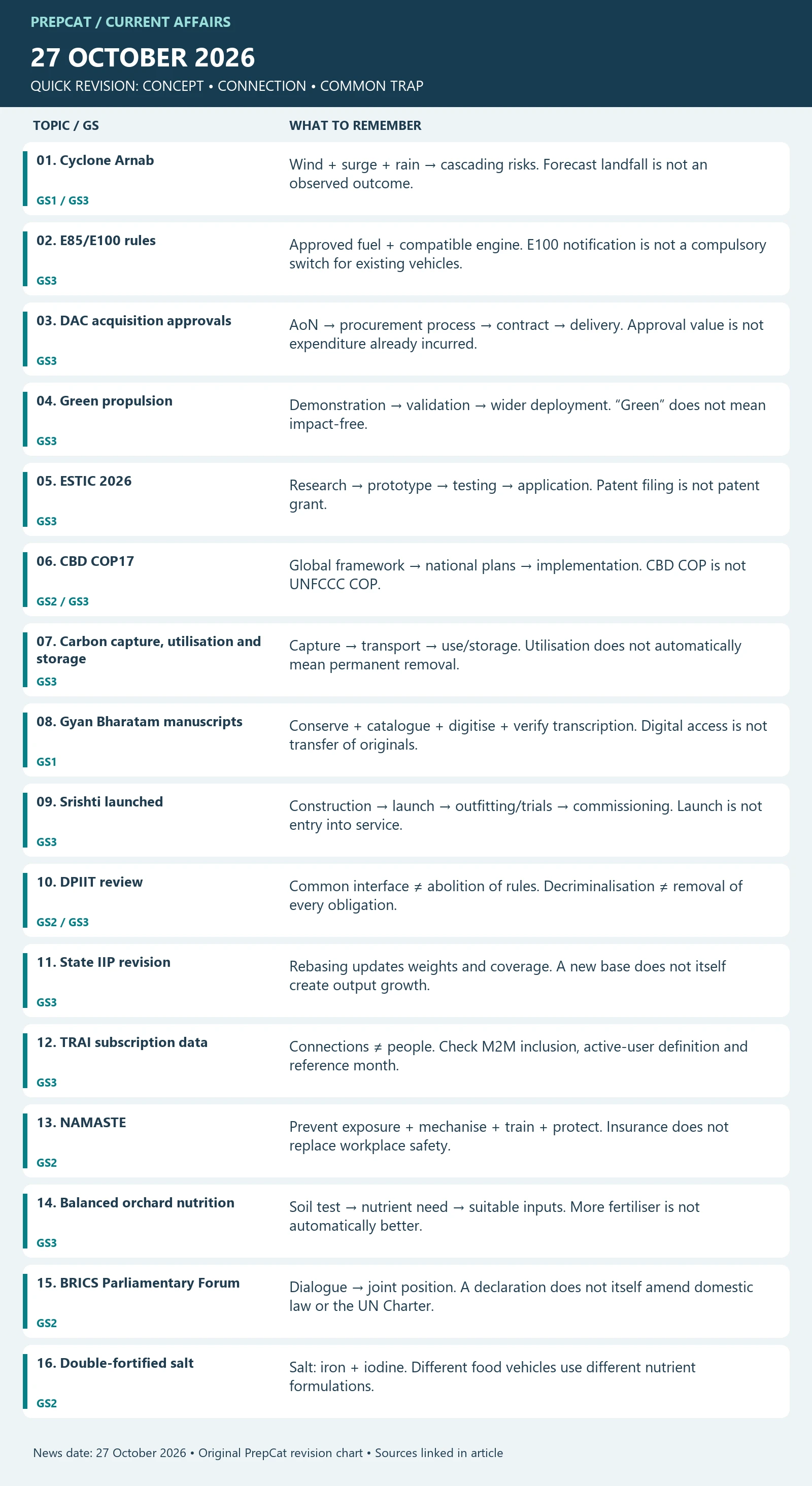
📌 Revision Pointers
Cyclone Arnab: 27 October report: preparedness and forecast; wind, surge and rain are distinct hazards.
E85/E100 rules: Certified flex-fuel vehicles only; E20 compatibility does not imply E100 compatibility.
DAC acquisition approvals: ₹2.12 lakh crore: estimated proposals at AoN stage; approval does not equal delivery.
Green propulsion: Hydrogen-peroxide-based propulsion; TRL-6 to TRL-9 is the programme objective, not a maturity level already reached.
ESTIC 2026: ESTIC: research, validation and application; AI-generated answers still require verification.
CBD COP17: Yerevan, Armenia; CBD is biodiversity. Distinguish national positions from negotiated COP outcomes.
Carbon capture, utilisation and storage: Capture, transport and durable storage are separate requirements; utilisation is not always permanent removal.
Gyan Bharatam and the Indo-French manuscript partnership: MoU signed 26 October, announced 27 October; digitisation complements physical conservation.
Srishti launched: Srishti: launched at Goa Shipyard on 27 October; launch is distinct from commissioning.
DPIIT review: NSWS simplifies the interface; it does not make every permission unnecessary or automatic.
State IIP revision: All-India base 2022–23; state workshop announced for 28–30 October. IIP measures output, not inflation.
TRAI subscription data: Reference month September; release October. Distinguish subscriptions, active connections and unique individuals.
NAMASTE: NAMASTE: mechanisation, safety and dignity. PPE provision and insurance are not proof of risk elimination.
Balanced orchard nutrition: Soil test + crop requirement + local conditions; balanced fertilisation does not mean equal nutrient doses.
BRICS Parliamentary Forum: 27 October: concluding declaration, a substantive update to the earlier preview; support for reform is not completed reform.
Double-fortified salt: Double-fortified salt = iron + iodine; fortification complements a broader nutrition response.
Revision guide: Read the chart for recall, then use the concept notes and practice questions. Dates below distinguish the news report from the underlying event; proposals and research findings are labelled accordingly.
1. Cyclone Arnab: preparedness and cascading disruption (GS1 / GS3)
Basic Concept: A tropical cyclone is an organised low-pressure system powered by heat and moisture over warm seas. Its hazards include wind, storm surge and heavy rainfall.
Core Context: A coastal storm can disrupt transport, power, communications and inland drainage. Risk depends on exposure and vulnerability as well as storm intensity.
Latest Developments: On 27 October, the Civil Aviation Ministry reviewed operational readiness using IMD inputs. Its late-evening release reported airport suspensions in coastal Andhra Pradesh and a forecast crossing of the Andhra Pradesh coast on 28 October. This is the forecast position as reported on the news date, not a later landfall outcome.
UPSC Prelims Pointers: A forecast track may change. Storm surge is an abnormal sea-level rise associated with a storm; it differs from rainfall flooding. Do not treat a forecast wind speed or cancellation estimate as a final observed total.
Sources: Civil Aviation Ministry, 27 October; Dated GDACS storm assessment.
2. E85/E100 rules: fuel certification and compatibility (GS3)
Basic Concept: Flex-fuel vehicles are designed to use an approved range of petrol–ethanol blends. Their materials and engine controls must suit those fuels.
Core Context: More ethanol can reduce crude-oil dependence, but environmental performance depends on feedstock, water use, production energy and vehicle performance.
Latest Developments: The 26 October MoRTH notification, reported in the 27 October news cycle, amended emission-certification provisions to expressly include E100 alongside E85. The ministry said existing vehicle owners are not required to switch or retrofit. Only vehicles designed and certified for these fuels should use them.
UPSC Prelims Pointers: E denotes ethanol. Compatibility with E10 or E20 does not establish compatibility with E85/E100. Fuel approval is different from a universal fuel mandate.
Sources: MoRTH, 26 October; 27 October newspaper headline sweep.
3. DAC acquisition approvals: what Acceptance of Necessity means (GS3)
Basic Concept: Capital acquisition adds long-lived defence equipment. Acceptance of Necessity (AoN) is an in-principle administrative approval at an early procurement stage.
Core Context: Approval, tendering, evaluation, contracting and delivery are separate steps. Approved estimated value is not the amount already spent or equipment already inducted.
Latest Developments: On 26 October, the Defence Acquisition Council approved proposals estimated at about ₹2.12 lakh crore, a major story in the 27 October papers. Proposals covered mobility, helicopters, air defence, unmanned systems and naval capabilities. The release indicated a large intended domestic-industry share.
UPSC Prelims Pointers: DAC is chaired by the Defence Minister. VSHORADS means Very Short-Range Air Defence System; counter-UAS systems address unmanned aerial threats. AoN is not a signed supply contract.
Sources: Defence Ministry, 26 October; 27 October cross-check of approval value.
4. Green propulsion: support for Manastu Space (GS3)
Basic Concept: Satellite propulsion changes a spacecraft’s motion or orientation. Chemical propulsion produces thrust through reactions; electric propulsion uses electrical energy to accelerate propellant.
Core Context: A technology demonstrated in space may still require engineering, integration and validation before wider commercial deployment. Technology Readiness Levels describe maturity rather than market success.
Latest Developments: A 26 October TDB–DST release, carried into the 27 October cycle, announced RDI support for Manastu Space’s scalable propulsion programme. It uses a hydrogen-peroxide-based propellant with additives and aims to advance from TRL-6 to TRL-9. The release distinguishes existing demonstration from further development.
UPSC Prelims Pointers: TDB means Technology Development Board; DST means Department of Science and Technology. “Green” is a comparative description, not proof of zero environmental impact or a non-chemical engine.
Sources: TDB–DST agreement, 26 October.
5. ESTIC 2026: research must become tested solutions (GS3)
Basic Concept: An innovation ecosystem connects research institutions, funding, entrepreneurs, industry and users. A discovery, prototype and dependable product are different stages.
Core Context: Research capacity includes skills and the ability to test, reproduce and scale results. AI assistance can speed work, while researchers remain responsible for checking evidence.
Latest Developments: The Emerging Science, Technology and Innovation Conclave was inaugurated at Bharat Mandapam, New Delhi, on 27 October. The official address emphasised critical technologies, research-to-application links, AI verification and measurable outcomes. This is an event and policy emphasis, not blanket approval of every exhibited technology.
UPSC Prelims Pointers: ESTIC expands to Emerging Science, Technology and Innovation Conclave. Distinguish a patent application from a granted patent, and a prototype from an operational product.
Sources: PMO official address, 27 October.
6. CBD COP17: India’s statement on biodiversity implementation (GS2 / GS3)
Basic Concept: The Convention on Biological Diversity addresses conservation, sustainable use and fair benefit-sharing from genetic resources. It is distinct from the UN climate convention.
Core Context: The Kunming–Montreal Global Biodiversity Framework sets global goals and targets. National plans, finance, capacity and monitoring determine how those ambitions are implemented.
Latest Developments: India delivered its national statement at the COP17 high-level segment in Yerevan, Armenia, on 27 October. It emphasised national circumstances, finance, technology transfer and science-based governance, and supported the multilateral benefit-sharing mechanism for digital sequence information, including the Cali Fund.
UPSC Prelims Pointers: CBD COP17 runs from 19–30 October 2026. Cartagena concerns biosafety; Nagoya concerns access and benefit-sharing. A national statement is not a final COP decision or a new global treaty.
Sources: Environment Ministry, 27 October; CBD official conference information.
7. Carbon capture, utilisation and storage: read the full chain (GS3)
Basic Concept: CCUS separates carbon dioxide, transports it and either uses it or stores it. Capture equipment alone does not complete the chain.
Core Context: Some industrial emissions arise from chemistry as well as energy use, making sectors such as cement difficult to decarbonise. Capture can complement other mitigation measures.
Latest Developments: A 27 October PIB backgrounder revisited CCUS in the context of India’s industrial transition and ESTIC. It described source capture, transport, utilisation, geological storage and shared hubs. This is a technology and policy explainer, not evidence that every listed project is operational.
UPSC Prelims Pointers: Use in a product does not automatically mean permanent storage: carbon may be released later. Net climate benefit depends on energy use, capture performance, storage durability and the full lifecycle.
Sources: PIB CCUS backgrounder, 27 October.
8. Gyan Bharatam and the Indo-French manuscript partnership (GS1)
Basic Concept: A manuscript is a handwritten record; preserving it involves the physical object as well as its content and context. Digitisation creates a digital representation.
Core Context: Cataloguing, conservation, transcription and access are different tasks. Fragile material requires care even after scanning, while automated transcription needs expert checking.
Latest Developments: The Culture Ministry’s 27 October release reported an MoU signed in Paris on 26 October with the Bibliothèque nationale de France under Gyan Bharatam. Cooperation covers digitisation, repository sharing, technology exchange, conservation and research on Indic-origin manuscripts.
UPSC Prelims Pointers: BnF is the National Library of France. OCR recognises printed characters; HTR addresses handwriting. A digital-access agreement does not by itself transfer ownership of original manuscripts.
Sources: Culture Ministry, 27 October.
9. Srishti launched: shipbuilding milestones explained (GS3)
Basic Concept: Launching places a ship in water during construction. Commissioning brings a completed vessel formally into service after the required preparation and acceptance.
Core Context: Offshore patrol vessels support surveillance, search and rescue, protection of offshore assets and humanitarian assistance. Such roles combine security with public services at sea.
Latest Developments: The next-generation offshore patrol vessel Srishti, Yard 1283, was launched at Goa Shipyard on 27 October. The Defence Ministry described indigenous design and construction and noted concurrent NGOPV construction at Goa Shipyard and GRSE, Kolkata.
UPSC Prelims Pointers: Do not describe Srishti as commissioned or operational solely because it was launched. HADR means Humanitarian Assistance and Disaster Relief; a patrol vessel is not necessarily a destroyer.
Sources: Defence Ministry, 27 October.
10. DPIIT review: simpler regulation and single-window systems (GS2 / GS3)
Basic Concept: A single-window system provides a common interface for multiple approvals. It can reduce repetitive submissions without abolishing the underlying legal requirements.
Core Context: Better regulation combines proportionate obligations, accessible services and accountability. Decriminalisation can change a sanction while leaving the regulatory duty in place.
Latest Developments: DPIIT’s 27 October review described startup support, compliance reform and the National Single Window System. Its Know Your Approvals module helps businesses identify applicable permissions, while integration and common data fields aim to reduce repeated entry.
UPSC Prelims Pointers: DPIIT is in the Commerce and Industry Ministry. A recognised startup is not automatically profitable. Digitised approval, automatic approval and exemption from approval are different arrangements.
Sources: DPIIT review, 27 October.
11. State IIP revision: base years and comparable statistics (GS3)
Basic Concept: The Index of Industrial Production tracks changes in industrial output relative to a reference period. It is a volume indicator, not a price index.
Core Context: Rebasing updates the reference year, weights and coverage to better represent the economy. Comparisons must use consistent definitions and series.
Latest Developments: On 27 October, MoSPI announced a state-IIP workshop scheduled for 28–30 October in Thiruvananthapuram. The release states that the All-India IIP base has moved from 2011–12 to 2022–23, with changes to the basket, factory panel and coverage. The state-level workshop was still forthcoming on the news date.
UPSC Prelims Pointers: State Departments of Economics and Statistics compile state IIP, with MoSPI providing technical guidance. A base-year change alone is not evidence that real industrial output increased.
Sources: MoSPI, 27 October.
12. TRAI subscription data: connections are not unique people (GS3)
Basic Concept: Tele-density measures telephone connections relative to population. One person can hold multiple connections, while machine-to-machine connections serve devices.
Core Context: Digital inclusion depends on coverage, affordability, quality, devices and skills. A connection count alone cannot establish meaningful access for everyone.
Latest Developments: TRAI released its September 2026 subscription data on 27 October. The report separately presents broadband totals with and without M2M cellular connections and includes urban–rural distribution, portability requests and active wireless users.
UPSC Prelims Pointers: TRAI means Telecom Regulatory Authority of India. VLR means Visitor Location Register. A tele-density above 100 does not mean more than 100% of people own phones; subscription totals and unique-user totals differ.
Sources: TRAI subscription release, 27 October.
13. NAMASTE: sanitation-worker safety and social protection (GS2)
Basic Concept: Safe sanitation work requires preventing exposure, mechanising hazardous tasks, training workers and providing effective protection and emergency procedures.
Core Context: PPE and health coverage serve different purposes. Insurance helps with healthcare costs; it does not remove occupational hazards or replace safe working systems.
Latest Developments: A 27 October Social Justice Ministry release reported distribution of PPE kits and Ayushman cards in Moradabad under NAMASTE, alongside worker profiling and coverage updates. The programme links occupational safety with dignity and social security.
UPSC Prelims Pointers: NAMASTE expands to National Action for Mechanised Sanitation Ecosystem. Profiling, validation, kit distribution and insurance coverage are different measures; none alone proves that every hazardous practice has ended.
Sources: Social Justice and Empowerment Ministry, 27 October.
14. Balanced orchard nutrition: soil tests before inputs (GS3)
Basic Concept: Balanced fertilisation matches nutrients to soil conditions and crop needs. Adding more of one nutrient cannot necessarily correct a shortage of another.
Core Context: Organic matter supports soil structure and nutrient cycling. Mineral fertilisers and organic resources can complement each other when used appropriately.
Latest Developments: On 27 October, ICAR-MGIFRI held a farmer programme in East Champaran, Bihar, on soil-test-based nutrition, recycling organic residues and sustainable mango and litchi orchards. Intercropping was discussed in relation to orchard age, canopy, moisture and crop compatibility.
UPSC Prelims Pointers: Balanced does not mean equal quantities of every fertiliser. Intercropping requires context; a suitable combination for one orchard is not a universal prescription.
Sources: ICAR-MGIFRI programme, 27 October.
15. BRICS Parliamentary Forum: from preview to joint declaration (GS2)
Basic Concept: Parliamentary diplomacy allows legislatures to discuss shared issues and exchange institutional practices. It differs from treaty negotiation and domestic law-making.
Core Context: The platform’s earlier preview was covered in the 23 October roundup. The new development is its concluding declaration, rather than another account of the planned meeting.
Latest Developments: On 27 October, the 12th BRICS Parliamentary Forum concluded in New Delhi with a joint declaration. The Secretariat reported support for more representative global governance, responsible AI and parliamentary cooperation, along with cooperation against terrorism and its financing.
UPSC Prelims Pointers: A joint parliamentary declaration does not itself amend the UN Charter or domestic laws. Endorsing Security Council reform is different from reform having been implemented.
Sources: Lok Sabha Secretariat conclusion, 27 October.
16. Double-fortified salt: a nutrition-policy tool, not a cure-all (GS2)
Basic Concept: Food fortification adds specified micronutrients to a food vehicle. Double-fortified salt combines iron and iodine; it is different from ordinary iodised salt.
Core Context: Iron and iodine address different nutritional needs. Anaemia has multiple causes, so fortification is one component of a broader response that includes diet, diagnosis and appropriate care.
Latest Developments: The 27 October nutrition debate revisited double-fortified salt and public food distribution. FSSAI identifies iron and iodine as its fortificants, and BIS specifies quality requirements. This is a policy discussion, not an announcement of a new universal distribution mandate.
UPSC Prelims Pointers: Do not confuse double-fortified salt with fortified rice, which has a different nutrient formulation. Quality, stability, procurement and monitoring affect programme delivery; fortification is not a reason to increase salt intake.
Sources: FSSAI fortified-food explanation; BIS double-fortified-salt standard; 27 October editorial-topic index.
Practice MCQs
Original practice questions based on this roundup; these are not previous-year UPSC questions.
Q1. With reference to flex-fuel vehicles, consider the following statements:
E20 compatibility automatically establishes E100 compatibility.
The approved fuel range depends on vehicle design and certification.
Which of the statements given above is/are correct?
(A) 1 only
(B) 2 only
(C) Both 1 and 2
(D) Neither 1 nor 2
Answer: (B) 2 only
Explanation: High-ethanol fuels require compatible materials, systems and certification. The notification does not compel existing owners to switch.
Q2. Consider the following statements about defence procurement:
Acceptance of Necessity is an in-principle administrative approval.
AoN establishes that all approved equipment has already been delivered.
Which of the statements given above is/are correct?
(A) 1 only
(B) 2 only
(C) Both 1 and 2
(D) Neither 1 nor 2
Answer: (A) 1 only
Explanation: AoN is an early procurement step. Contracting, production and acceptance follow through their own processes.
Q3. With reference to carbon capture and utilisation, consider the following statements:
Captured carbon dioxide used in a fuel may be released again when the fuel is used.
Every use of captured carbon dioxide necessarily amounts to permanent atmospheric removal.
Which of the statements given above is/are correct?
(A) 1 only
(B) 2 only
(C) Both 1 and 2
(D) Neither 1 nor 2
Answer: (A) 1 only
Explanation: Utilisation does not establish permanent storage. Climate benefit requires lifecycle assessment and attention to carbon permanence.
Q4. Consider the following statements about CBD COP17:
It is a meeting under the Convention on Biological Diversity.
The Cartagena Protocol concerns biosafety.
A national statement automatically becomes a binding final COP decision.
Which of the statements given above is/are correct?
(A) 1 and 2 only
(B) 2 and 3 only
(C) 1 and 3 only
(D) 1, 2 and 3
Answer: (A) 1 and 2 only
Explanation: CBD is the biodiversity convention and Cartagena addresses biosafety. National positions and negotiated COP decisions are different.
Q5. With reference to the Index of Industrial Production, consider the following statements:
It is an indicator of industrial output rather than consumer-price inflation.
Changing its base year alone proves that physical production has increased.
Which of the statements given above is/are correct?
(A) 1 only
(B) 2 only
(C) Both 1 and 2
(D) Neither 1 nor 2
Answer: (A) 1 only
Explanation: IIP measures output changes. Rebasing changes the reference and may update coverage and weights; it does not itself produce real growth.
Q6. Consider the following statements about telecom data:
One person may account for more than one subscription.
Machine-to-machine connections necessarily represent distinct human subscribers.
Which of the statements given above is/are correct?
(A) 1 only
(B) 2 only
(C) Both 1 and 2
(D) Neither 1 nor 2
Answer: (A) 1 only
Explanation: Connections and people are different units. M2M connections can link devices, so totals must be interpreted using the report definitions.
Q7. Consider the following statements about double-fortified salt:
Its specified fortificants include iron and iodine.
It is a complete solution for every cause of anaemia.
It is identical in nutrient formulation to fortified rice.
Which of the statements given above is/are correct?
(A) 1 only
(B) 1 and 2 only
(C) 2 and 3 only
(D) 1, 2 and 3
Answer: (A) 1 only
Explanation: Double-fortified salt supplies iron and iodine. Anaemia can have several causes, and rice fortification uses a different formulation.
💭 Conclusion
This edition connects the day’s developments with the underlying concepts needed for UPSC preparation. Revise institutions and mechanisms alongside the news, and distinguish announcements, proposals, research evidence and completed implementation. Use the chart for recall and the MCQs to check understanding.