
India’s RDI Fund: From Research Risk to Commercial Deployment — Spotlight
The 16 October TDB–QNu agreement illustrates how RDI finance supports technology maturation.
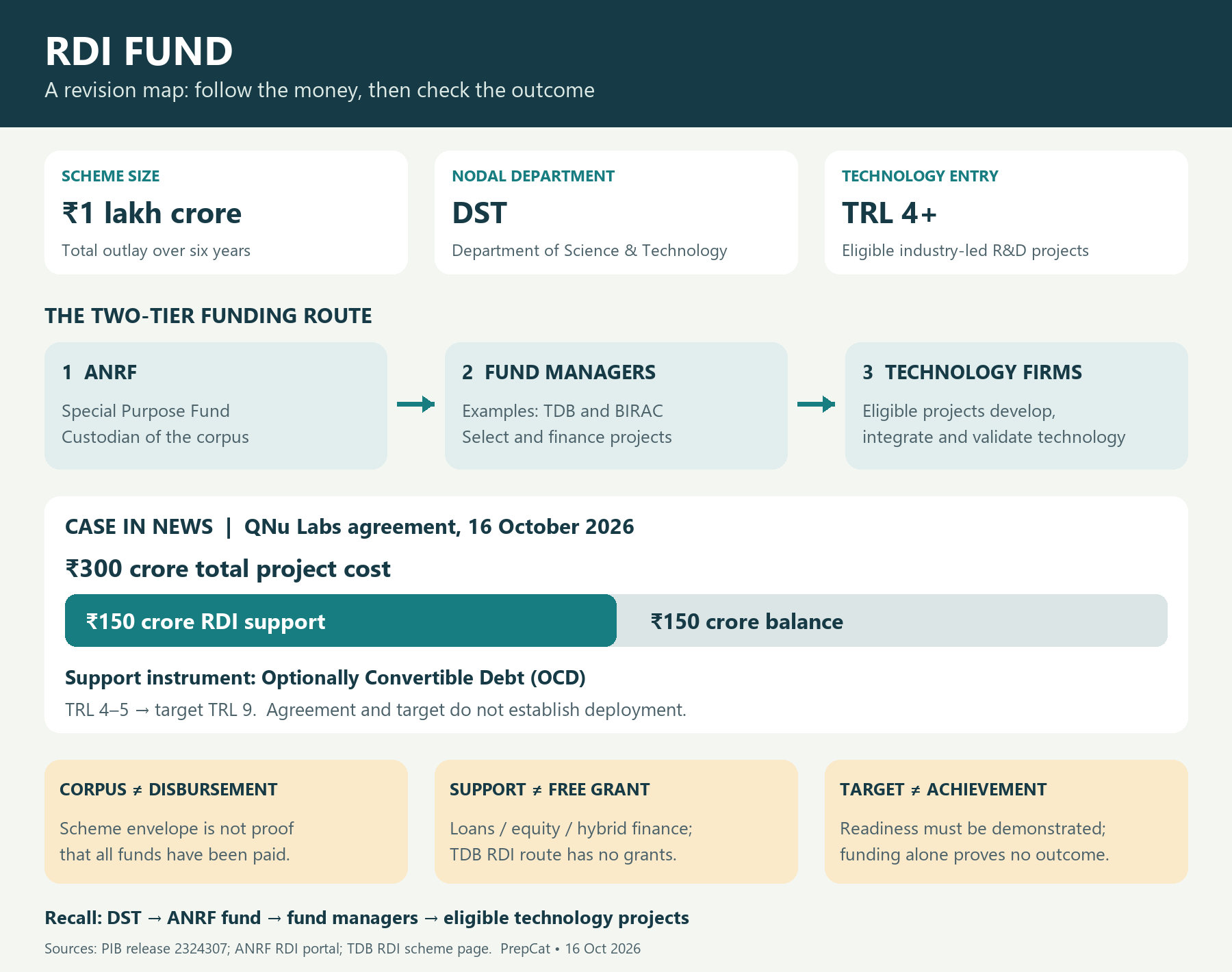
Follow the fund route: DST, ANRF Special Purpose Fund, second-level fund managers and eligible projects.
Use the revision chart to distinguish scheme outlay, project support and demonstrated outcomes.
📌 Revision Pointers
Scheme: ₹1 lakh crore outlay over six years; Cabinet approval 1 July 2025.
Nodal: DST; corpus custodian: Special Purpose Fund within ANRF.
Implementation: SLFMs, including TDB and BIRAC, finance eligible projects.
Readiness: TRL 4+ framework; maturity is not percentage completion.
QNu case: ₹150 crore support for a ₹300 crore project through OCD; target TRL 9.
Trap: agreement ≠ disbursement ≠ deployment; debt ≠ grant.
Basic Concept: Why Research Needs Patient Finance
Research, Development and Innovation (RDI) connects scientific ideas with usable products and processes. A laboratory result is only one stage: a firm may still need engineering, testing, integration and customers. Deep technologies can face long development periods and uncertain results before revenues arrive.
Patient finance gives such work time to mature. It does not remove technical or commercial risk. Public support can help address financing gaps where private investors are unwilling to bear the entire early risk, but its value must ultimately be judged through credible progress and useful outcomes.
Core Context: What India’s RDI Fund Does
The Union Cabinet approved the RDI Scheme on 1 July 2025. The scheme has a ₹1 lakh crore outlay over six years, focused on expanding private-sector research and innovation in strategic and sunrise sectors. The ₹1 lakh crore figure is a scheme-level envelope, not the amount available to a single company or proof that the entire sum has already been spent.
Areas identified in the official framework include energy and climate technologies, artificial intelligence, biotechnology, digital technologies and other strategically important fields. The purpose is to help promising technologies advance towards practical use, rather than treating every research activity as automatically eligible.
How the Funding Route Works
Remember the route: Department of Science & Technology (DST) → Special Purpose Fund within the Anusandhan National Research Foundation (ANRF) → Second-Level Fund Managers (SLFMs) → eligible technology projects. DST is the nodal department; the Special Purpose Fund is the custodian of the corpus. These are different functions.
SLFMs select and finance projects within their authorised mandate. TDB and the Biotechnology Industry Research Assistance Council (BIRAC) have been designated as SLFMs. The approved framework allows other eligible fund-management entities; it is not a scheme limited to one implementing organisation. The March 2026 parliamentary reply states that the RDI Scheme does not provide direct funding to universities.
Latest Development: The 16 October 2026 Agreement
According to PIB, TDB signed an agreement with Bengaluru-based QNu Labs for ₹150 crore in RDI support for a ₹300 crore project. Support is through Optionally Convertible Debt (OCD). The proposed quantum-security and sensing programme aims to move technologies from TRL 4–5 towards TRL 9.
This is an agreement to support development and maturation. It is not evidence that the target readiness level, all deployment objectives or commercial success have already been achieved. This case should be read as technology-development finance, with technical outcomes evaluated separately.
Read the Revision Chart
Open the full-resolution revision chart. Start at the top with scheme size, nodal department and readiness threshold. Follow the arrows to separate the fund custodian from project-level financiers. Then read the project example below.

Worked arithmetic: ₹150 crore divided by ₹300 crore equals 50%. The remaining ₹150 crore is the arithmetic balance of the announced project cost, not proof of a particular investor, financing instrument or completed payment. Do not confuse the share of project support with a shareholding percentage.
Loan, Equity, Hybrid: Do Not Call Everything a Grant
Loan: financing creates a repayment obligation under agreed terms; a longer tenure gives more time, not automatic debt forgiveness.
Equity: financing is linked to ownership; returns depend on the investment’s performance.
Hybrid or convertible instrument: combines features or permits conversion under specified conditions. OCD should not be labelled an unconditional cash grant or automatic equity ownership.
The official ANRF funding description provides for long-term loans, selected equity investments and possible contributions to funds of funds. TDB’s RDI route explicitly excludes grants. The TDB call describes support of up to 50% of project cost: “up to” is a ceiling under the framework, not a promise that every eligible proposal receives half its cost.
TRL: Maturity Is Not a Percentage Score
Technology Readiness Level (TRL) describes maturity on a staged scale. In the commonly used NASA framework, TRL 4 involves laboratory validation of components; higher stages require progressively stronger demonstrations and system integration. The precise assessment must suit the technology and its intended environment.
Do not read TRL 4 as “40% complete,” or a target of TRL 9 as an achievement. The RDI framework supports eligible industry-led projects at TRL 4 and above. Scientific promise, engineering readiness, commercial viability and regulatory acceptance remain distinct questions.
UPSC Prelims Pointers and Memory Hook
D–A–F–P: DST → ANRF fund → Fund managers → Projects. This is a memory aid, not an additional statutory institution.
Three unequal pairs: corpus ≠ disbursement; financing ≠ grant; target ≠ achieved outcome.
Case facts: TDB–QNu agreement; ₹150 crore support; ₹300 crore project; OCD; TRL 4–5 towards 9.
GS links: science and technology, innovation finance, industrial development and public accountability.
Mains Lens: What Would Demonstrate Success?
As an analytical checklist, examine whether support attracts additional private investment, helps projects cross technical milestones and produces useful, reliable products. Good oversight should separate sanction, disbursement, development and deployment. Transparent selection, proportionate milestones and independent technical assessment help balance experimentation with public accountability. Funding announcements alone cannot answer these questions.
Practice Check
Consider the following statements:
The Special Purpose Fund within ANRF serves as custodian of the RDI corpus.
The QNu agreement establishes that the supported technologies have already reached TRL 9.
₹150 crore support for a ₹300 crore project is arithmetically equal to 50% of project cost.
Which statements are correct?
A. 1 only
B. 1 and 3 only
C. 2 and 3 only
D. 1, 2 and 3
Answer: B
Explanation: ANRF’s fund is the custodian. TRL 9 is the project’s target, while 150 ÷ 300 = 50%. Neither the ratio nor the agreement proves completed disbursement or deployment.
Primary Sources
PIB: 16 October agreement; Cabinet approval, 1 July 2025; ANRF: funding mechanism; ANRF: governance; TDB: RDI funding route; Parliamentary reply, 11 March 2026; NASA: TRL explanation.
💭 Conclusion
The RDI Fund links innovation policy with the difficult task of financing technology maturation. For revision, keep the institutions, instruments and outcomes separate: know who holds the corpus, who selects projects, how support is structured and what remains to be demonstrated. The QNu agreement is a useful financing case, while its proposed technical achievements remain targets to be assessed.