
PLFS Redesign for 2027: Platform Work, Unpaid Activities and Labour Indicators — Spotlight
Understand the proposed 2027 PLFS redesign and why sampling matters.
Separate different forms of work from employment classification.
Use the schematic and worked example to distinguish LFPR, WPR and unemployment rate.
📌 Revision Pointers
Status: consultation proposal announced 23 October 2026; intended start January 2027.
Sampling: better platform-worker coverage; weights remain essential.
Classification: work is broader than employment; unpaid does not automatically mean outside employment.
Denominators: LFPR and WPR use population; unemployment rate uses labour force.
Interpretation: survey changes do not automatically create jobs, benefits or GDP revisions.
PLFS Redesign for 2027: Making Platform and Unpaid Work Visible
Basic Concept: The Periodic Labour Force Survey (PLFS), conducted by the National Statistics Office under MoSPI, estimates employment and unemployment. It is a sample survey: selected households represent a wider population through a statistical design. It is not a census of every worker, nor an administrative register of platform companies.
Core Context: Labour statistics depend on what is asked, who is sampled, the reference period and the definition of an activity. If a relatively uncommon category is scarcely represented in the sample, its estimates can be imprecise. A better design improves the opportunity to measure that category; it does not create jobs or automatically improve working conditions.
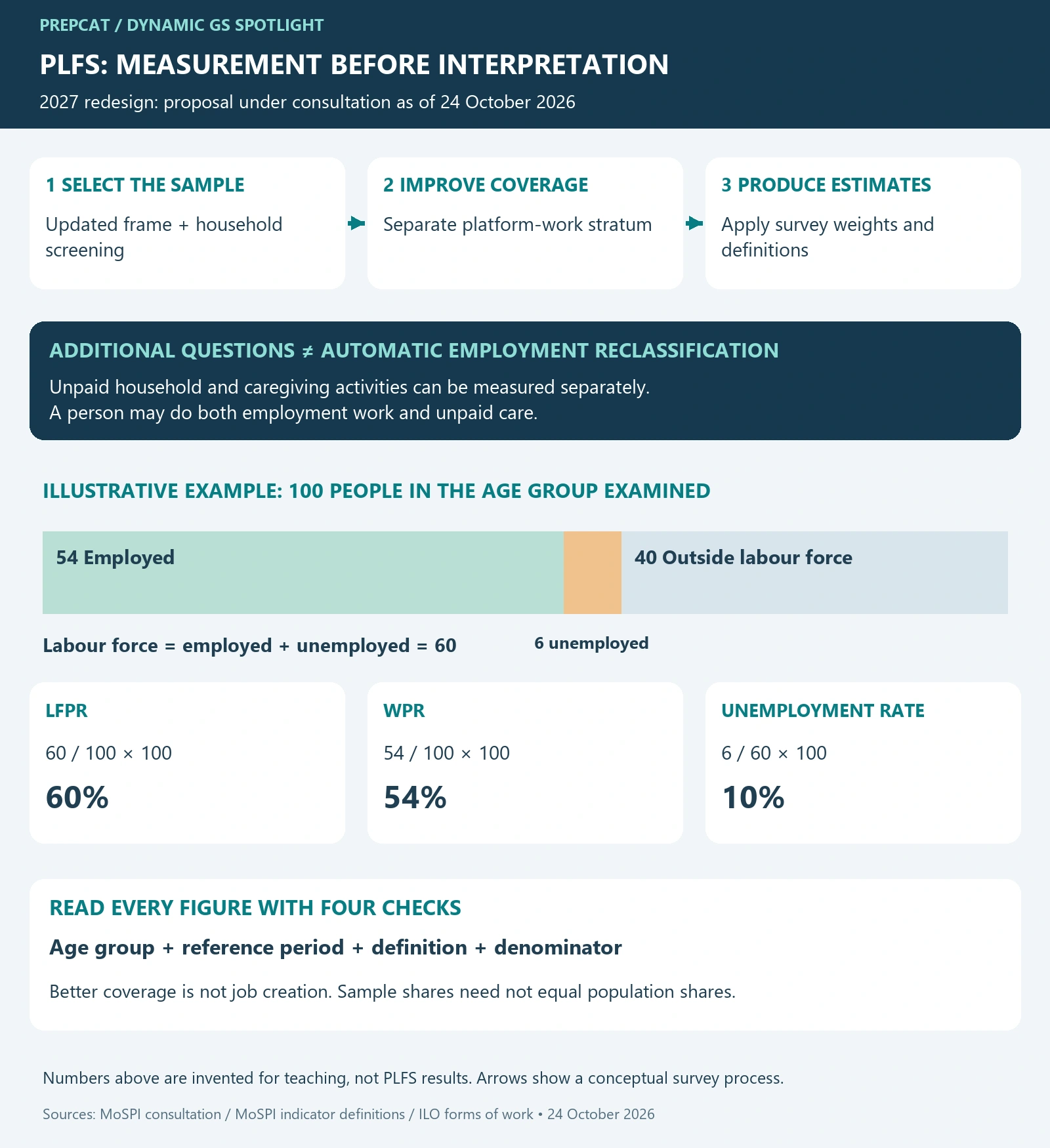
Latest Developments: MoSPI’s 23 October 2026 consultation, covered in the 24 October news cycle, proposes changes from January 2027. It includes a separate household sampling stratum based on digital-platform work, an updated frame, and additional questions on unpaid activities. The unpaid-activity items cover people aged 15 and above, in rural and urban first visits, for annual reporting. These are proposals under consultation, not results from a completed 2027 survey.
UPSC Prelims Pointers: A sampling frame identifies the units from which samples are selected. A stratum is a group used in sampling design. More observations from a group do not mean its unweighted sample share equals its population share. Distinguish the survey’s design from the indicator definitions used to report its findings.
Why Platform Work Needs Careful Measurement
Digital platforms can connect customers, tasks and workers, as in app-mediated delivery or ride services. Platform work is related to the gig economy, but the two labels are not interchangeable: some gig work is arranged without digital platforms. A person may combine app-based tasks with another job, or do platform work only during part of a year. Clear screening questions and reference periods therefore matter.
Illustrative example: imagine a village or urban block in which only a few selected households include platform workers. Surveying more households with that characteristic can improve information about them. Analysts still need appropriate weights to reconstruct population estimates. Otherwise, deliberately better coverage could be mistaken for an actual surge in the group’s population. This is a teaching example, not a reported PLFS result.
Work Is Broader Than Employment
Cooking, caring for children, volunteering and training can involve productive effort even without a wage. ILO statistical standards distinguish several forms of work, including employment, own-use production, volunteer work and unpaid trainee work. Measuring an activity does not necessarily place it inside the employment indicator.
Nor does “unpaid” automatically mean “not employed”. For example, a contributing helper in a market-oriented family enterprise can be classified within employment under the applicable framework even without receiving a separate wage. Unpaid care for one’s own household raises a different classification question. Always read the survey definitions rather than treating payment status alone as the deciding test.
This distinction makes unpaid household contributions visible without mechanically adding every such activity to the number employed. It also avoids assuming that everyone outside employment is unemployed: unemployment depends on the relevant search/availability criteria. A student or homemaker may be outside the labour force, depending on their situation and the classification rules.
Three Indicators: Check the Denominator
LFPR: labour force ÷ relevant population × 100. The labour force includes employed and unemployed persons.
WPR: employed persons ÷ relevant population × 100.
Unemployment Rate: unemployed persons ÷ labour force × 100.
Illustrative arithmetic: in a population of 100 people in the age group being examined, suppose 54 are employed, 6 unemployed and 40 outside the labour force. The labour force is 60: LFPR = 60%, WPR = 54%, and unemployment rate = 6/60 × 100 = 10%. It is not 6%. These are invented numbers for learning, not official estimates.
Use the same age group and reference period when comparing figures. PLFS usual status and current weekly status differ in their reference periods; do not join unlike series into one trend without examining methodological notes.
Why It Matters for Policy—and What It Cannot Prove
Better coverage can inform research on livelihoods, skills, working conditions, social protection and the distribution of unpaid responsibilities. It can help identify questions for policy, such as whether workers have stable earnings or whether care responsibilities restrict paid-work opportunities. Those are analytical uses, not outcomes established by the consultation itself.
Changes to a frame, sample or questionnaire can also affect comparability. A measured difference may reflect real change, improved coverage or both. Researchers should examine weights, uncertainty, definitions and transition notes before making causal claims. A survey redesign does not itself confer employee status, create a social-security entitlement or value all unpaid work in GDP.
Quick Check and Sources
Q1. Is unemployment rate calculated using all people as the denominator? Answer: No; it uses the labour force.
Q2. Does adding unpaid-care questions automatically reclassify all carers as employed? Answer: No; measurement and employment classification are separate.
Q3. Has the January 2027 redesign already produced official results on 24 October 2026? Answer: No; the development is a consultation proposal.
MoSPI: proposed PLFS changes, 23 October 2026; MoSPI: labour indicator definitions; ILO: different forms of work; ILOSTAT: measurement standards; 24 October news sweep.
💭 Conclusion
The PLFS proposal is a reminder that a changing economy requires careful measurement. Better sampling can reveal platform work and additional questions can illuminate unpaid activities, while clear definitions preserve the meaning of employment indicators. Read every figure alongside its denominator, reference period and methodology.