
India’s Changing Weather Patterns
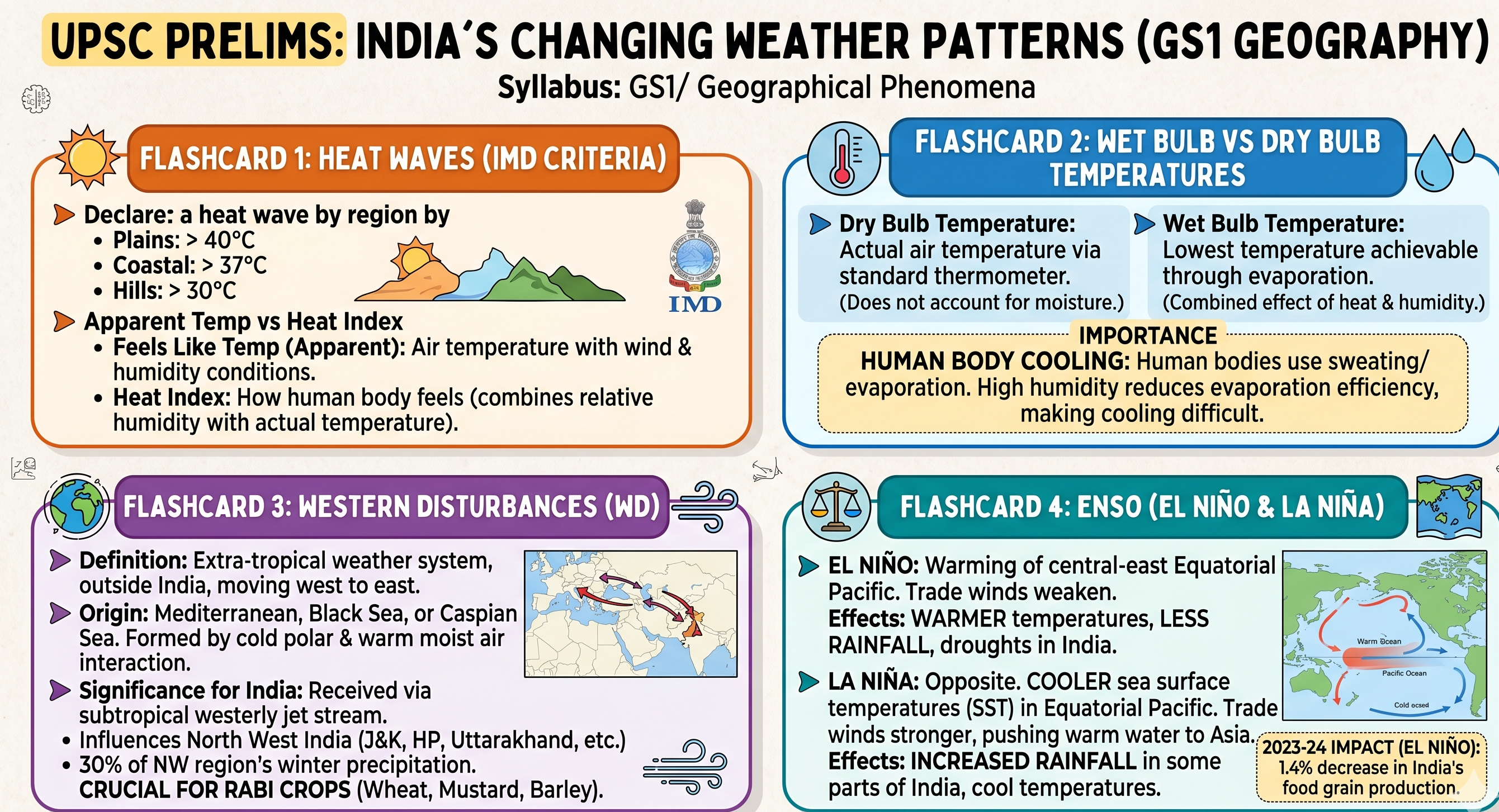
Heatwave Criteria (IMD): A heatwave is declared when temperatures exceed 40°C in the plains, 37°C in coastal areas, and 30°C in hilly regions.
Apparent Temperature ("Feels Like"): This is a combined measure of air temperature, wind, and humidity to determine how the human body actually perceives the heat or cold.
Wet Bulb vs. Dry Bulb Temperature: * Wet Bulb: Measures the lowest temperature achievable through evaporation; it reflects heat plus humidity.
Dry Bulb: The standard air temperature measured by a thermometer, excluding atmospheric moisture.
Western Disturbance (WD) Definition: An extra-tropical weather system originating outside India that moves west to east, bringing winter/spring precipitation to Northern India.
WD Origin & Path: WDs originate over the Mediterranean, Black, or Caspian Seas. They are carried to India by the Subtropical Westerly Jet Stream in the upper atmosphere.
Significance for North-West India: WDs account for 30% of the annual precipitation in Jammu & Kashmir, Ladakh, Himachal Pradesh, and Uttarakhand during winter.
Rabi Crop Impact: Winter rainfall from WDs is critical for the success of Rabi crops, specifically Wheat, Mustard, and Barley.
ENSO Framework: The El Niño–Southern Oscillation (ENSO) is a periodic fluctuation in sea surface temperatures (SST) and atmospheric pressure in the Equatorial Pacific Ocean.
El Niño vs. La Niña:
El Niño: Warming of the central-east Equatorial Pacific; typically weakens trade winds and leads to droughts or less rainfall in India.
La Niña: Cooling of the Equatorial Pacific SST; strengthens trade winds and generally leads to increased rainfall in India.
Economic Consequences: Climate extremes have direct fiscal impacts; for example, the El Niño phenomenon contributed to a 1.4% decrease in India’s food grain production for the 2023-24 crop year.