
Ecological Pyramids: Numbers, Biomass and Energy — Prelims Revision
Distinguish organism counts, standing biomass and energy flow.
Use contrasting diagrams to remember which pyramids can be inverted.
Revise common traps and test yourself with two quick checks.
📌 Revision Pointers
Count: numbers ignore individual body size.
Stock: biomass is a snapshot.
Flow: energy includes a time interval.
Exception: aquatic biomass can be inverted.
Constant: energy pyramids remain upright.
Core Concept: Count, Stock, Flow
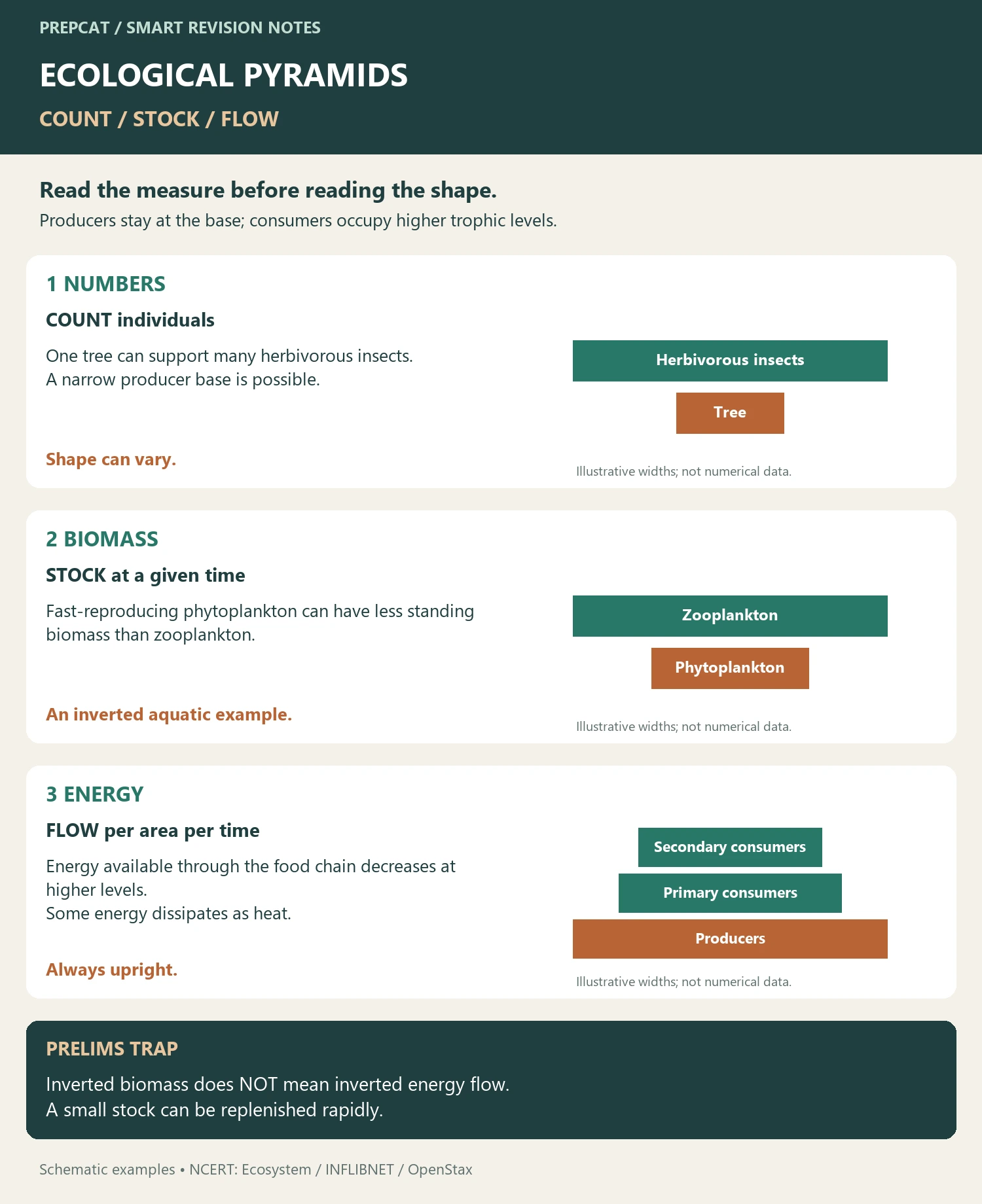
An ecological pyramid compares trophic levels using one chosen measure. Producers form the base. A diagram of numbers counts individuals; biomass measures living material, commonly as dry mass per unit area; energy measures transfer per unit area per unit time. The diagrams are schematic examples, not measured datasets.
Key Comparisons
Numbers: organism size is not counted. A tree can support many herbivorous insects, so the producer level need not be widest.
Biomass: a snapshot of standing stock. Aquatic examples can be inverted when phytoplankton biomass is smaller than zooplankton biomass. Rapid producer turnover helps sustain consumers.
Energy: always upright in the standard trophic model. Transfers reduce the energy available at higher levels; respiration dissipates energy as heat.
Memory Hook
N = Number; B = Body stock; E = Energy flow. Count and stock can give unexpected shapes. Flow remains upright.
Common Mistakes
Do not call every aquatic biomass pyramid inverted: compare the actual organisms and standing stocks.
Do not confuse a small producer stock with low production over time.
The familiar 10% transfer rule is a teaching approximation; actual transfer efficiency varies.
A simple pyramid cannot fully represent a food web. Omnivores may occupy several trophic levels, and decomposers act across levels.
Two Quick Checks
1. Can an inverted biomass pyramid coexist with an upright energy pyramid? Yes. Standing stock and energy flow over time measure different things.
2. Does one tree count as more individuals because it outweighs many insects? No. That would confuse numbers with biomass.
Sources
NCERT Biology: Ecosystem; INFLIBNET: Ecological Pyramids; OpenStax Biology 2e: Energy Flow.
💭 Conclusion
Identify the measure first. A narrow producer stock can support consumers through rapid replenishment without reversing energy flow.