
Insolvency and Bankruptcy Code (IBC): NCLT Process and the 2026 Amendment
IBC questions keep tripping aspirants on timelines, CoC powers, and the waterfall mechanism — and 2026's sweeping amendment, driven by chronic NCLT delays, has just rewritten several of those very numbers, making this a high-yield GS Paper 3 revision block.
📌 Revision Pointers
330 vs reality — The statutory CIRP limit is 330 days, but actual average resolution has exceeded 600-700 days, which is the direct trigger for the 2026 amendment.
2026 reform — The Amendment Act received Presidential assent on 6 April 2026. It introduces a creditor-initiated resolution framework; avoid treating it as elimination of the adjudicating authority’s statutory role.
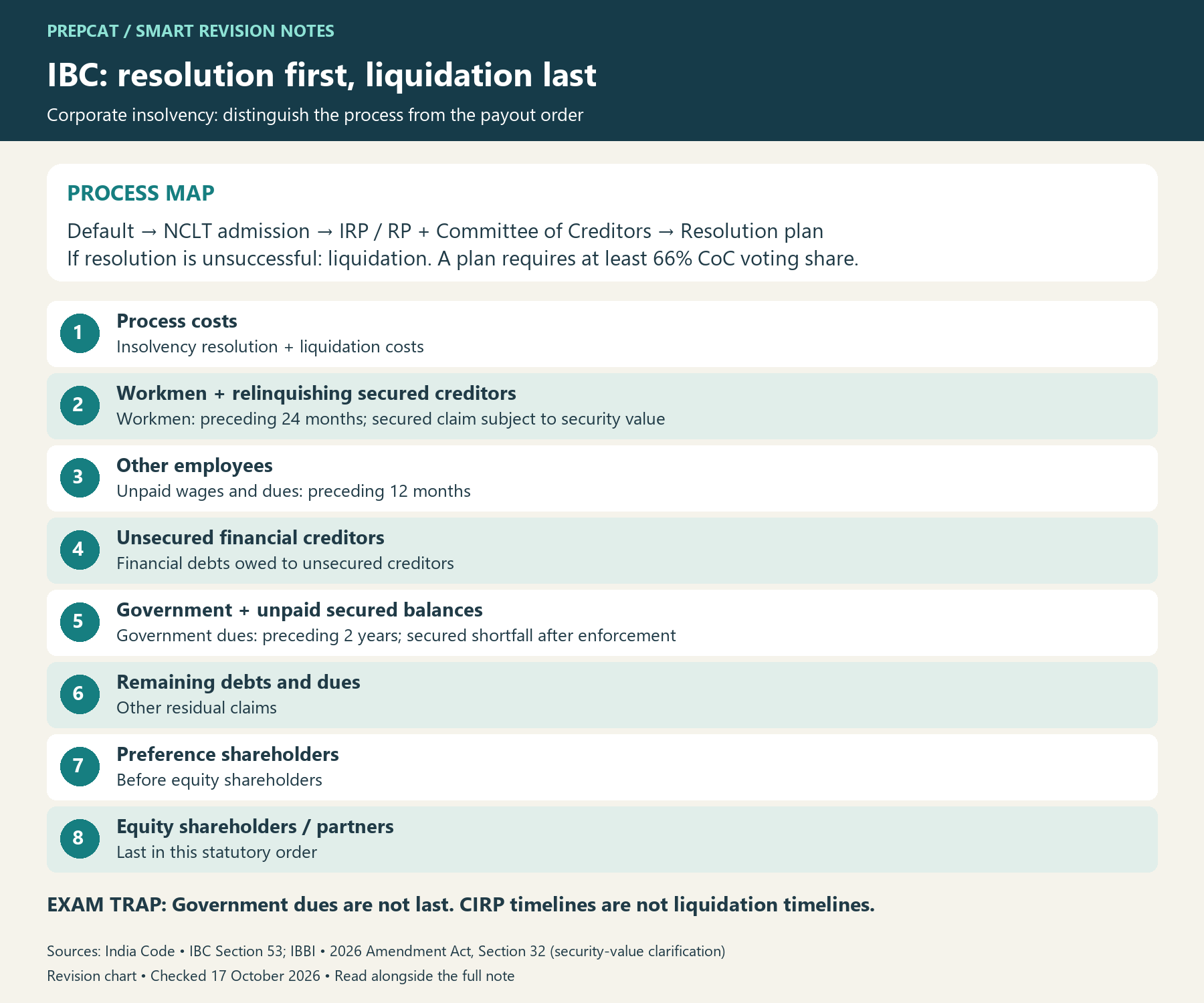
Waterfall mechanics — Section 53 liquidation waterfall: process costs → workmen and secured creditors relinquishing security → other employees → unsecured financial creditors → government dues and unpaid secured balances → remaining debts → preference shareholders → equity shareholders/partners. Statutory look-back periods and security-value limits apply.
New 2026 frameworks — Group insolvency (one process for a corporate group's SPVs) and cross-border insolvency recognition were both added as enabling frameworks.
PYQ Connect — GS Paper 3 (Economy) has repeatedly tested IBC basics (CIRP, NCLT/NCLAT roles, haircuts) and landmark case law like Essar Steel; expect a Prelims/Mains question built directly around the IBC (Amendment) Act, 2026's CIIRP mechanism and compressed timelines.
Core Concept
The Insolvency and Bankruptcy Code (IBC), 2016 is India's unified, time-bound law for resolving corporate and individual insolvency, replacing a fragmented regime under SARFAESI, SICA, and the Companies Act's winding-up provisions. It created a market-driven, "resolution first, liquidation last" process: once a default is established, control of the defaulting company shifts from its promoters to a creditor-led Committee of Creditors (CoC), assisted by an Insolvency Professional (IP), which must either revive the firm through a resolution plan or send it to liquidation — all adjudicated by the National Company Law Tribunal (NCLT), with appeals lying to the NCLAT.
Key Points
The Corporate Insolvency Resolution Process (CIRP) is triggered by a default of ₹1 crore or more (this threshold was raised from ₹1 lakh in 2020); the CoC, made up of financial creditors, approves a resolution plan with a 66% voting majority.
The statutory CIRP timeline is 330 days (180 days + a 90-day extension + litigation time, as capped by the Supreme Court's Essar Steel judgment), but it has been routinely breached in practice — actual resolution has often taken 600-700+ days because of NCLT bench vacancies and heavy litigation.
A Pre-Packaged Insolvency Resolution Process (PIRP) has existed for MSMEs since 2021, allowing debtor-in-possession negotiation with creditors before a formal CIRP is triggered, but its uptake has stayed low.
When resolution fails, liquidation proceeds under a Liquidator's supervision, with proceeds distributed per the Section 53 "waterfall": process costs first; then workmen’s dues for the preceding 24 months and secured creditors relinquishing security; other employees’ dues for 12 months; unsecured financial debts; government dues for two years together with secured shortfalls after enforcement; remaining debts; preference shareholders; and equity shareholders or partners. Under the 2026 clarification, a relinquishing creditor ranks as secured only to the value of the security, with the remainder unsecured.
Even as cumulative creditor recovery has crossed roughly ₹4 lakh crore and over 1,300 companies have been rescued since 2016, average creditor haircuts have stayed steep, often in the 70-95% range.
Memory Trick
Default → admission → resolution professional and CoC → resolution plan, or liquidation if resolution is unsuccessful. Remember the eight rungs of Section 53 separately: costs, workmen/secured, employees, unsecured financial, government/secured shortfall, residual debts, preference, equity. The 180-day CIRP period and its permitted 90-day extension are not liquidation timelines.
Current Relevance (2026)
The IBC (Amendment) Act, 2026 received Presidential assent on 6 April 2026. Its creditor-initiated framework and amendments to liquidation rules require careful reading of the enacted text and commencement notifications. Section 53 clarifies the treatment of relinquished security and government claims; do not describe government dues as the final tier.
Revision Chart: Sources
Chart and factual corrections checked on 17 October 2026.
💭 Conclusion
For revision, distinguish the corporate resolution process from the liquidation waterfall. The 2026 amendment is an additional legal development; creditor-led resolution still operates within a statutory framework.