
Lokpal and Lokayuktas: India's Anti-Corruption Architecture
Lokpal and Lokayuktas sit at the intersection of Polity (constitutional/statutory bodies) and Governance (anti-corruption architecture), making them a recurring Prelims-cum-Mains theme; recent reports on a stalled Prosecution Wing and sharply falling complaint numbers have reopened the debate on the Lokpal's real-world effectiveness, a dimension aspirants must master beyond the bare statutory provisions.
📌 Revision Pointers
Legal Basis — Created by the Lokpal and Lokayuktas Act, 2013 (passed after the Anna Hazare-led movement); Section 3, which set up the Lokpal, came into force on 16 January 2014.
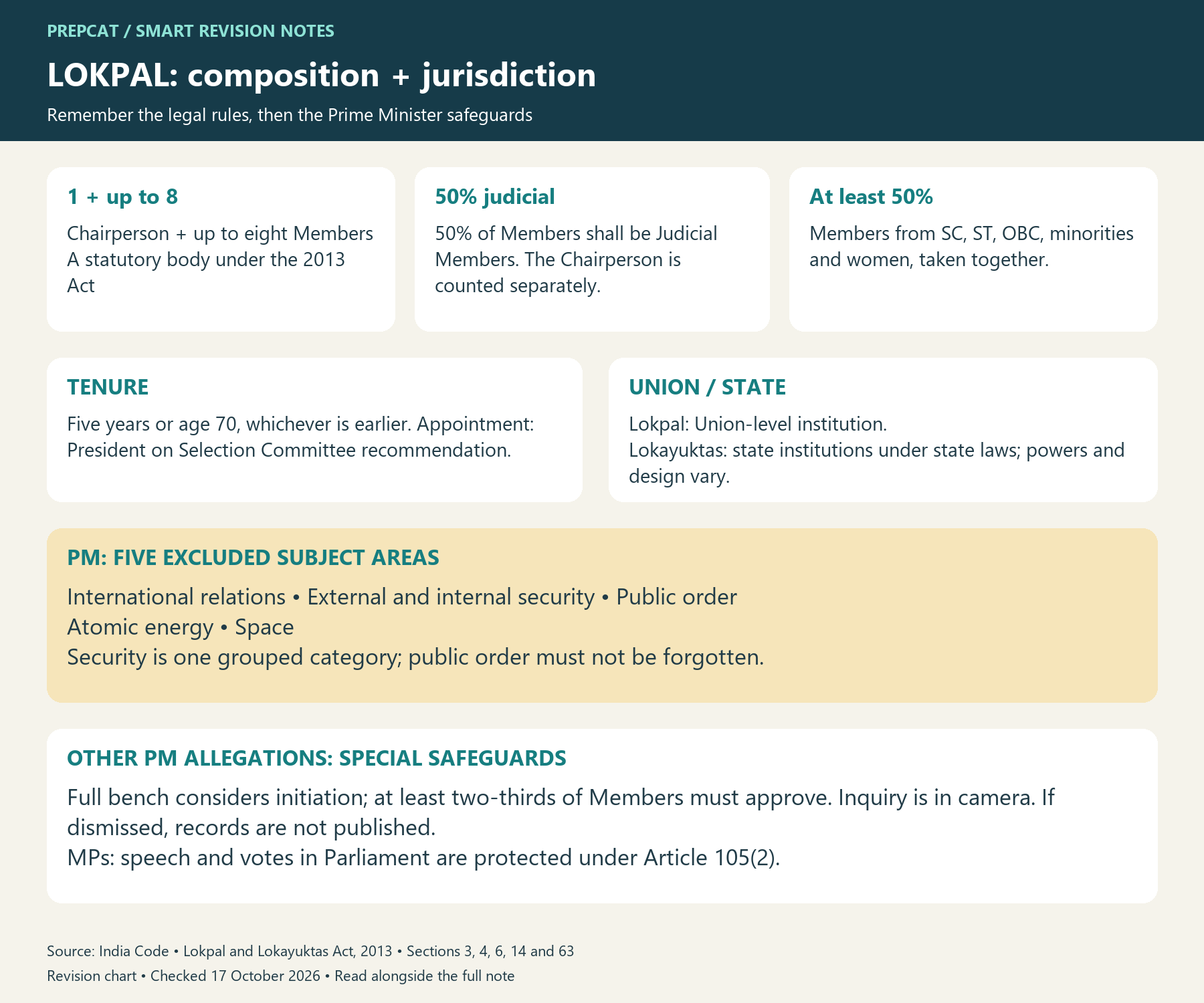
Composition Rule — A Chairperson and up to eight Members; 50% must be judicial Members, and at least 50% must come from SC/ST/OBC/minority/women categories. Term: five years or age 70, whichever is earlier.
Jurisdictional Reach — Covers the Prime Minister (with five sensitive subject-area exclusions), Union Ministers, MPs, and Group A-D central government employees, plus certain NGOs/societies receiving large public or foreign funding.
2025-26 Flashpoint — Complaints fell from a peak of 2,469 in 2022-23 to just 233 up to September 2025; the Prosecution Wing was notified only in June 2025 (over a decade after the Act), prompting the Parliamentary Standing Committee's 145th Report (January 2026) to press for full operationalisation of the Inquiry and Prosecution Wings.
Lokayukta Variance — States retain flexibility under the 2013 Act to design their own Lokayukta's powers and independence, producing a patchwork of strong and weak state-level ombudsmen (Maharashtra set up India's first Lokayukta in 1971).
PYQ Connect — Prelims has repeatedly tested Lokpal's composition, appointment process and jurisdiction, often in statement-based or comparative-institution formats; Mains GS2 places it under 'statutory, regulatory and quasi-judicial bodies' and the wider governance/accountability debate, while GS4 links it to the Ethics theme of institutional integrity.
Core Concept
The Lokpal is the Union-level anti-corruption ombudsman, and Lokayuktas are its state-level counterparts, both instituted under the Lokpal and Lokayuktas Act, 2013 — enacted in the wake of the Anna Hazare-led anti-corruption movement to give India's fight against high-level corruption a dedicated, statutory institutional structure instead of leaving it to internal departmental vigilance alone.
Key Points
Composition: a Chairperson plus up to eight Members, with 50% judicial Members and at least 50% drawn from SC/ST/OBC, minority and women categories; the President appoints them on the recommendation of a Selection Committee comprising the PM, the Lok Sabha Speaker, the Leader of Opposition, the CJI or a nominee, and an eminent jurist.
Jurisdiction extends to the Prime Minister (excluding international relations, security, public order, atomic energy and space), Union Ministers, MPs, and all Group A to D central government officials, as well as specified societies/NGOs receiving substantial government or foreign funds.
Powers include ordering or supervising preliminary inquiries, directing and supervising CBI investigations referred to it, exercising civil court-like powers for search and seizure, sanctioning prosecution, and issuing policy directions to the Central Vigilance Commission (CVC).
Lokayuktas exist at the state level under the same 2013 Act, but states have considerable freedom in deciding their composition and powers, which is why some state Lokayuktas are far more effective than others; Maharashtra created India's first Lokayukta in 1971, well before the central law.
Complaints must relate to offences under the Prevention of Corruption Act, 1988, can be filed by individuals, NGOs, companies or even foreign nationals holding a passport, and must ordinarily be filed within seven years of the alleged offence.
Memory Trick
Remember 1 + 8 and 50/50: Chairperson plus up to eight Members; 50% of Members shall be judicial, while at least 50% must be from SC/ST/OBC/minorities/women taken together. For the Prime Minister, remember five excluded subject areas: international relations; external and internal security; public order; atomic energy; space. Other PM inquiries require full-bench consideration and approval by at least two-thirds of Members.
Current Relevance (2025-2026)
The Lokpal marked its Foundation Day on 16 January 2026, twelve years after Section 3 of the 2013 Act brought the body into existence on 16 January 2014 — yet its institutional machinery is still being completed. Its dedicated Prosecution Wing, needed to independently sanction prosecution in cases it investigates, was notified only in June 2025. Government data show complaints received by the Lokpal falling sharply, from a peak of 2,469 in 2022-23 to just 233 in the period up to September 2025 (cumulative complaints since the Lokpal became operational in 2019-20 stand at roughly 6,955, about 90% of them filed in the first four years) — a trend critics link to the Lokpal disposing of most complaints on technical grounds and to a transparency gap, since no annual report has been tabled in Parliament since 2021-22. Responding to these concerns, Parliament's Standing Committee on Personnel, Public Grievances, Law and Justice, in its 145th Report placed around January 2026, urged the Lokpal to urgently and fully operationalise both its Inquiry and Prosecution Wings. The current Chairperson, Justice A.M. Khanwilkar (a former Supreme Court judge), took charge in 2024, succeeding the Lokpal's first Chairperson Justice P.C. Ghose (2019) — so the question of whether a fully staffed, decade-old Lokpal can still deliver credible anti-corruption outcomes remains a live governance debate for 2025-26.
Revision Chart: Sources
Chart and factual corrections checked on 17 October 2026.
💭 Conclusion
With a parliamentary committee now pressing for full operationalisation of its investigative machinery even as complaint numbers and transparency both decline, the Lokpal's journey from a hard-won legislative promise to a fully functioning anti-corruption watchdog remains unfinished — a storyline likely to resurface in both fact-based Prelims questions and analytical Mains answers on institutional accountability.