
Money Supply M0–M4: RBI Formulae and Prelims Traps
Revise reserve money, narrow money and broad money using a branching formula chart.
Includes a numerical example, the NSC exclusion and the M2-versus-M3 trap.
📌 Revision Pointers
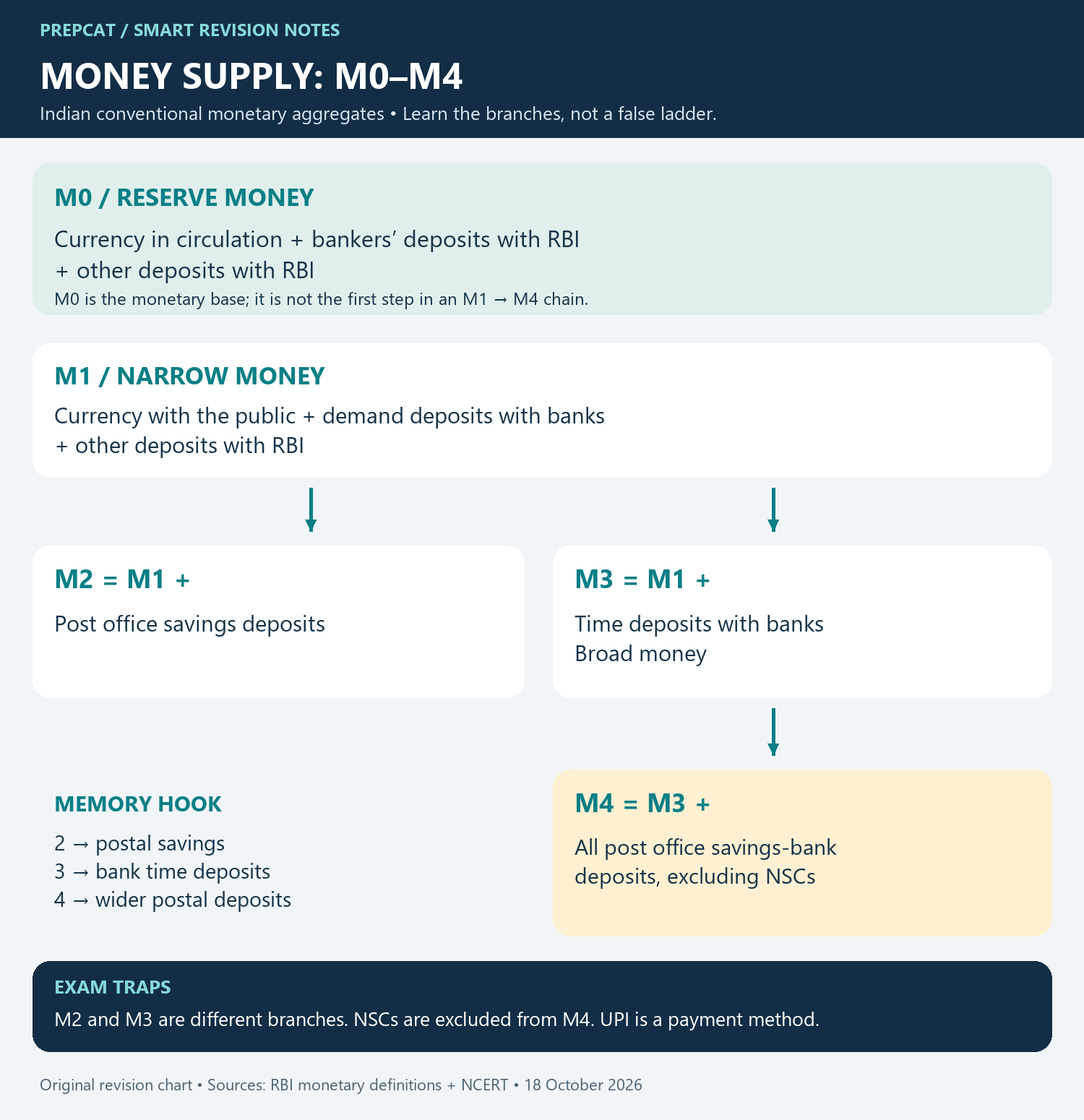
M0: circulation currency + bankers’ RBI deposits + other RBI deposits.
M1: public currency + bank demand deposits + other RBI deposits.
M2: M1 + post office savings deposits.
M3: M1 + bank time deposits.
M4: M3 + all eligible post office deposits; NSCs excluded.
Do not double-count: M3 starts with M1, not M2; postal savings already sit within the wider postal total.
Core Concept
Money supply is a stock measured at a point in time. India’s conventional aggregates differ in which currency and deposits they include. M0 describes the monetary base; M1–M4 describe different measures of money stock.
Open the full-resolution money-supply chart.
Key Formulae
M0 / reserve money: currency in circulation + bankers’ deposits with RBI + other deposits with RBI.
M1 / narrow money: currency with the public + demand deposits with the banking system + other deposits with RBI.
M2: M1 + savings deposits of post office savings banks.
M3 / broad money: M1 + time deposits with the banking system.
M4: M3 + all deposits with post office savings banks, excluding National Savings Certificates (NSCs).
The Distinctions That Matter
Public cash vs circulation: currency with the public excludes cash held by banks; currency in circulation includes that bank cash.
Demand vs time: demand deposits are withdrawable on demand; time deposits are placed for an agreed term. Both are liabilities of banks to depositors.
Other RBI deposits vs bankers’ deposits: these are separate components. Do not put all banks’ reserve balances into M1.
M2 vs M3: they add different things to M1. Do not memorise M3 as “M2 + time deposits”.
Worked Example — Hypothetical ₹ Crore
Assume currency with the public = 100; bank demand deposits = 200; other RBI deposits = 5; bank time deposits = 400; post office savings deposits = 30; all eligible post office deposits = 90, including that 30 and excluding NSCs.
M1: 100 + 200 + 5 = 305.
M2: 305 + 30 = 335.
M3: 305 + 400 = 705.
M4: 705 + 90 = 795. Do not add the 30 again.
Memory Hook
“One: public cash + demand + other RBI deposits. Two adds postal savings to One. Three adds bank time to One. Four adds wider postal deposits to Three.” Remember M0 separately as reserve money.
Common Prelims Traps
NSCs: excluded from the conventional M4 definition.
UPI: a payment method, not an extra component to add to a deposit balance.
Frameworks: these conventional measures differ from RBI’s new monetary aggregates (NM1–NM3) and liquidity aggregates (L1–L3).
No false ladder: M0 is not simply “M1 minus one deposit type”; it uses a different currency concept and includes bankers’ RBI deposits.
Two Recall Checks
1. Is M3 equal to M2 plus bank time deposits? Answer: No. The conventional formula starts from M1; using M2 would also add postal savings.
2. Do bank cash reserves count as currency with the public? Answer: No. Bank-held cash is excluded from that component.
Sources
RBI: Notes on Tables, monetary aggregate definitions; RBI: reserve money and monetary dynamics; IIT Kanpur SATHEE: NCERT Money and Banking.
💭 Conclusion
Recall the components rather than relying on the numbering. Keep M0 separate, branch from M1 to M2 and M3, then add the eligible postal deposits to M3 for M4. Always identify whose currency and whose deposits a question describes.